
One of the general opening principles is to “develop your pieces” from their starting position. A consequence of this in operation is that one needs to be careful of blocking in their own pieces, for instance, with misplaced pawns. This could potentially occur with pawns blocking the diagonals for your bishops, or the pawns occupying the development squares of the knights.
A further tactical idea then is that it is sometimes possible to block or box in your opponent’s pieces and if achieved, you can gain an important advantage in the middle game.
This happened in this game where I played with the Black pieces. I played the Englund Gambit against my opponent’s Queen’s Pawn Opening and it is accepted (1. d4 e5 2. dxe5). We trade our knights, and then our queens, and then our second pair of knights. Although Stockfish thinks that we’re very equal after this trade on move 12 giving only the slimmest of advantage to Black [-0.20], I thought that I was quite a bit better.
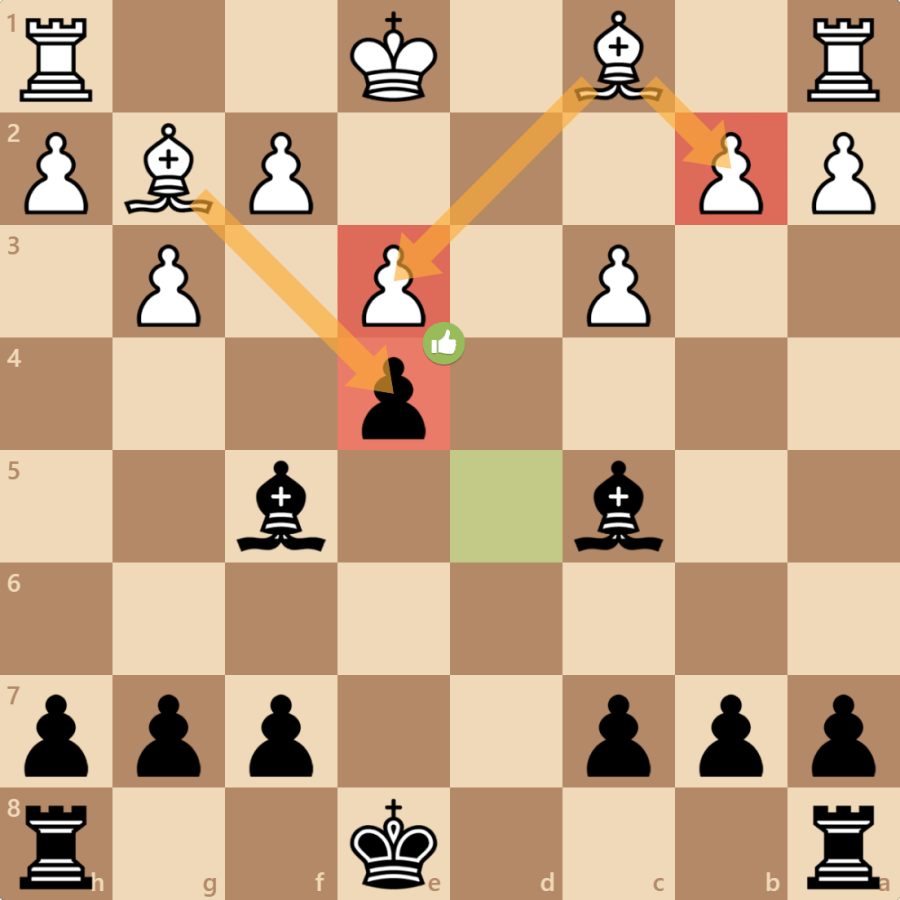
As can be seen, both of my opponent’s bishops were stuck, I had substantially more space, and had the option to castle to either side, developing my rooks into the centre.
This advantage in relative tempo and development became obvious in the subsequent few moves with me being able to launch an attack and infiltrate with my rook while White was still trying to develop. On move 17 and 18, White underestimates the threat to their back rank and blunders an unavoidable checkmate. Seeing the inevitable, my opponent resigns. GG!
Game on chess.com: https://www.chess.com/game/live/60484819207
[Event "Live Chess"]
[Site "Chess.com"]
[Date "2022.10.26"]
[Round "-"]
[White "kulabinx123"]
[Black "vitualis"]
[Result "0-1"]
[Timezone "UTC"]
[ECO "A40"]
[ECOUrl "https://www.chess.com/openings/Englund-Gambit-2.dxe5-Nc6-3.Nf3-Qe7"]
[UTCDate "2022.10.26"]
[UTCTime "00:55:55"]
[WhiteElo "1329"]
[BlackElo "1381"]
[TimeControl "1800"]
[Termination "vitualis won by resignation"]
[StartTime "00:55:55"]
[EndDate "2022.10.26"]
[EndTime "01:03:02"]
[Link "https://www.chess.com/game/live/60484819207"]

1. d4 e5 2. dxe5 {Englund Gambit Accepted} 2... Nc6 3. Nf3 Qe7 4. e3 Nxe5 5. Nxe5 Qxe5 6. Qd4 Qc5 7. Qxc5 Bxc5 {Trading queens on my terms means that I win a tempo of development [+0.27]} 8. c3 Nf6 9. Nd2 d5 10. g3 Bf5 11. Bg2 Ne4 $6 12. Nxe4 dxe4 {Both of White's bishops are now boxed in [-0.20]} 13. O-O O-O-O 14. b4 Be7 15. Bb2 Rd2 16. Rab1 Bf6 {This pins White's pawn on c3 to the bishop, preventing further development [-2.41]} 17. Rfd1 $2 {A mistake [-4.07]} 17... Rhd8 $1 18. a4 $4 {A blunder as a forced checkmate through White's back rank is now possible [-M6]} 18... Rxd1+ {[%c_effect
c8;square;c8;type;Winner,g1;square;g1;type;ResignWhite] Game may have continued...} (18... Rxd1+ 19. Rxd1 Rxd1+ 20. Bf1 Bh3 21. f3 Rxf1#) 0-1
 Adventures of a Chess Noob
[…] Argh! Luckily, it isn’t too bad, and I still have the advantage [-0.86]. I trade off my opponent’s knight, their only developed piece for a bishop, we opposite side castle, and we enter the middle game at the end of move 9 with potentially an excellent advantage. Although we had material equality, my opponent had no developed pieces, and the development was blocked in by their own pawns (https://adventuresofachessnoob.com/?p=1306). […]
LikeLike