
Recently, I encountered for the first time the Göring Gambit in the Scotch Game (1. e4 e5 2. Nf3 Nc6 3. d4 exd4 4. c3).

This interesting line is like the Danish Gambit, immediately inviting Black’s pawn to capture down the side. In lower-rated games of blitz and rapid in the Lichess community database, this seems to be a great opening with White having a substantial win advantage (58%) over Black (39%). For the loss in material, White gains opening lines, accelerated development, and many attacking chances. For instance, after the double-pawn sacrifice line, although White is objectively worse, it has a potentially fearsome attack.
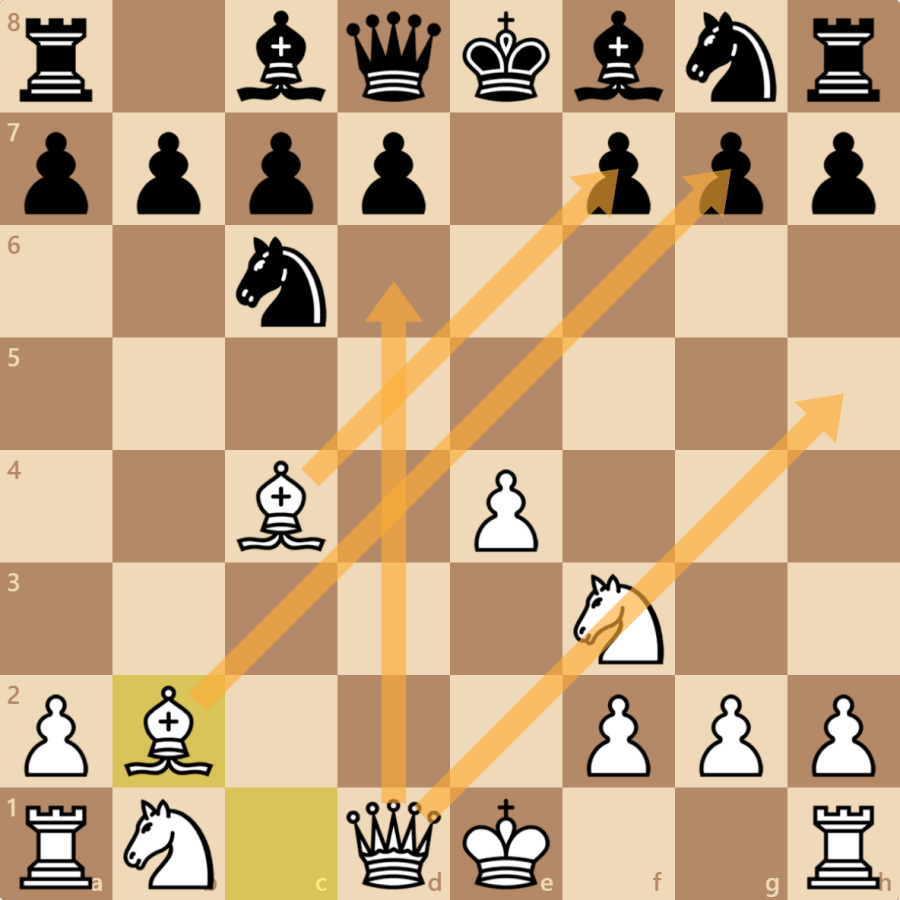
Against the Göring Gambit, the best response by Black seems to be the immediate (4… d5). Stockfish rates this at neutrality [0.00] but the Lichess community database suggests an important win advantage for Black (51% vs 45%). Sensible moves give a good position for Black, and chess continues.
In this game, I was suspicious of the gambit, so I declined it by just developing my other knight (4… Nf6). Stockfish thought that this was fine [0.00] but I immediately play an accurate move afterwards (5… Qe7) and then a blunder (6… Nxd4) losing a knight. During the game, I didn’t think it was “too bad” as I got two pawns for the piece and at the end of an opening exchanges of trades, I thought that I had gotten some compensation being down only one point of material, having more pawns, and White having lost the right to castle. Stockfish completely disagreed with my assessment with an evaluation of better than [+6] for White at the end of move 13!
This game was really in two halves. My opponent crushed me through their opening and followed through in the middle game. We entered a rook and pawn endgame where they had two rooks for my one, but I did have a pawn majority. On move 37, they had a potentially unstoppable win – Stockfish finds a forced mate in 18! But the thing with rook and pawn endgames is how quickly a single wrong move can turn the tide…
White had already sacrificed one rook to advance their g-pawn towards promotion. I knew that if I couldn’t stop that pawn, the game was done. So, I chased the pawn with my king and on move 38, White makes a game changing blunder (38. g7), giving a slight advantage back to Black [-0.35]. White pushed their pawn immediately and perhaps didn’t calculate the next few moves. They needed to defend the pawn first with the rook (38. Rg5) and then sacrifice the second rook to give the extra step of tempo for the pawn to promote.
Instead, I was now just quick enough to stop the pawn’s promotion by placing my king onto it’s promotion square (39… Kg8)! The tables are now turned. Although we each had three pawns and one rook, my pawns were connected. White’s king was also poorly placed. Tactically, my win approach was clear. First, take out the pawn threatening promotion. And second, invite/force a trade of rooks. On move 43, my opponent obliged, and the rooks were off the board. With only 7 pieces left on the board, chess is “solved” and Tablebase rated the game as a Black. Luckily, I didn’t make a mistake and on move 67 White resigned, one move away from checkmate. GG!
Game on chess.com: https://www.chess.com/game/live/61001991643
[Event "Live Chess"]
[Site "Chess.com"]
[Date "2022.11.01"]
[Round "-"]
[White "Daviddubinchik"]
[Black "vitualis"]
[Result "0-1"]
[Timezone "UTC"]
[ECO "C44"]
[ECOUrl "https://www.chess.com/openings/Ponziani-Opening-Jaenisch-Counterattack-4.d4-exd4"]
[UTCDate "2022.11.01"]
[UTCTime "00:39:12"]
[WhiteElo "1382"]
[BlackElo "1380"]
[TimeControl "1800"]
[Termination "vitualis won by resignation"]
[StartTime "00:39:12"]
[EndDate "2022.11.01"]
[EndTime "01:11:58"]
[Link "https://www.chess.com/game/live/61001991643"]

1. e4 e5 2. Nf3 Nc6 3. d4 exd4 4. c3 {[%c_arrow
d4c3;keyPressed;none;from;d4;opacity;0.8;to;c3;persistent;false,d7d5;keyPressed;none;from;d7;opacity;0.8;to;d5;persistent;false,g8f6;keyPressed;none;from;g8;opacity;0.8;to;f6;persistent;false]
Scotch Game: Göring Gambit. An interesting approach by White to gambit a second pawn for rapid development} 4... Nf6 {The response I played in the game [0.00]} (4... dxc3 {This is the most common response by Black (74\%). Although it is objectively slightly better for Black [-0.2], at lower-rated games White has a substantial win advantage (58\%) over Black (39\%).} 5. Bc4 {White can go down the double-pawn sacrifice line} 5... cxb2 6. Bxb2 {[%c_arrow
c4f7;keyPressed;none;from;c4;opacity;0.8;to;f7;persistent;false,b2g7;keyPressed;none;from;b2;opacity;0.8;to;g7;persistent;false,d1h5;keyPressed;none;from;d1;opacity;0.8;to;h5;persistent;false,d1d6;keyPressed;none;from;d1;opacity;0.8;to;d6;persistent;false]
White is objectively worse but has many many attacking opportunities}) (4... d5 {Response [0.00] with the best win advantage for Black (51\% vs 45\%)} 5. exd5 Qxd5 6. cxd4 Bb4+ 7. Nc3 Bg4 8. Be2 {And chess continues...}) 5. e5 Qe7 {And I immediately play an inaccuracy [+0.82]} 6. cxd4 Nxd4 {Followed by a blunder [+4.71]} 7. Qxd4 c5 8. Qd1 d6 9. Bf4 Bg4 10. Be2 Bxf3 11. exf6 Qxe2+ 12. Qxe2+ Bxe2 13. Kxe2 gxf6 {In the game, I thought I had compensation only being down one point of material, but with a pawn advantage, and White losing the right to castle. Stockfish disagrees giving a winning advantage to White [+6.13]} 14. Re1 O-O-O 15. Kf1 Rg8 16. Nc3 h5 17. Rad1 Kc7 18. Nd5+ Kc6 19. Nxf6 Rh8 20. Rd2 Bh6 21. Bxh6 Rxh6 22. Ne4 f6 23. Red1 f5 24. Ng5 Rg6 25. Nf7 Rd7 26. Ne5+ $1 {White makes a great move [+7.96] forcing a trade of my rook for their knight} 26... dxe5 27. Rxd7 e4 28. Rf7 Rg5 29. h4 Rg4 30. Rxf5 Rxh4 31. Rdd5 Rh1+ 32. Ke2 b6 33. Rxh5 Rc1 34. g4 Rc2+ 35. Ke3 Rxb2 36. g5 Kxd5 37. g6+ Ke6 {This position completely winning for White [+M18] but it requires White to make the correct critical next move. If the Black king can block the pawn from promoting, Black will win.} 38. g7 $4 {White blunders [-0.35] $1 The attempt to save both the pawn and rook results in being one step too slow and the pawn will be stopped.} ({The vital move White had to find, which sacrifices their rook for an unstoppable pawn promotion to queen} 38. Rg5 Kf6 39. g7 Kxg5 40. g8=Q+) 38... Kf7 $1 39. Rg5 Kg8 {The pawn cannot promote} 40. Kxe4 Re2+ 41. Kf3 Re7 42. Kf4 Rxg7 {If rooks are traded Black has a completely winning king and pawn endgame} 43. Rxg7+ Kxg7 {With 7 pieces left on the board, chess is \"solved\". Tablebase rates this as a Black win with all legal moves by White $1} 44. Ke3 Kf6 45. Kd3 Ke6 46. Kc4 Ke5 47. Kd3 b5 48. Kc3 a5 49. a3 Kf4 50. Kb3 c4+ 51. Kc3 Ke4 52. a4 b4+ 53. Kxc4 Kf3 54. Kb3 Kxf2 55. Kc2 Ke2 56. Kb3 Kd3 57. Kb2 Kc4 58. Kc2 b3+ 59. Kb2 Kb4 60. Kb1 Kxa4 61. Kb2 Kb4 62. Kb1 Kc3 63. Kc1 a4 64. Kb1 b2 65. Ka2 Kc2 66. Ka3 b1=Q 67. Kxa4 Qb6 {[%c_effect c2;square;c2;type;Winner,a4;square;a4;type;ResignWhite]}
0-1
 Adventures of a Chess Noob