50+2 Chess Quick Wins: Tactical ideas for exciting chess for beginner players. Buy on Amazon! US | CA | UK | DE | FR | IT | ES | NL | AU
My book, “50+2 Chess Quick Wins: Tactical ideas for exciting chess for beginner players” was published and released on Amazon in October 2023. This is the seventh video and article of a series that will cover the first section of the book, that explains tactical ideas and themes that underlie many quick win games!
The principal win state of chess is checkmate. In essence, where the opponent’s king is placed under attack and cannot escape from that attack. It stands to reason then that one of the simplest and most straightforward means to get to that win state is to attack the opponent’s king with pieces!
Although this might sound trivial, it is not necessarily an intuitive concept for many beginner and beginner-intermediate players as they enter the middlegame. If the strategy is to attack the opponent’s king where the opponent has castled short, then one of the overarching tactics is to move our pieces to the kingside. A specific tactic that is often worth thinking about categorically is to attack along the flank, the h-file. Why single out the h-file? Well, there is no i-file. The h-file is the board’s edge so no defensive resources can exist on the other side of the h-file. In essence, the h-file will often be less well defended than the f- and g-files, potentially making it a good target or line of entry.
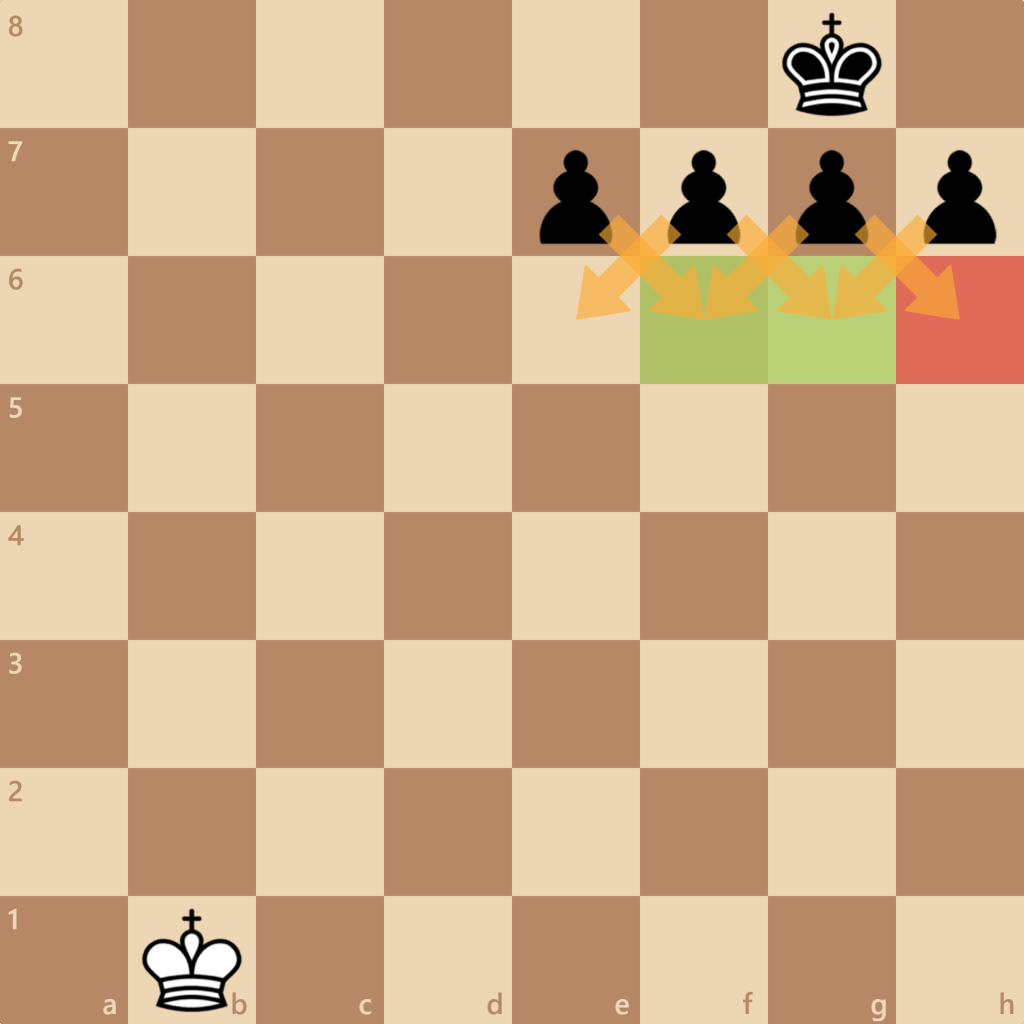
Consider the following indicative pattern, where we only have the king’s defensive pawns after the king has castled kingside. Notice that of the f-, g-, and h-files, the h6 square is specifically weaker than the others on the sixth rank as there is no i-pawn that also defends that square.
The following rook-queen attack along the h-file is a great demonstration.
This was a simple example of “attacking down the h-file”. There are more complicated h-file attacking ideas against the castled king, for instance, with the knight + queen, or the coordinated Greek Gift Sacrifice attack, which we will see in subsequent articles and videos in this series!
[Event "Game example"]

[Result "1-0"]


1. d4 c6 2. Nc3 d5 3. Bf4 Bf5 4. e3 e6 5. Bd3 Bxd3 6. Qxd3 Nf6 7. Nf3 Bd6 8. Bg3

Bxg3 9. hxg3 {[%c_arrow

d3h7;keyPressed;none;from;d3;opacity;0.8;to;h7;persistent;false,h1h7;keyPressed;none;from;h1;opacity;0.8;to;h7;persistent;false][%c_highlight

h7;keyPressed;none;opacity;0.8;square;h7;persistent;false,h1;keyPressed;alt;opacity;0.8;square;h1;persistent;false,d3;keyPressed;alt;opacity;0.8;square;d3;persistent;false]

Let's keep an eye on that h-file $1} 9... O-O {[%c_highlight

d3;keyPressed;alt;opacity;0.8;square;d3;persistent;false,h1;keyPressed;alt;opacity;0.8;square;h1;persistent;false,h7;keyPressed;none;opacity;0.8;square;h7;persistent;false][%c_arrow

h1h7;keyPressed;none;from;h1;opacity;0.8;to;h7;persistent;false,d3h7;keyPressed;none;from;d3;opacity;0.8;to;h7;persistent;false]

Arguably, Black castling kingside to where White already has an attack down the

h-file is a bit of the mistake. The black knight's defence of the h7 square is

critical $1} 10. g4 {[%c_highlight

f6;keyPressed;none;opacity;0.8;square;f6;persistent;false,d3;keyPressed;alt;opacity;0.8;square;d3;persistent;false,h1;keyPressed;alt;opacity;0.8;square;h1;persistent;false,h7;keyPressed;none;opacity;0.8;square;h7;persistent;false][%c_arrow

g4g5;keyPressed;none;from;g4;opacity;0.8;to;g5;persistent;false,g5f6;keyPressed;none;from;g5;opacity;0.8;to;f6;persistent;false,h1h7;keyPressed;none;from;h1;opacity;0.8;to;h7;persistent;false,d3h7;keyPressed;none;from;d3;opacity;0.8;to;h7;persistent;false]

g4, planning for g5 to dislodge the knight $1} 10... Nxg4 $4 {[%c_effect

g4;square;g4;type;Blunder;persistent;true][%c_highlight

d3;keyPressed;alt;opacity;0.8;square;d3;persistent;false,h1;keyPressed;alt;opacity;0.8;square;h1;persistent;false,h7;keyPressed;none;opacity;0.8;square;h7;persistent;false][%c_arrow

h1h7;keyPressed;none;from;h1;opacity;0.8;to;h7;persistent;false,d3h7;keyPressed;none;from;d3;opacity;0.8;to;h7;persistent;false]

Black, only seeing the \"hanging\" pawn, doesn't understand the attack and

blunders} 11. Qxh7# {[%c_effect

e1;square;e1;type;Winner,g8;square;g8;type;CheckmateBlack][%c_highlight

h8;keyPressed;none;opacity;0.8;square;h8;persistent;false,g8;keyPressed;none;opacity;0.8;square;g8;persistent;false,h1;keyPressed;alt;opacity;0.8;square;h1;persistent;false,h7;keyPressed;alt;opacity;0.8;square;h7;persistent;false][%c_arrow

h7g8;keyPressed;none;from;h7;opacity;0.8;to;g8;persistent;false,h7h8;keyPressed;none;from;h7;opacity;0.8;to;h8;persistent;false,h1h7;keyPressed;none;from;h1;opacity;0.8;to;h7;persistent;false]

Checkmate $1} 1-0
 Adventures of a Chess Noob
[…] pattern on the h-pawn, after the opponent has castled kingside. It combines the tactical ideas of attacking down the h-file, beginning with sacrificing a bishop to punch a hole in that file. This also draws the king onto […]
LikeLike