
One of the things that I’ve learned along my chess journey is that it is often beneficial to set up pre-emptive tactics. That is, creating a position where a tactic like a pin or a discovered check might become available in the future, even if it isn’t immediately useable. Although this might not be the most accurate move, heuristically, it will often create the environment for a winning attack!
This game is a great example of this idea that was implemented in the early middle game. Let’s go!
I had the white pieces and Black responds with the Pirc Defense (1. e4 d6), a hypermodern opening that is one of my least favourite openings to play against. Although I’ve historically done “okay” against the Pirc (winning just better than 50% of the time), I’ve never felt comfortable playing against it.
A historical note:
The Pirc Defense is named after Yugoslav GM Vasja Pirc (1907-1980), who was a strong advocate for the opening that now bears his name. I’ve extracted all of Pirc’s games where he played his named opening in PGN format for your perusal. I found the original list of games of Vasja Pirc from NM Bill Wall’s (@minichess) amazing website.
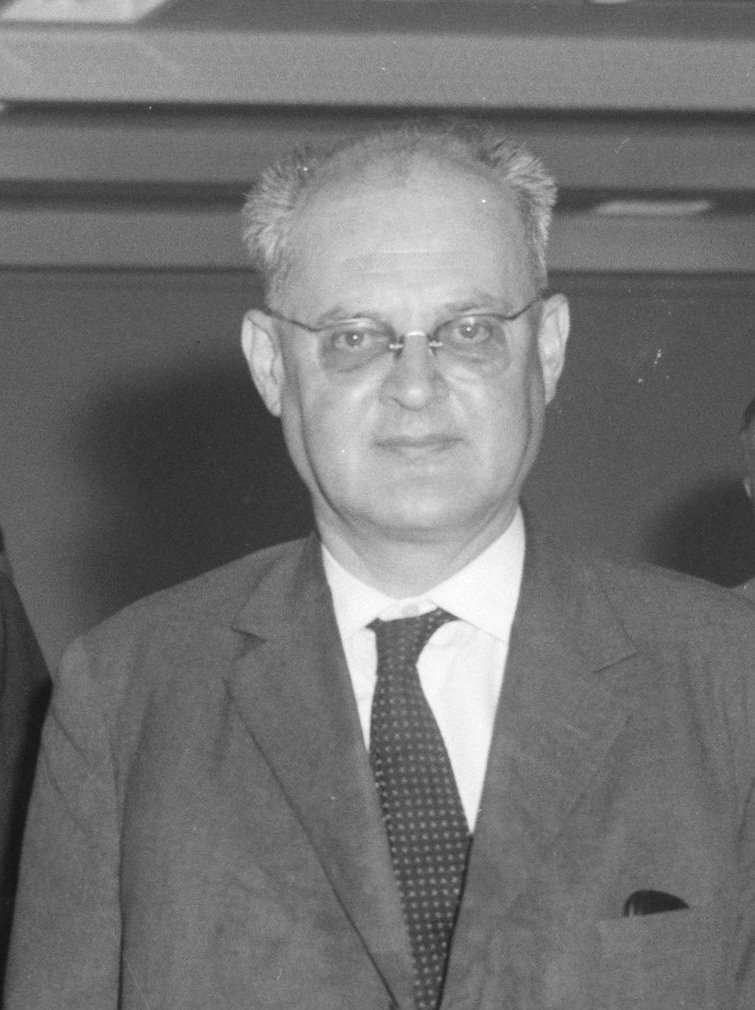
Vasja Pirc at IBM international chess tournament Amsterdam, 1964
By Joop van Bilsen (ANEFO) – GaHetNa (Nationaal Archief NL)
Interestingly, when I looked at the first games in the modern databases where the Pirc Defense was played, I once again discovered that it was known and played regularly by Moheschunder Bannerjee in his 1850 series of games against John Cochrane in Kolkata (Calcutta), India! What is curious to me is that in a very real way, the “hypermodern” systems (which came in contrast to the “Modern”, and now “Classical” era advocated by Steinitz and Tarrasch, were staples of Indian chess!
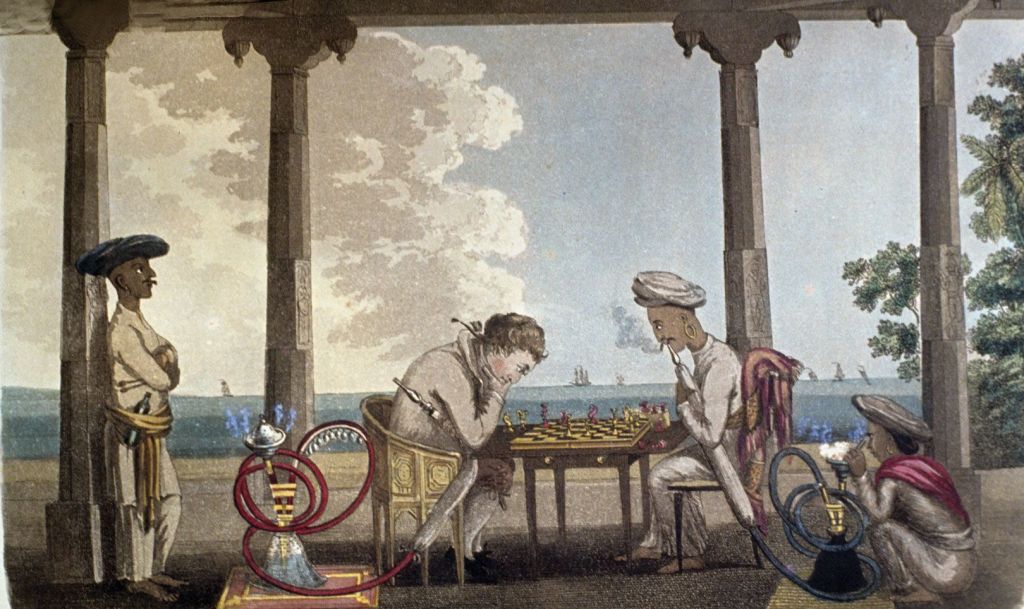
Cochrane and Bannerjee, Calcutta 1850
In this game, I responded to Black’s Pirc by pushing my centre pawns (e-, d-, and then f-pawn) to the fourth rank. Previously when I was looking at f4/f5 openings, I noticed that there were several named openings that made use of an early f4 against the Pirc/Modern Defense and that these were quite successful. Indeed, although (5. f4?!) was considered inaccurate by Stockfish, Black had only a single good response (5… Nxe4), which isn’t immediately obvious, especially if Black was attempting to play a more conservative and defensive opening.
In the game, Black pushed their e-pawn (5… e5??), and this was a blunder. I don’t respond in the most accurate manner, and apparently it was best to keep the tension with (6. Nf3). However, trading down was still “fine” and at the end of the trade sequence, I force a queen trade and win a concession as Black had to move their king, losing the right to castle. Stockfish evaluated the position as largely equal [+0.1], however, as we’ll see, Black’s king on the fully open d-file is a weakness that I manage to take advantage of, which became the winning attack.
In the next four moves, we once again build the tension again and on move 12, Black once again fired first with (12… Bxc3??) and this was also a blunder. Why? A turn earlier, I long-castled, which put a rook on the d-file. And move was part of the thesis of this article. Stockfish doesn’t think that this was the best move (though it was a good one), preferring the development of the other knight first. However, the rook on the d-file sets up a powerful tactical resource as the rook is now facing Black’s exposed king. Although I couldn’t use it immediately, it creates the environment for a future discovered check, or pin.
After (12… Bxc3??), Black’s light square bishop on d7 was pinned to the king after I recaptured with (13. Bxc3). And a few balanced captures later, on move 17 (17. Rxd1), Black’s bishop was going to be lost the following turn, giving White the material advantage. Black struggled against the position, trying to coordinate their rook pair, to recapture material, but it didn’t work out for them. Black’s king was just too vulnerable in the centre of the board and on move 23, the dust settled, and we’d entered the endgame where White had an extra piece, and a pawn majority on the kingside. Black opted to resign rather than play out the endgame. Good game, GG!
The big takeaway from this video is that setting up pre-emptive tactical possibilities can be a good coherent approach, even if Stockfish might not consider the move the most accurate on analysis.
Game: https://www.chess.com/game/daily/649711603
[Event "TA 2024 Anzac remembrance KO Div 2 1000- 1450+ - Round 1"]
[Site "Chess.com"]
[Date "2024.04.24"]
[Round "-"]
[White "vitualis"]
[Black "poorestknight"]
[Result "1-0"]
[Tournament "https://www.chess.com/tournament/ta-2024-anzac-remembrance-ko-div-2-1000-1450"]
[CurrentPosition "3r4/ppp2k1p/7B/8/8/8/PPP3PP/2K1R3 b - - 1 23"]
[Timezone "UTC"]
[ECO "B07"]
[ECOUrl "https://www.chess.com/openings/Pirc-Defense-2.Nc3-Nf6"]
[UTCDate "2024.04.24"]
[UTCTime "21:12:00"]
[WhiteElo "1226"]
[BlackElo "1207"]
[TimeControl "1/432000"]
[Termination "vitualis won by resignation"]
[StartTime "21:12:00"]
[EndDate "2024.05.08"]
[EndTime "11:22:56"]
[Link "https://www.chess.com/game/daily/649711603"]
[WhiteUrl "https://images.chesscomfiles.com/uploads/v1/user/3711094.f52a0759.50x50o.ab18600a8723.png"]
[WhiteCountry "17"]
[WhiteTitle ""]
[BlackUrl "https://images.chesscomfiles.com/uploads/v1/user/255885981.232e8231.50x50o.371b0b707f21.jpg"]
[BlackCountry "17"]
[BlackTitle ""]

1. e4 d6 {Pirc Defense [+0.6]. This is a hypermodern opening.} 2. Nc3 Nf6 3. Bc4
e6 4. d4 Nbd7 5. f4 $6 {[%c_arrow
d1e2;keyPressed;none;from;d1;opacity;0.8;to;e2;persistent;false][%c_highlight
e2;keyPressed;none;opacity;0.8;square;e2;persistent;false][%c_effect
f4;square;f4;type;Inaccuracy;persistent;true]} 5... e5 $4 {[%c_arrow
f6e4;keyPressed;none;from;f6;opacity;0.8;to;e4;persistent;false][%c_highlight
e4;keyPressed;none;opacity;0.8;square;e4;persistent;false,e5;keyPressed;none;opacity;0.8;square;e5;persistent;false][%c_effect
e5;square;e5;type;Blunder;persistent;true] This is a blunder [+2]. Best move for
Black is Nxe4, as after White recaptures with Nxe4, Black has the fork with d5.}
6. dxe5 $2 {[%c_arrow
g1f3;keyPressed;none;from;g1;opacity;0.8;to;f3;persistent;false][%c_highlight
f3;keyPressed;none;opacity;0.8;square;f3;persistent;false][%c_effect
e5;square;e5;type;Mistake;persistent;true] Stockfish suggests keeping the
tension and developing instead [+2 $37 +0.5].} 6... dxe5 7. fxe5 Nxe5 8. Qxd8+ {I
thought that this won a good concession from Black, though interestingly,
Stockfish doesn't think that the advantage is significant [+0.1]} 8... Kxd8 9.
Bb3 Bb4 10. Bd2 Re8 11. O-O-O Bd7 $6 {[%c_effect
d7;square;d7;type;Inaccuracy;persistent;true][%c_arrow
c8g4;keyPressed;none;from;c8;opacity;0.8;to;g4;persistent;false][%c_highlight
g4;keyPressed;none;opacity;0.8;square;g4;persistent;false] An inaccuracy [+0.5]}
12. Nf3 Bxc3 $4 {[%c_arrow
e5g4;keyPressed;none;from;e5;opacity;0.8;to;g4;persistent;false][%c_highlight
g4;keyPressed;none;opacity;0.8;square;g4;persistent;false,c3;keyPressed;none;opacity;0.8;square;c3;persistent;false][%c_effect
c3;square;c3;type;Blunder;persistent;true] Black decides to relieve the tension
by starting the capture chain. However, this is a blunder $1 [+3.1].
Fundamentally, the mistake is that Black's king is exposed on the fully opened
d-file and their light square bishop on d7 will be pinned, and lost, at the end
of the capture sequence. Let's go $1} 13. Bxc3 Nxe4 14. Bxe5 Nf2 15. Bxf7 Rf8 16.
Be6 Nxd1 17. Rxd1 {[%c_arrow
d1d7;keyPressed;none;from;d1;opacity;0.8;to;d7;persistent;false,d7d8;keyPressed;none;from;d7;opacity;0.8;to;d8;persistent;false,e6d7;keyPressed;none;from;e6;opacity;0.8;to;d7;persistent;false][%c_highlight
d7;keyPressed;none;opacity;0.8;square;d7;persistent;false] And at the end, White
wins an extra piece $1 [+6]} 17... Ke7 18. Bxd7 Rad8 19. Bxg7 Rf7 20. Re1+ Kxd7
21. Ne5+ Ke6 22. Nxf7+ Kxf7 23. Bh6 {[%c_effect
c1;square;c1;type;Winner,f7;square;f7;type;ResignBlack] The dust settles, and we
enter an endgame where I have an extra piece, and a kingside pawn majority.
Black opts to resign rather than play the endgame, GG $1} 1-0
 Adventures of a Chess Noob