A little while ago, I wrote an article and recorded a video about the reversal, transforming a losing position into a win through a planned tricky manoeuvre. As noted previously, I find it wone of the most exciting experiences in chess. From the perspective of framing – it also means that you’ve something to play for after making a dreadful blunder. In this game, I carelessly blunder my queen on move 10… 😭
As with many of my adventures in chess, it began with the Vienna Gambit, to which my opponent with the black pieces declined with d6 (1. e4 e5 2. Nc3 Nf6 3. f4 d6). Those of you who are Vienna Gambit aficionados will know that the best response to the Vienna Gambit (Falkbeer) is to enter the Vienna Game Main Line with (3… d5). However, if one chooses to decline the gambit, then (3… d6) is the next best option.
With White, our next tactical step in the opening is relatively simple. We want to play d4 to control the centre with pawns, but this will be best supported with a piece in addition to the queen. Otherwise, after a capture sequence of: d4 exd4 Qxd4, Black develops their queen’s knight with Nc6, and wins tempo on our queen. So, we first develop our king’s knight (4. Nf3) to prepare for d4 and play that the next turn if allowed.

Now, the capture sequence gives us the advantage, (5. d4 exd4 6. Nxd4 Nxd4 7. Qxd4), as we finish with my queen commanding the centre of the board!
In the position, it isn’t obvious for Black their best way to develop in the opening, and indeed, their next two ideas (7… Qe7?!) and (8… g6?!) are inaccuracies that move the evaluation to [+2]. For Black, the e7 square is not great for the queen in the Vienna Game opening as White is ever ready to leap forward with the queen’s knight to d5, with an attack on the queen and Black’s c7 square (which comes with an absolute fork of king and rook). As for g6, a fianchetto king’s bishop (9… Bg7) can be a tricky way to play for Black against the Vienna, but it risks weakening the dark squares around the king, especially if Black castles short.
In this position, on move 10, I make my OBVIOUS blunder! This was an unrated game of 10-minute rapid with no increment. This is what I sometimes play as a de facto game of low-stakes blitz when I don’t have much time, and don’t want to think too hard! 😅 My logic was that I wanted to pre-emptively move my queen off the long dark square diagonal after Black’s bishop parked itself on g7. With minimal thinking (I played the move in 5.1 seconds), I stepped my queen forward one square (10. Qd5??) thinking that I had a battery with the light square c4-bishop. Except that d5 was, of course, defended by Black’s f6-knight! This impulsive move resulted with a clean loss of my queen… 🤣
Now, I’ve played enough games of chess to know that some people will rage quit after losing their queen after such a blunder. That, however, isn’t my style. No one ever won by resigning! As noted in the opening, we can frame this a different way. We have the opportunity to play for a reversal! We play for at least a draw and optimally for a win! This can be immensely fun and rewarding!
Strategically, it’s important to recognise that the position is already losing. From that perspective, the accuracy of moves is of lesser importance as a loss is a loss. Rather, to get a reversal, one must create opportunities for our opponent to make mistakes and blunder. And to do that, we tactically want to play aggressively, making threats on the board, creating complications, and play moves which may be unexpected such as piece sacrifices! A material disadvantage in the opening stages of the game might not be felt, especially if the opponent is behind on development.
So, my immediate next move was (11. Nxd5) placing pressure on Black’s queen on e7. Now arguably, Bxd5 is better as Black has a follow up Qxe4. However, I wanted to set the aggressive tone and see how Black would respond… and they played (11… Qd7?!), yes!
A very common response when you opponent has an unexpected windfall like winning a queen is that the loss aversion bias kicks in! For many people, after winning a material advantage, they will instinctively hold onto that advantage, and prioritise that over taking further perceived risks. For Black, Qd7 is a defensive and conservative move that moves it out of the attack. Black wants to “protect their queen” rather than use it to press for the advantage in an attack immediately. This gives me an avenue for a counterattack! 🤩
The queen’s knight on the d5 square is a common and powerful tactic in the Vienna Game. With White’s queen now on d7, I noticed that Nf6 would be a royal fork! However, I needed to deflect Black’s fianchetto g7-bishop to make it work. So, (12. f5) to open the dark square diagonal for my own bishop, with a plan for Bh6!
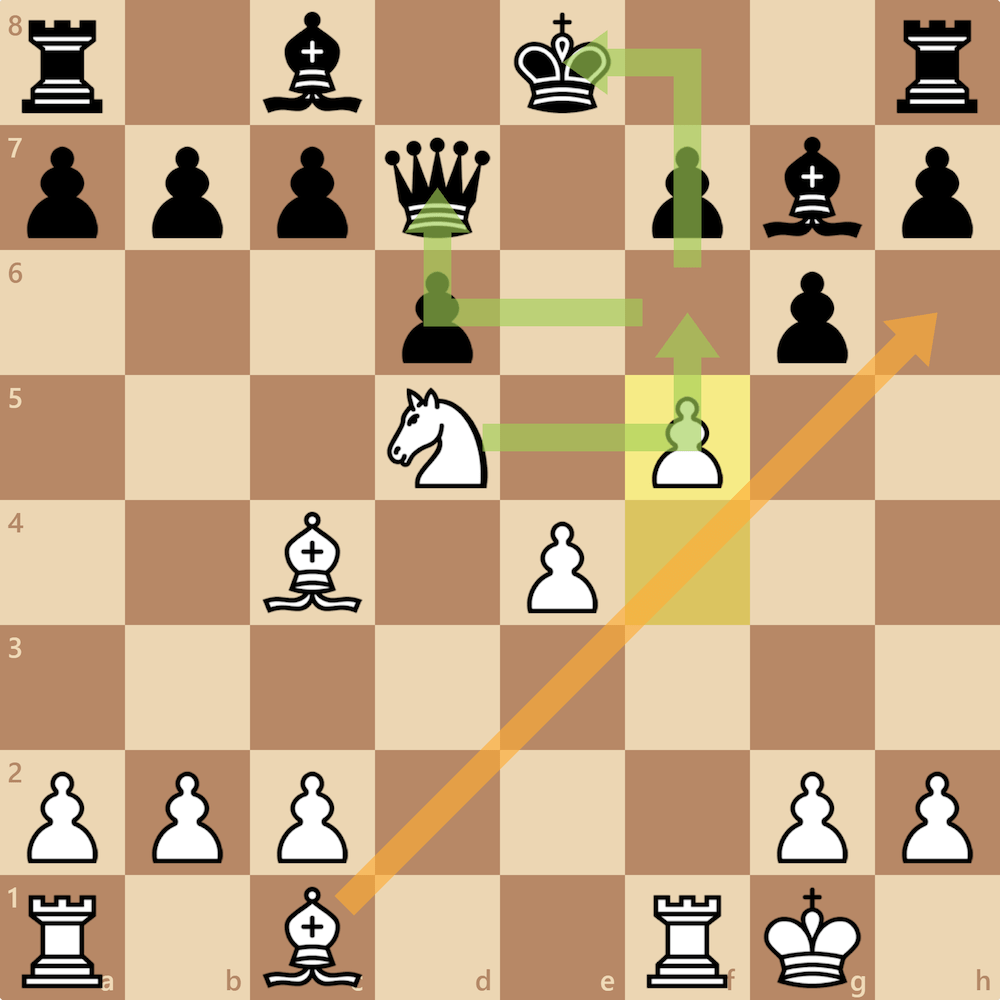
Black captured the pawn as expected (12… gxf5) and so (13. Bh6!?). If Black captures the seemingly hanging bishop with Bxh6, then Nf6+ royal fork! Making threats, creating complications, piece sacrifices – inviting our opponent to blunder!
Black resists the temptation and castles. No problem! Notice that Nf6 remains a royal fork after Black’s castle! Notice further that after Black’s (12… gxf5) and (13… O-O), that Black’s king is now on a semi-opened g-file… meaning, that it could be attacked directly down the g-file! The way to exploit this is to add an extra attacker, so rook lift with (14. Rf3), as Rg3 would be extremely powerful! 😀
The curious thing here is that according to the engine, Black is completely winning at better than [-5] and up 7 points of material. Under the cold-blooded calculation of the engine, Black’s most accurate move is in fact Bxh6 and to give up their queen! This makes sense as White would lose two minor pieces for the queen and the game simplifies to a late middlegame and towards an endgame where Black is simply up a piece! However, sacrificing a queen for such a reason is not very human… 🤖
Instead, Black attempted to avoid the potential royal fork by dislodging my d5-knight with (14… c6). However, I didn’t have to comply as I could DOUBLE-DOWN on the attack and sacrifice a bishop with (15. Bb5!?)! Visually, this is unusual as it walks the bishop into a fork, but it pins Black’s c6-pawn to the queen!
Black obliges and captures the bishop (15… cxb5) which now gives me the final step of tempo for (16. Rg3), pinning Black’s g7-bishop in place. In this position, the tactics narrow to a critical point and Black must find the single good response to maintain their ostensible [-5] advantage.
Making threats, creating complications, piece sacrifices – inviting our opponent to blunder!
The move they needed to find was (16… f6), which still involved a queen trade (17. Rxg7+ Qxg7 18. Bxg7) and thus not easy to accept even if seen. Instead, Black opted for (16… fxe4??) and I get my reversal! In fact, it’s checkmate-in-two and after (17. Nf6+!) royal fork, I don’t even need to capture the queen! Black is forced to play (17… Kh8) as their only legal move, and (18. Bxg7#), GG!
The big takeaway from this game is frame a blunder in the opening, including losing a queen, as an opportunity and not as a loss! Playing aggressive and tricky chess for a reversal is enormously fun and satisfying!
Game: https://www.chess.com/analysis/library/2ebN6NhRRx
[Event "Live Chess"]
[Site "Chess.com"]
[Date "2024.06.30"]
[Round "?"]
[White "vitualis"]
[Black "Random Noob"]
[Result "1-0"]
[TimeControl "600"]
[WhiteElo "1300"]
[BlackElo ""]
[Termination "Guest0580161983 won by checkmate"]
[BlackUrl ""]
[BlackCountry "225"]
[BlackTitle ""]
[WhiteUrl "https://images.chesscomfiles.com/uploads/v1/user/3711094.f52a0759.100x100o.671ef4f371ed@3x.png"]
[WhiteCountry "17"]
[WhiteTitle ""]

1. e4 {[%clk 0:09:59.9][%timestamp 1]} 1... e5 {[%clk 0:09:58.4][%timestamp 16]}
2. Nc3 {[%clk 0:09:58.7][%timestamp 12]} 2... Nf6 {[%clk 0:09:56.7][%timestamp
17]} 3. f4 {[%clk 0:09:57.3][%timestamp 14]} 3... d6 {[%clk
0:09:54.2][%timestamp 25] Vienna Gambit (Falkbeer), Declined 3... d6} 4. Nf3
{[%clk 0:09:54.6][%timestamp 27][%c_arrow
g1f3;keyPressed;none;from;g1;opacity;0.8;to;f3;persistent;false,f3d4;keyPressed;shift;from;f3;opacity;0.8;to;d4;persistent;false,d2d4;keyPressed;shift;from;d2;opacity;0.8;to;d4;persistent;false][%c_highlight
f3;keyPressed;none;opacity;0.8;square;f3;persistent;false,d4;keyPressed;ctrl;opacity;0.8;square;d4;persistent;false]
This is the best move to prepare for d4. This is an well trodden line of the
Vienna and first appears in databases from the mid-19th century (Pindar -
Horwitz, 1861, Manchester UK).} 4... Nc6 {[%clk 0:09:49.5][%timestamp 47]} 5. d4
{[%clk 0:09:52.7][%timestamp 19]} 5... exd4 {[%clk 0:09:48][%timestamp 15]} 6.
Nxd4 {[%clk 0:09:51.1][%timestamp 16]} 6... Nxd4 {[%clk 0:09:47.6][%timestamp
4]} 7. Qxd4 {[%clk 0:09:49.6][%timestamp 15] I'm very happy with this position
from the opening as I have superior development and better control of the centre
[+0.4]} 7... Qe7 $6 {[%clk 0:09:46.2][%timestamp 14][%c_effect
e7;square;e7;type;Inaccuracy;path;null;size;100%25;animated;false;persistent;true][%c_arrow
f8e7;keyPressed;none;from;f8;opacity;0.8;to;e7;persistent;false][%c_highlight
e7;keyPressed;none;opacity;0.8;square;e7;persistent;false] And it's no easy for
Black to play the position. This was inaccurate and Be7 to prepare for kingside
castling is best [+1.8]. Against the Vienna Game, Black putting the queen on e7
is risky given that one of the tactical resources that White has is Nd5.} 8. Bc4
{[%clk 0:09:24.3][%timestamp 253][%c_arrow
c1d2;keyPressed;none;from;c1;opacity;0.8;to;d2;persistent;false][%c_highlight
d2;keyPressed;shift;opacity;0.8;square;d2;persistent;false] The other option is
Bd2 to prepare for long castling...} 8... g6 $6 {[%clk 0:09:43.7][%timestamp
25][%c_effect
g6;square;g6;type;Inaccuracy;path;null;size;100%25;animated;false;persistent;true][%c_arrow
c7c6;keyPressed;none;from;c7;opacity;0.8;to;c6;persistent;false][%c_highlight
c6;keyPressed;none;opacity;0.8;square;c6;persistent;false] Black was planning on
a kingside fianchetto. I can see the logic, but this isn't the most accurate
move [+2.1] and potentially weakens the dark squares around the kingside,
especially if Black castles short.} 9. O-O {[%clk 0:09:18.2][%timestamp 61]}
9... Bg7 {[%clk 0:09:42.3][%timestamp 14]} 10. Qd5 $4 {[%clk
0:09:13.1][%timestamp 51][%c_effect
d5;square;d5;type;Blunder;path;null;size;100%25;animated;false;persistent;true][%c_highlight
d5;keyPressed;none;opacity;0.8;square;d5;persistent;false][%c_arrow
c3d5;keyPressed;none;from;c3;opacity;0.8;to;d5;persistent;false] My logic was to
pre-emptively move the queen off the long dark square diagonal. As I was playing
a 10-min game, but unrated and very quickly (I spent 5.1 seconds making the
move), I failed to notice this OBVIOUS blunder [-5] as the square was controlled
by Black's f6-knight  $1 I made an impulse move and saw the error immediately  $1
😅} 10... Nxd5 {[%clk 0:09:37.6][%timestamp 47]} 11. Nxd5 {[%clk
0:09:08.1][%timestamp 50][%c_arrow
c4d5;keyPressed;none;from;c4;opacity;0.8;to;d5;persistent;false][%c_highlight
d5;keyPressed;shift;opacity;0.8;square;d5;persistent;false] Arguably, Bxd5 is
better as Black has Qxe4, but this move allowed me to immediately pressure
Black's queen  $1 As I was losing, I wanted to see how they would respond to
pressure  $1} 11... Qd7 $6 {[%clk 0:09:28.6][%timestamp 90][%c_effect
d7;square;d7;type;Inaccuracy;path;null;size;100%25;animated;false;persistent;true][%c_arrow
e7e4;keyPressed;none;from;e7;opacity;0.8;to;e4;persistent;false][%c_highlight
e4;keyPressed;none;opacity;0.8;square;e4;persistent;false] Yes  $1 A very common
response when your opponent has an unexpected windfall like winning a queen, is
that the loss aversion bias kicks in  $1 Against the attack on their queen, rather
than attack with Qxe4, they played a defensive Qd7, which is inaccurate [-4.4].
Tactically, it is often better that they play aggressive attacking chess, and
even be willing to return material for activity and opportunity. This gives me
an opportunity to counterattack  $1 In the very early parts of the game, a
material disadvantage might not be felt if the opponent's pieces have yet to
become active.} 12. f5 {[%clk 0:08:46.3][%timestamp 218][%c_arrow
d5f6;keyPressed;shift;from;d5;opacity;0.8;to;f6;persistent;false,f6e8;keyPressed;shift;from;f6;opacity;0.8;to;e8;persistent;false,f6d7;keyPressed;shift;from;f6;opacity;0.8;to;d7;persistent;false,c1h6;keyPressed;none;from;c1;opacity;0.8;to;h6;persistent;false]
Here, I saw a tricky tactic  $1 Nf6+ is a royal fork, but I need to deflect
Black's g7-bishop to make it work  $1 So, I open up the dark square diagonal with
a plan to play Bh6  $1 To get the attack, I'm willing to sacrifice pawns and
pieces to make it happen  $1} 12... gxf5 {[%clk 0:09:24.2][%timestamp 44] Notice
the semi-opened g-file...} 13. Bh6 $5 {[%clk 0:08:45][%timestamp 13][%c_effect
h6;square;h6;type;Interesting;persistent;true][%c_arrow
e4f5;keyPressed;none;from;e4;opacity;0.8;to;f5;persistent;false][%c_highlight
f5;keyPressed;shift;opacity;0.8;square;f5;persistent;false] As per the plan  $1
exf5 is more accurate and perhaps more sensible. However, tricky tactics invite
the opponent to blunder  $1} 13... O-O {[%clk 0:09:22.6][%timestamp 16]} 14. Rf3
{[%clk 0:08:26.2][%timestamp 188] I can't immediately play Bxg7 as after Kxg7,
the royal fork is no longer available. And indeed, the opened g-file is now a
big problem with Black's king  $1 Rook lift and then Rg3 would pin Black's bishop
in place with a massive attack on their king  $1} 14... c6 $6 {[%clk
0:09:18.9][%timestamp 37][%c_effect
c6;square;c6;type;Inaccuracy;path;null;size;100%25;animated;false;persistent;true]
Surprisingly, the engine's cold hearted calculus is that Black's most accurate
move is in fact Bxh6 and allow the royal fork and the loss of their queen  $1 The
more human option that blocks the royal fork from working is Kh8.} 15. Bb5 $5
{[%clk 0:08:10.7][%timestamp 155][%c_effect
b5;square;b5;type;Interesting;path;null;size;100%2525;animated;false;persistent;true][%c_arrow
f3g3;keyPressed;none;from;f3;opacity;0.8;to;g3;persistent;false][%c_highlight
g3;keyPressed;none;opacity;0.8;square;g3;persistent;false] I DOUBLE DO $146 on the
attack by sacrificing my light square bishop  $1 Black's c6-pawn is pinned to
their queen  $1 Rg3 is probably the most accurate move. However, remember that
Black is still comfortably ahead so anything other than a knockout reversal
doesn't actually change the outcome  $1} 15... cxb5 {[%clk 0:09:17.1][%timestamp
18]} 16. Rg3 {[%clk 0:08:08.9][%timestamp 18]} 16... fxe4 $4 {[%clk
0:08:59.4][%timestamp 177][%c_effect
e4;square;e4;type;Blunder;path;null;size;100%25;animated;false;persistent;true][%c_highlight
e4;keyPressed;none;opacity;0.8;square;e4;persistent;false,f6;keyPressed;none;opacity;0.8;square;f6;persistent;false][%c_arrow
f7f6;keyPressed;none;from;f7;opacity;0.8;to;f6;persistent;false] And here, Black
had a single good move, which was f6  $1 They didn't find it, played fxe4 which
blunders [+M2] and I get my reversal  $1 To play for the win, I tactically
positions that invite my opponent to blunder  $1 😁} 17. Nf6+ $1 {[%clk
0:08:07.7][%timestamp 12][%c_effect
f6;square;f6;type;GreatFind;path;null;size;100%25;animated;false;persistent;true][%c_arrow
f6g8;keyPressed;none;from;f6;opacity;0.8;to;g8;persistent;false,f6d7;keyPressed;none;from;f6;opacity;0.8;to;d7;persistent;false][%c_highlight
f6;keyPressed;alt;opacity;0.8;square;f6;persistent;false,d7;keyPressed;none;opacity;0.8;square;d7;persistent;false,g8;keyPressed;none;opacity;0.8;square;g8;persistent;false]
Royal fork, and Black's g7-bishop is pinned to the king by my rook  $1} 17... Kh8
{[%clk 0:08:56.4][%timestamp 30]} 18. Bxg7# {[%clk 0:08:05][%timestamp
27][%c_effect
g1;square;g1;type;Winner,h8;square;h8;type;CheckmateBlack][%c_arrow
g7h8;keyPressed;none;from;g7;opacity;0.8;to;h8;persistent;false,g3g7;keyPressed;none;from;g3;opacity;0.8;to;g7;persistent;false,f6g8;keyPressed;none;from;f6;opacity;0.8;to;g8;persistent;false][%c_highlight
h8;keyPressed;none;opacity;0.8;square;h8;persistent;false,g7;keyPressed;none;opacity;0.8;square;g7;persistent;false,g8;keyPressed;none;opacity;0.8;square;g8;persistent;false]
And in fact, I didn't even need to capture Black's queen  $1 Checkmate, and as
noted back on move 8, Black's advance of the g-pawn to fianchetto their bishop
risked weakening the dark squares, and that weakness proved fatal  $1 GG  $1} 1-0
 Adventures of a Chess Noob