I love playing aggressive, tricky, romantic manoeuvres! 🤩 To quote myself from the draft manuscript (about 40% complete!) of my upcoming book, from the perspective of the romanticist:
It is not enough to simply win, but one must strive to win with style!
– vitualis the chess noob
I had an epiphany some time ago on my chess journey that I don’t really play to win, but rather, I play to have fun! Now, I don’t play with the intention of losing, but I would definitely prefer to play a game of exciting and evocative chess, even if I lost, than play a dull and uninteresting game where I won mechanically. And thus, the name of my blog and channel – it’s the adventures of a chess noob! 😁
I had a really fun time with this following game, where I’d realised that I’d made a mistake in the opening, and so decided to play some tricky, high-risk, high-reward tactics, and was rewarded with a beautiful win. Let’s go!
I had the white pieces, and the game starts with the Vienna Game, my opponent from Türkiye knew the basics and brought us into the Main Line, to which I responded with the Paulsen Attack (1. e4 e5 2. Nc3 Nf6 3. f4 d5 4. fxe5 Nxe4 5. Qf3).
A historical note:
Louis Paulsen (1833-1891) was a German, and later American chess master who is considered one of the greatest theoreticians, and one of the strongest chess players in the later half of the 19th century. In the USA’s first major chess tournament of New York 1857, Paulsen was ranked second after Morphy! During the period of romantic attacking chess, Paulsen’s extensive opening analysis suggested that a defence was always possible, and as such, Black could always at least maintain neutrality, and should White’s attack be premature and fail, Black would capture the advantage. These theoretical ideas were unpopular at the time, but arguably, he was proven correct with Steinitz’s conversion towards advocating the positional style, and his subsequent success becoming the first world chess champion.
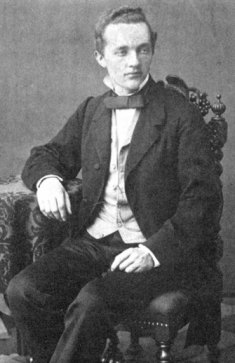
Paulsen’s theoretical contribution have resulted in his name being attached to variations of many openings. The Vienna Game: Main Line, Paulsen Attack was played by Paulsen himself against Englishman Joseph (“the Black Death”) Blackburne with success in (Paulsen — Blackburne, 1889, Breslau, Germany).
Black then played a move that I knew was likely inaccurate (5… Bc5?!), and it was, but I had a mental block on how to respond! Black’s bishop and their e4-knight both pressured my f2 square, so I had to do something… but after thinking for a minute, I didn’t feel any closer to definitively finding the correct solution, that I knew must exist.
Retrospectively on analysis, I realised that I had held an idea in my head that trading knights was bad, i.e., Nxe4, as a principle rather than a heuristic, which is contextually based on the assumption that Black plays accurately. Against Black’s inaccurate Bc5, removing one of the attackers of the f2 square was the best move. I did find the second-best move, which was to gambit another pawn – (6. d4?!). This blocked Black’s c5-bishop for a turn and forced them to capture (6… Bxd4), while it opened the diagonal for my dark square bishop to develop, and then force a bishop trade (7. Be3 Bxe3 8. Qxe3).
After this was played, I realised that although I had stepped out of an immediate danger, I was nonetheless behind. Black had won one of my pawns, I was left with an isolated e-pawn, and I didn’t seem to have much in terms of compensation. Stockfish’s evaluation agreed with my impression – in this part of the game, my opponent had an advantage of around [-1 to -2].
We played on and the early middlegame was a bit of an impasse. There was a tension between Black’s e4-knight and my c3-knight, and for several turns, neither of us were willing to initiate the trade. The position was complex, and it seems our mutual human intuition was wrong as the engine recommended for both of us to initiate the trade for advantage! 😂
Eventually I took the leap, but after a series of trades in the middle of the board, I once again recognised that I didn’t have the advantage. On move 16, Black opposite-side castled (16… O-O), and I began a risky and moderately ridiculous manoeuvre, that nonetheless worked out!
It started with (17. Nf5), placing my knight on a square that attacked Black’s g7-pawn/square, and gave control of the fully open d-file to my rook. In doing so, I knowingly hung my a2-pawn to Black’s queen on a5. My logic was that I was going to launch an attack on Black’s king, and sacrificing a pawn or two was possibly just the tempo I needed to make it work!
Black, expectedly, developed their rook to the e-file (17… Rfe8), threatening to reveal an attack on my queen on e4 by moving their e5-knight. And here, I found a tricky move with (18. Qd4?!) – this is technically a mistake [-3.3], but I’ve set up a major threat! Black’s knight is pinned to the g7-pawn as moving the knight would allow for Qxg7#!
Black captured my a2-pawn with their queen (18… Qxa2), giving me a step of tempo. And here, I played my last gamble with (19. Rde1?!), which is technically a blunder. If Black was looking at the position carefully, then they’d realise that immediately placing one of their rooks on d8 wins my queen! I cannot move my queen off the fully open d-file as Black would have checkmate with Qa1#!
However, my intuition was that Black would have (relative) tunnel vision having just moved their queen and would be primed to attack with their queen again with (19… Qa1+), and my prediction was right! Their logic was that by forcing my king onto the d-file, they would be able to absolute pin my queen to the king. Why would I allow this? Wheels within wheels!
After (20. Kd2) my only legal move, my rooks on the back rank attack Black’s queen on a1. Black could immediately attempt to pin my queen, but that would not be advantageous as I would also capture their rook after the queen trade. So, I had a one move reprieve and Black would need to move their queen first. Their best move is to give another check with (20… Qa5+), but this would require them to make the decision to give up their tactic of constructing the d-file absolute pin. That’s a hard choice to make, especially you don’t recognise the danger! Black instead, parked their queen on a “safe” square (20… Qa6??), I get a reversal, and this blunder by Black completely justified my attack plan!
With (21. Rxe5!) I take out Black’s e5-knight! Remember, this knight was pinned to g7. Now, moving my rook threatens checkmate-in-one! Black, however, probably thought there was no risk as they had (21… Red8), and it seems like they are just fast enough, pinning my queen to the king. That means checkmate isn’t possible right, as the queen cannot move off the d-file?
However, this pin is an illusion! The allure of winning my queen was too strong for them to resist, and this approach did hold true risk for me, but Black moved one step too slow. I sacrifice, THE ROOK! Black’s back rank was vulnerable and with (21. Re8+!!), a brilliant move according to the chess.com analytic engine, the trap is sprung, and the full tactic revealed! 🤩
Black has only one legal move, which is to capture the rook (22… Rxe8). In doing so, the White queen is unpinned, and she delivers the coup de grâce with (23. Qxg7#). Good game, GG!
The big takeaway from this game is to try playing romantically. Look beyond the limited mental framing of winning and losing and play for enjoyment and fun. Attempt a tactic because the payoff is beautiful and become comfortable with the risk. After all, in casual games what does it really matter to lose some ELO?
Game: https://www.chess.com/game/live/113651431901
[Event "Live Chess"]
[Site "Chess.com"]
[Date "2024.07.02"]
[Round "?"]
[White "vitualis"]
[Black "sonerbayram"]
[Result "1-0"]
[ECO "C29"]
[WhiteElo "1311"]
[BlackElo "1215"]
[TimeControl "900+10"]
[EndTime "2:40:39 PDT"]
[Termination "vitualis won by checkmate"]
[WhiteUrl "https://images.chesscomfiles.com/uploads/v1/user/3711094.f52a0759.100x100o.671ef4f371ed@3x.png"]
[WhiteCountry "17"]
[WhiteTitle ""]
[BlackUrl "https://images.chesscomfiles.com/uploads/v1/user/3998593.db8c6a9c.100x100o.192b0129ea28@3x.jpeg"]
[BlackCountry "138"]
[BlackTitle ""]

1. e4 {[%clk 0:15:08.9][%timestamp 11]} 1... e5 {[%clk 0:15:08.5][%timestamp
15]} 2. Nc3 {[%clk 0:15:16.8][%timestamp 21]} 2... Nf6 {[%clk
0:15:16.9][%timestamp 16]} 3. f4 {[%clk 0:15:25.9][%timestamp 9]} 3... d5 {[%clk
0:15:25][%timestamp 19]} 4. fxe5 {[%clk 0:15:34.8][%timestamp 11]} 4... Nxe4
{[%clk 0:15:33.4][%timestamp 16]} 5. Qf3 {[%clk 0:15:44][%timestamp 8] Vienna
Game: Main Line, Paulsen Attack} 5... Bc5 $6 {[%clk 0:15:37.4][%timestamp
60][%c_arrow
f7f5;keyPressed;none;from;f7;opacity;0.8;to;f5;persistent;false][%c_highlight
f5;keyPressed;none;opacity;0.8;square;f5;persistent;false][%c_effect
c5;square;c5;type;Inaccuracy;persistent;true]} 6. d4 $6 {[%clk
0:14:33.4][%timestamp 806][%c_arrow
c3e4;keyPressed;none;from;c3;opacity;0.8;to;e4;persistent;false][%c_highlight
e4;keyPressed;none;opacity;0.8;square;e4;persistent;false][%c_effect
d4;square;d4;type;Inaccuracy;persistent;true] I hadn't considered Bc5 previously
and had a bit of a block in thinking the response. After 1:20 min, I decided to
gambit another pawn with d4 $1 This is inaccurate - Nxe4 dxe4 Qxe4 - is good for
White.} 6... Bxd4 {[%clk 0:15:43.3][%timestamp 41]} 7. Be3 $2 {[%clk
0:14:42.2][%timestamp 12][%c_arrow
c3e4;keyPressed;none;from;c3;opacity;0.8;to;e4;persistent;false][%c_highlight
e4;keyPressed;none;opacity;0.8;square;e4;persistent;false][%c_effect
e3;square;e3;type;Mistake;persistent;true] This was a mistake - Nxe4 was best}
7... Bxe3 $6 {[%clk 0:15:37.8][%timestamp 155][%c_arrow
d8h4;keyPressed;none;from;d8;opacity;0.8;to;h4;persistent;false][%c_highlight
h4;keyPressed;none;opacity;0.8;square;h4;persistent;false][%c_effect
e3;square;e3;type;Inaccuracy;persistent;true]} 8. Qxe3 {[%clk
0:14:50.3][%timestamp 19]} 8... Bf5 $2 {[%clk 0:15:45.3][%timestamp 25][%c_effect
f5;square;f5;type;Mistake;persistent;true][%c_arrow
e4c3;keyPressed;none;from;e4;opacity;0.8;to;c3;persistent;false][%c_highlight
c3;keyPressed;none;opacity;0.8;square;c3;persistent;false] [-2 $37 -1]} 9. O-O-O
{[%clk 0:14:51.7][%timestamp 86]} 9... c6 {[%clk 0:15:49][%timestamp 63]} 10.
Nf3 {[%clk 0:14:22.8][%timestamp 389]} 10... Qa5 $2 {[%clk 0:15:51.4][%timestamp
76][%c_effect a5;square;a5;type;Mistake;persistent;true][%c_arrow
e4c3;keyPressed;none;from;e4;opacity;0.8;to;c3;persistent;false][%c_highlight
c3;keyPressed;none;opacity;0.8;square;c3;persistent;false] A mistake [-1 $37
+1.2]} 11. Nd4 {[%clk 0:14:15.5][%timestamp 173]} 11... Bg6 {[%clk
0:15:55][%timestamp 64]} 12. Be2 $2 {[%clk 0:14:00][%timestamp 255][%c_effect
e2;square;e2;type;Mistake;persistent;true][%c_arrow
c3e4;keyPressed;none;from;c3;opacity;0.8;to;e4;persistent;false][%c_highlight
e4;keyPressed;none;opacity;0.8;square;e4;persistent;false] Neither of us were
willing to break this tension. This move was a mistake [+1.2 $37 -1.8]} 12... Nd7 $2
{[%clk 0:15:56.2][%timestamp 88][%c_effect
d7;square;d7;type;Mistake;persistent;true][%c_arrow
e4c3;keyPressed;none;from;e4;opacity;0.8;to;c3;persistent;false][%c_highlight
c3;keyPressed;none;opacity;0.8;square;c3;persistent;false] Very interesting
tension $1 [0.0]} 13. Nxe4 $1 {[%clk 0:12:46.3][%timestamp 837][%c_effect
e4;square;e4;type;GreatFind;persistent;true][%c_highlight
e4;keyPressed;alt;opacity;0.8;square;e4;persistent;false] I finally found it...}
13... Bxe4 {[%clk 0:16:00.5][%timestamp 57]} 14. Bf3 $2 {[%clk
0:12:40.6][%timestamp 157][%c_arrow
e5e6;keyPressed;none;from;e5;opacity;0.8;to;e6;persistent;false][%c_highlight
e6;keyPressed;none;opacity;0.8;square;e6;persistent;false][%c_effect
f3;square;f3;type;Mistake;persistent;true] Often Vienna Game, Main Line
positions can get pretty tricky $1 [-1.5]} 14... Nxe5 $6 {[%clk
0:16:07.5][%timestamp 30][%c_effect
e5;square;e5;type;Inaccuracy;persistent;true][%c_arrow
a5a2;keyPressed;none;from;a5;opacity;0.8;to;a2;persistent;false][%c_highlight
a2;keyPressed;none;opacity;0.8;square;a2;persistent;false]} 15. Bxe4 {[%clk
0:12:42.9][%timestamp 77]} 15... dxe4 {[%clk 0:16:13.6][%timestamp 39]} 16.
Qxe4 $6 {[%clk 0:12:44.5][%timestamp 84][%c_effect
e4;square;e4;type;Inaccuracy;persistent;true][%c_arrow
d4f5;keyPressed;none;from;d4;opacity;0.8;to;f5;persistent;false][%c_highlight
f5;keyPressed;none;opacity;0.8;square;f5;persistent;false]} 16... O-O {[%clk
0:16:21.7][%timestamp 19]} 17. Nf5 {[%clk 0:12:38][%timestamp 165] Note: the
knight attacks the g7 square...} 17... Rfe8 {[%clk 0:16:23][%timestamp 87]} 18.
Qd4 $5 {[%clk 0:12:33.8][%timestamp 142][%c_effect
d4;square;d4;type;Interesting;persistent;true][%c_arrow
a2a3;keyPressed;none;from;a2;opacity;0.8;to;a3;persistent;false][%c_highlight
a3;keyPressed;shift;opacity;0.8;square;a3;persistent;false] Note: Black's
e5-knight is pinned to the g7 square as there is a mate threat $1 This is
technically a mistake [-3.3] but we set up a major threat $1} 18... Qxa2 {[%clk
0:16:25.7][%timestamp 73]} 19. Rde1 $5 {[%clk 0:12:31.3][%timestamp
125][%c_effect e1;square;e1;type;Interesting;persistent;true] I double down on
the attack $1 This is technically a blunder as Black can place a rook onto the
d-file, which wins my queen. However, I was playing a high risk, high stakes
gamble $1 🤪} 19... Qa1+ $2 {[%clk 0:16:32.2][%timestamp 35][%c_arrow
e8d8;keyPressed;none;from;e8;opacity;0.8;to;d8;persistent;false][%c_highlight
d8;keyPressed;none;opacity;0.8;square;d8;persistent;false][%c_effect
a1;square;a1;type;Mistake;persistent;true]} 20. Kd2 {[%clk 0:12:40.6][%timestamp
7]} 20... Qa6 $4 {[%clk 0:16:04.7][%timestamp 375][%c_effect
a6;square;a6;type;Blunder;persistent;true][%c_highlight
a6;keyPressed;none;opacity;0.8;square;a6;persistent;false,a5;keyPressed;none;opacity;0.8;square;a5;persistent;false][%c_arrow
a1a5;keyPressed;none;from;a1;opacity;0.8;to;a5;persistent;false] A blunder $1} 21.
Rxe5 $1 {[%clk 0:12:15.6][%timestamp 350][%c_effect
e5;square;e5;type;GreatFind;persistent;true][%c_highlight
e5;keyPressed;alt;opacity;0.8;square;e5;persistent;false] Note: Black's weak
back rank $1 I'm also tempting Black with a seeming pin of my queen on the king
down the d-file...} 21... Red8 $4 {[%clk 0:16:05.1][%timestamp 96][%c_effect
d8;square;d8;type;Blunder;persistent;true][%c_highlight
d8;keyPressed;none;opacity;0.8;square;d8;persistent;false,d4;keyPressed;none;opacity;0.8;square;d4;persistent;false][%c_arrow
d8d4;keyPressed;none;from;d8;opacity;0.8;to;d4;persistent;false,d4d2;keyPressed;none;from;d4;opacity;0.8;to;d2;persistent;false]
This looks like a great move, but it loses the game $1} 22. Re8+ $3 {[%clk
0:12:16][%timestamp 96][%c_effect
e8;square;e8;type;Brilliant;persistent;true][%c_highlight
e8;keyPressed;alt;opacity;0.8;square;e8;persistent;false,g8;keyPressed;none;opacity;0.8;square;g8;persistent;false][%c_arrow
e8g8;keyPressed;none;from;e8;opacity;0.8;to;g8;persistent;false] And I
sacrifice... the rook $1} 22... Rxe8 {[%clk 0:16:12.6][%timestamp 25] Forced
move $1} 23. Qxg7# {[%clk 0:12:25.6][%timestamp 4][%c_effect
d2;square;d2;type;Winner,g8;square;g8;type;CheckmateBlack][%c_arrow
f5g7;keyPressed;none;from;f5;opacity;0.8;to;g7;persistent;false,g7g8;keyPressed;none;from;g7;opacity;0.8;to;g8;persistent;false,g7h8;keyPressed;none;from;g7;opacity;0.8;to;h8;persistent;false,g7f8;keyPressed;none;from;g7;opacity;0.8;to;f8;persistent;false][%c_highlight
g7;keyPressed;none;opacity;0.8;square;g7;persistent;false,g8;keyPressed;none;opacity;0.8;square;g8;persistent;false,h8;keyPressed;none;opacity;0.8;square;h8;persistent;false,f8;keyPressed;none;opacity;0.8;square;f8;persistent;false]
Good game, GG $1} 1-0
 Adventures of a Chess Noob