
Last week, I had two consecutive games with different opponents (one on chess.com, and the next on Lichess) where I had the white pieces, and Black played down a specific line of the Zhuravlev Countergambit against my Vienna Game (1. e4 e5 2. Nc3 Bb4).
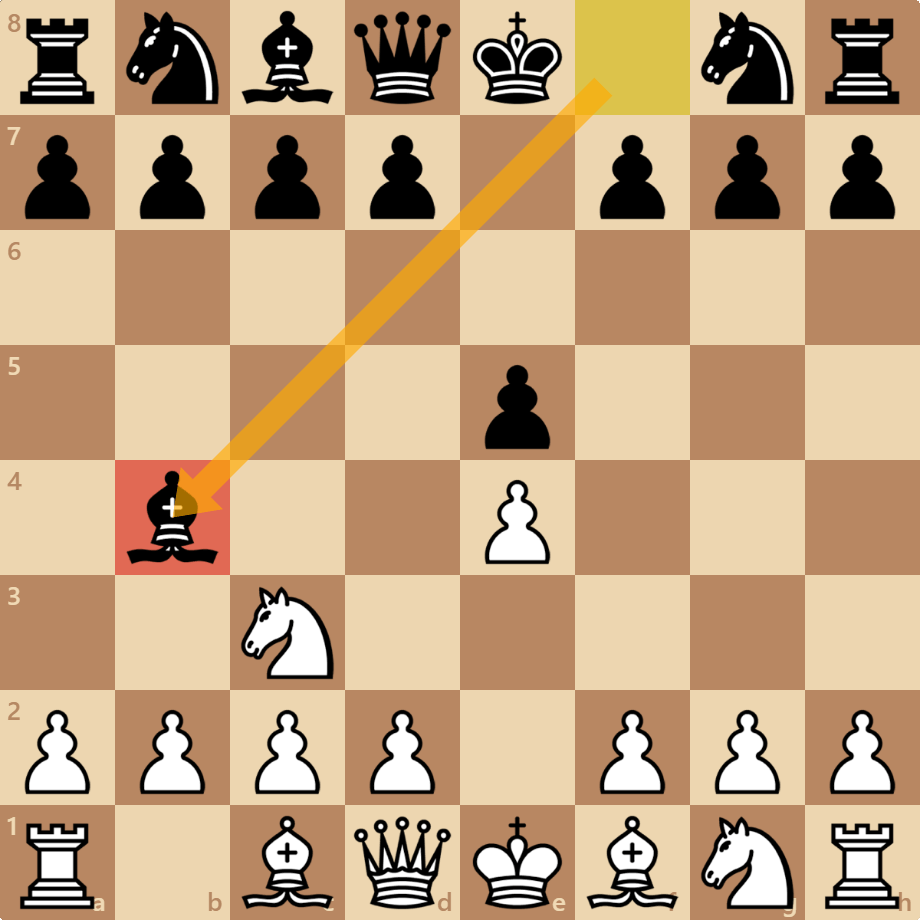
1. e4 e5 2. Nc3 Bb4
Those of you who follow my channel might remember that I discussed the history of this line in Quick Wins #87, including the earliest recorded game by the OG Vienna Game romantic masters (Hamppe — Falkbeer, 1855, Vienna)and the game by namesake Soviet/Latvian IM Valerys Zhuravlev in (Klavins — Zhuravlev, 1969, Riga, Latvia). Check out those games!
Now against the Zhuravlev Countergambit on move 3, White has many good moves.
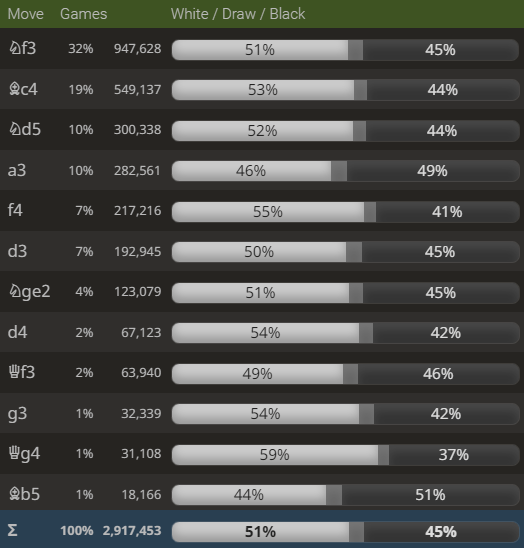
The Lichess community database gives statistics on the top 12 most frequently made moves from the position, which had been reached in almost 3 million games. As can be seen, almost all of them give a win ratio advantage to White, but there is one that appears to be categorically better. The 11th most played move, occurring only 1.1% of the time against the Zhuravlev, is one of my favourite moves in chess: 3. Qg4! Although it isn’t the most accurate according to the engine, it’s certainly not a mistake, and White wins 59% to Black 37%!
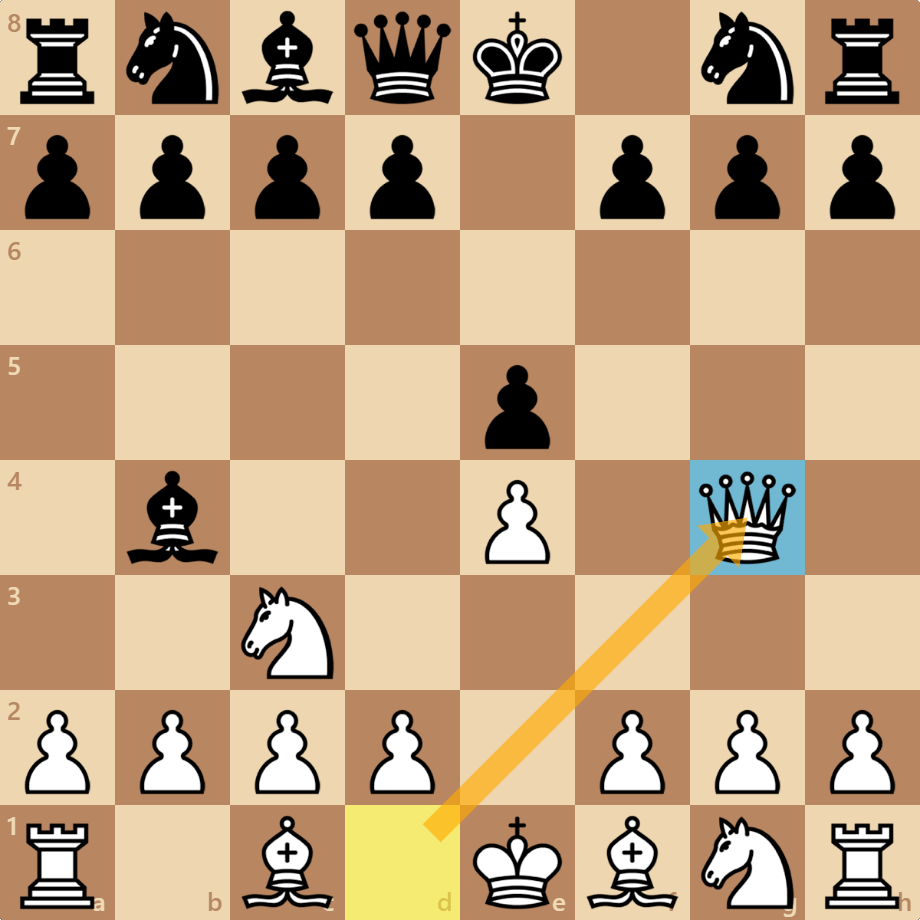
Given the visual similarity to the Giraffe Attack, I call this the Anti-Zhuravlev Giraffe Counterattack. The fascinating thing about this Giraffe-ish attack is its propensity to induce a blunder from Black, even at the intermediate level! The obvious threat from the giraffe queen is the attack on Black’s g7 pawn. In both of my consecutive games, Black responded to this threat with the sensible looking (3… Qf6), developing the queen and defending the g-pawn. This response by Black is the second most played move (26%), which is only slightly less frequent (29%) than Black committing to an exchange (3… Bxc3). However, the move is a blunder, and White wins from the position 80% to Black 18%! Yes, in the position White has over four times the odds of winning compared to Black, and it’s only at the end of turn 3! Wow! 🤩
The reason is that White now has (4. Nd5!), a triple fork of Black’s bishop, queen, and c7-pawn (which comes with an absolute fork of Black’s king and rook). According to the engine, White is better than [+5] in the position. Fundamentally, Black cannot defend both their g-pawn (from White’s queen) and their c-pawn (from White’s knight) with a single move of their queen.
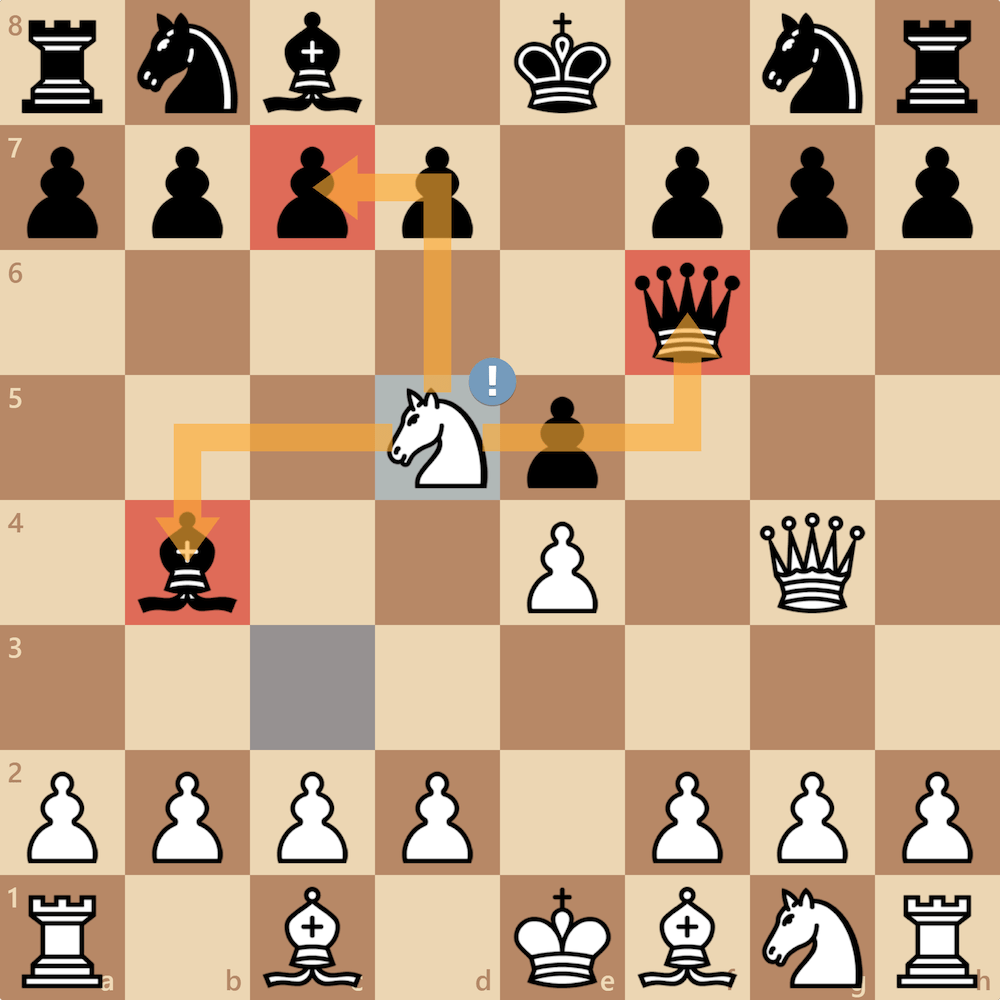
In my game of 10+5 on Lichess, Black thinks for a while, desperados their bishop (4… Bxd2 5. Bxd2), and then immediately resigns having suffered emotional damage. In my 15+10 game on chess.com, Black finds the best move in the terrible position, which was to exchange queens (4… Qg6 5. Qxg6 fxg6). At this point, I had a clean capture of Black’s bishop (6. Nxb4), which is better than Nxc7+ and then Nxa8. Why is the bishop better than pawn and rook?
Well, Black’s b4-bishop was Black’s only active piece, and this was a clean capture that kept my knight active on the board. Capturing, the c7-pawn and then a8-rook yields more material initially, but Black’s rook hasn’t been activated and the knight ends up trapped on the a8 square. Depending on the context, but especially in the early part of the game, activity can often be more important than material!
My general strategic approach for the rest of the game was relatively simple: consolidate, ensure king safety, and trade pieces to enter an endgame with an additional piece. Black played quite well into the early middlegame but finally on turn 17, I was able to force the first trade (of knights). Turn 20, I forced a trade of bishops. With every trade, my numerical piece superiority is increasingly felt! Turn 25, a pair of rooks leave the game!
We each continued to have 6 or 7 pawns each on the board, which made knights especially effective. Knights can leap over lines of pawns, where rooks and bishops can be obstructed. Turn 31, I happily trade a bishop for Black’s knight, and I now have rook and knight vs Black’s rook.
On move 35, I miscalculate and make a blunder. Thinking that I had two attackers on Black’s f6-pawn where Black had only a single defender (their a6-rook), I captured the pawn with (35. Nxf6+). This blunders a winning advantage of over [+6] back to equality [0.00]. Can you see why this move is a blunder? What is Black’s single move that equalises the position?
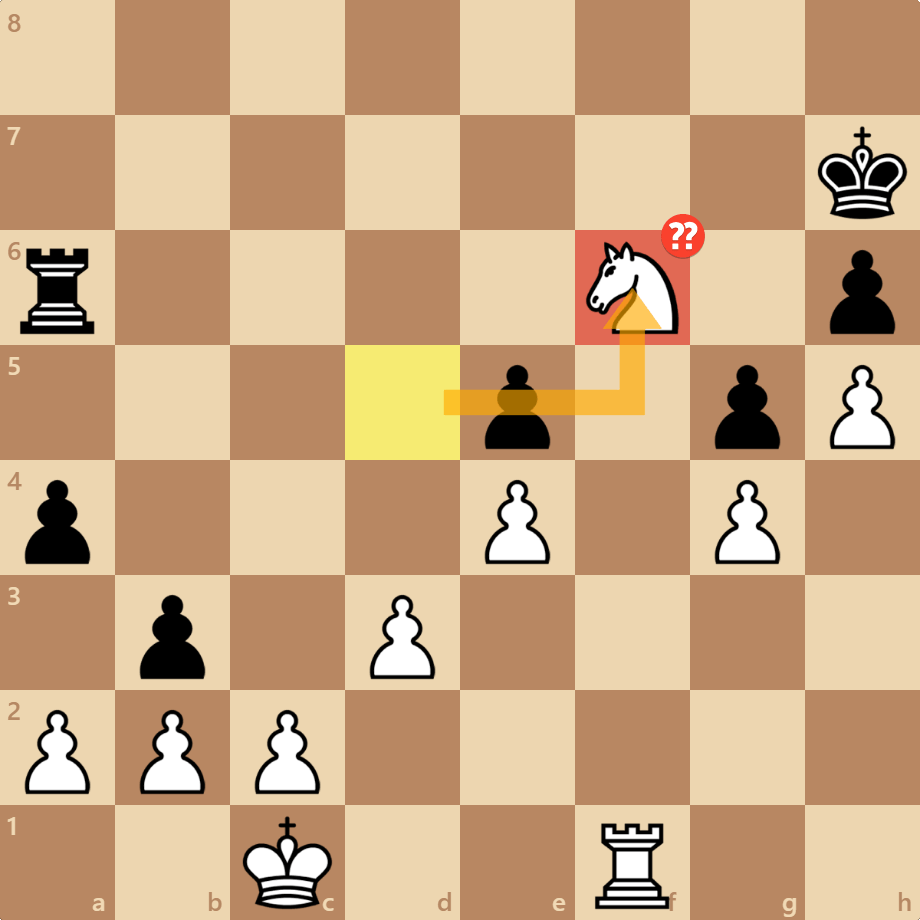
My assumption was that Black could not capture my knight with (35… Rxf6), but this wasn’t correct! The problem was my back rank and Black’s b3-pawn. If I recaptured with (36. Rxf6), the rook leaving the back rank, Black could then follow up with (36… bxa2). The single step of tempo means that Black’s pawn cannot be stopped from promoting to queen. To prevent this, my rook cannot recapture and must stay on the back rank, which mean that Black would cleanly win the knight on f6. Although Black would have to play carefully from the position (rook and pawn endgames are tricky!) the position is nominally equal!
Luckily for me, Black didn’t see this tactic! 😅 I continue to manoeuvre my knight and finally (48. Rxb3) – the capture of Black’s b-pawn transformed my a- and b-pawns into connected passed pawns! It was no longer possible for Black to prevent pawn promotion (without trading away their final piece). They play on for a while, but this was an easy endgame to win. Black resigned on turn 61 as they had no tactical resources left and it was clear that their king was simply waiting to die. Good game, GG!
The big takeaway from this game is that if you are a Vienna Game aficionado, try the (3. Qg4) anti-Zhuravlev Giraffe Counterattack! I think you’d like it! 🤩
Game 1: https://www.chess.com/game/live/118715270879
Game 2: https://www.chess.com/analysis/library/X5cfeo43Q
[Event "Live Chess"]
[Site "https://www.chess.com/game/live/118715270879"]
[Date "2024.08.30"]
[Round "-"]
[White "vitualis"]
[Black "Nicolas5192"]
[Result "1-0"]
[CurrentPosition "5k2/8/7Q/4p1pP/4P3/3P4/1P1KN3/8 b - -"]
[Timezone "UTC"]
[ECO "C25"]
[ECOUrl "https://www.chess.com/openings/Vienna-Game-Zhuravlev-Countergambit-3.Qg4"]
[UTCDate "2024.08.30"]
[UTCTime "00:02:16"]
[WhiteElo "1196"]
[BlackElo "1235"]
[TimeControl "900+10"]
[Termination "vitualis won by resignation"]
[StartTime "00:02:16"]
[EndDate "2024.08.30"]
[EndTime "00:31:04"]
[Link "https://www.chess.com/game/live/118715270879"]
[WhiteUrl "https://images.chesscomfiles.com/uploads/v1/user/3711094.f52a0759.50x50o.ab18600a8723.png"]
[WhiteCountry "17"]
[WhiteTitle ""]
[BlackUrl "https://images.chesscomfiles.com/uploads/v1/user/370126747.744cb6cd.50x50o.42227b507825.jpg"]
[BlackCountry "110"]
[BlackTitle ""]

1. e4 {[%clk 0:15:09.9][%timestamp 1]} 1... e5 {[%clk 0:15:05.4][%timestamp 46]}
2. Nc3 {[%clk 0:15:18.3][%timestamp 16]} 2... Bb4 {[%clk 0:15:05.2][%timestamp
102] Vienna Game: Zhuravlev Countergambit} 3. Qg4 {[%clk 0:15:25.7][%timestamp
26] Anti-Zhuravlev Giraffe Counterattack $1} 3... Qf6 $4 {[%clk
0:15:05.1][%timestamp 101][%c_effect
f6;square;f6;type;Blunder;persistent;true][%c_highlight
f6;keyPressed;none;opacity;0.8;square;f6;persistent;false] A natural move to
defend g7, but blunderous $1 [+5.5]} 4. Nd5 $1 {[%clk 0:15:06.8][%timestamp
289][%c_effect d5;square;d5;type;GreatFind;persistent;true][%c_highlight
d5;keyPressed;alt;opacity;0.8;square;d5;persistent;false,f6;keyPressed;none;opacity;0.8;square;f6;persistent;false,b4;keyPressed;none;opacity;0.8;square;b4;persistent;false,c7;keyPressed;none;opacity;0.8;square;c7;persistent;false][%c_arrow
d5f6;keyPressed;none;from;d5;opacity;0.8;to;f6;persistent;false,d5b4;keyPressed;none;from;d5;opacity;0.8;to;b4;persistent;false,d5c7;keyPressed;none;from;d5;opacity;0.8;to;c7;persistent;false]
Queen's knight to d5 is a powerful tactic for opening attacks, and specifically
in the Vienna Game $1} 4... Qg6 {[%clk 0:13:28.2][%timestamp 1069] Fundamentally,
Black cannot simultaneously defend both the g7- and c7-pawns with a single queen
move. After almost two minutes, Black finds the best move in the position, which
is to invite a trade of queens.} 5. Qxg6 {[%clk 0:15:04.7][%timestamp 121]} 5...
fxg6 {[%clk 0:13:18.2][%timestamp 200]} 6. Nxb4 {[%clk 0:15:12.6][%timestamp 21]
I evaluated (correctly $1) that capturing the bishop is better than Nxc7+ and then
Nxa8. The logic $2 Although I notionally capture more material by going for the
rook, here, I remove Black's only active piece and my knight remains active.
Black's rook has yet to been activated, and after Nxa8, the knight is trapped in
the corner.} 6... c6 {[%clk 0:13:12.9][%timestamp 153]} 7. Nd3 {[%clk
0:15:16][%timestamp 66] Now, the general approach is the consolidate, aim to
trade down pieces to an endgame $1} 7... d6 {[%clk 0:13:18.5][%timestamp 44]} 8.
f4 {[%clk 0:15:16.2][%timestamp 98]} 8... exf4 {[%clk 0:13:19.7][%timestamp 88]}
9. Nxf4 {[%clk 0:15:24.8][%timestamp 14]} 9... Nf6 {[%clk 0:13:20.9][%timestamp
88]} 10. d3 {[%clk 0:15:09.1][%timestamp 257]} 10... O-O {[%clk
0:13:22][%timestamp 89]} 11. Nf3 {[%clk 0:15:16.3][%timestamp 28]} 11... Na6
{[%clk 0:12:59.1][%timestamp 329]} 12. Bd2 {[%clk 0:15:19.4][%timestamp 69]}
12... b5 {[%clk 0:12:37.6][%timestamp 315]} 13. O-O-O {[%clk
0:15:28.1][%timestamp 13]} 13... Nc5 {[%clk 0:12:40.9][%timestamp 67]} 14. Nd4
{[%clk 0:15:27.7][%timestamp 104]} 14... Bd7 {[%clk 0:12:34.4][%timestamp 165]}
15. h3 {[%clk 0:15:00.3][%timestamp 374]} 15... a5 {[%clk 0:12:39.7][%timestamp
47]} 16. g4 {[%clk 0:14:59.8][%timestamp 105]} 16... g5 {[%clk
0:12:24.1][%timestamp 256]} 17. Nh5 {[%clk 0:15:07.2][%timestamp 26] Black has
been playing well, but here, I effective force Black to trade away their knight
- finally $1} 17... Nxh5 {[%clk 0:12:28.3][%timestamp 58]} 18. gxh5 {[%clk
0:15:16][%timestamp 12]} 18... h6 {[%clk 0:12:35][%timestamp 33]} 19. Be2 {[%clk
0:15:12][%timestamp 140]} 19... b4 {[%clk 0:12:08.7][%timestamp 363]} 20. Bg4
{[%clk 0:15:15.4][%timestamp 66] Trade away the bishops, and close the g- and
h-files $1} 20... Bxg4 {[%clk 0:11:39.2][%timestamp 395]} 21. hxg4 {[%clk
0:15:23.5][%timestamp 19]} 21... Rac8 {[%clk 0:11:41.3][%timestamp 79]} 22. Nf5
{[%clk 0:15:15.8][%timestamp 177] Infiltrate with the knight and mop up
material $1} 22... Rcd8 {[%clk 0:11:20.7][%timestamp 306]} 23. Ne7+ {[%clk
0:15:09.8][%timestamp 160][%c_arrow
e7g8;keyPressed;none;from;e7;opacity;0.8;to;g8;persistent;false,e7c6;keyPressed;none;from;e7;opacity;0.8;to;c6;persistent;false][%c_highlight
g8;keyPressed;none;opacity;0.8;square;g8;persistent;false,c6;keyPressed;none;opacity;0.8;square;c6;persistent;false]}
23... Kh7 {[%clk 0:11:15.1][%timestamp 156]} 24. Nxc6 {[%clk
0:15:13.5][%timestamp 63]} 24... Ra8 {[%clk 0:11:20.7][%timestamp 44]} 25. Rhf1
{[%clk 0:13:49.3][%timestamp 942] Offer a trade of rooks $1} 25... Rf6 {[%clk
0:11:07.8][%timestamp 229]} 26. Rxf6 {[%clk 0:13:38][%timestamp 213]} 26... gxf6
{[%clk 0:11:14.6][%timestamp 32]} 27. Rf1 {[%clk 0:13:46.7][%timestamp 13]}
27... Nd7 {[%clk 0:11:18.5][%timestamp 61]} 28. Be3 {[%clk 0:13:37.5][%timestamp
192]} 28... Kg7 {[%clk 0:11:22.4][%timestamp 61]} 29. Bd4 {[%clk
0:13:46.1][%timestamp 14]} 29... Ra6 {[%clk 0:11:11.4][%timestamp 210]} 30. Ne7
{[%clk 0:13:52][%timestamp 41]} 30... Ne5 {[%clk 0:10:46.9][%timestamp 345]} 31.
Bxe5 {[%clk 0:13:14.8][%timestamp 472] Trade yet another minor piece $1} 31...
dxe5 {[%clk 0:10:50.7][%timestamp 62]} 32. Nf5+ {[%clk 0:13:19.8][%timestamp
50]} 32... Kh7 {[%clk 0:10:55.4][%timestamp 53]} 33. Ne7 {[%clk
0:13:03.1][%timestamp 267]} 33... a4 {[%clk 0:10:46.4][%timestamp 190]} 34. Nd5
{[%clk 0:13:10.1][%timestamp 30]} 34... b3 {[%clk 0:10:35][%timestamp 214]} 35.
Nxf6+ $4 {[%clk 0:13:09.4][%timestamp 107][%c_effect
f6;square;f6;type;Blunder;persistent;true][%c_highlight
f6;keyPressed;none;opacity;0.8;square;f6;persistent;false] I miscalculated here
and this blunders from [+6 to 0.00] $1} 35... Kg7 $4 {[%clk 0:10:28.9][%timestamp
161][%c_effect g7;square;g7;type;Blunder;persistent;true][%c_highlight
g7;keyPressed;none;opacity;0.8;square;g7;persistent;false,f6;keyPressed;none;opacity;0.8;square;f6;persistent;false][%c_arrow
a6f6;keyPressed;none;from;a6;opacity;0.8;to;f6;persistent;false] Luckily for me,
Black didn't see the single correct line $1} (35... Rxf6 36. Rxf6 $4 {[%c_effect
f6;square;f6;type;Blunder;persistent;true][%c_highlight
f6;keyPressed;none;opacity;0.8;square;f6;persistent;false] Capturing will be
losing $1} (36. Rg1 {[%c_arrow
b3a2;keyPressed;none;from;b3;opacity;0.8;to;a2;persistent;false,a2a1;keyPressed;none;from;a2;opacity;0.8;to;a1;persistent;false,c1d2;keyPressed;none;from;c1;opacity;0.8;to;d2;persistent;false]
Effectively, the knight has been lost without compensation and the game is now a
draw $1}) 36... bxa2 {[%c_arrow
a2a1;keyPressed;none;from;a2;opacity;0.8;to;a1;persistent;false][%c_highlight
a1;keyPressed;none;opacity;0.8;square;a1;persistent;false,a2;keyPressed;alt;opacity;0.8;square;a2;persistent;false]
And Black will promote $1}) 36. Ne8+ {[%clk 0:13:00.6][%timestamp 188]} 36... Kg8
{[%clk 0:10:25.6][%timestamp 133]} 37. cxb3 {[%clk 0:12:58.3][%timestamp 123]}
37... axb3 {[%clk 0:10:28.4][%timestamp 72]} 38. a3 {[%clk 0:13:03.7][%timestamp
46]} 38... Rc6+ {[%clk 0:10:27.2][%timestamp 112]} 39. Kb1 {[%clk
0:13:07.3][%timestamp 64]} 39... Re6 {[%clk 0:10:14.2][%timestamp 230]} 40. Nf6+
{[%clk 0:12:49.5][%timestamp 278] The knight is powerful in a congested space $1
The idea is to now use my piece superiority to block Black from being able to
infiltrate with their rook, and then activate the king into the attack $1} 40...
Kg7 {[%clk 0:10:14.7][%timestamp 95]} 41. Nd5 {[%clk 0:12:55.4][%timestamp 41]}
41... Rd6 {[%clk 0:09:51.9][%timestamp 328]} 42. Kc1 {[%clk
0:12:57.6][%timestamp 78]} 42... Rc6+ {[%clk 0:09:56.9][%timestamp 50]} 43. Nc3
{[%clk 0:13:05.5][%timestamp 21]} 43... Rd6 {[%clk 0:09:55][%timestamp 119]} 44.
Kd2 {[%clk 0:13:12.7][%timestamp 28] King now part of the attack $1} 44... Rc6
{[%clk 0:09:38.2][%timestamp 268]} 45. Rc1 {[%clk 0:13:18.1][%timestamp 46]}
45... Rf6 {[%clk 0:09:42.4][%timestamp 58]} 46. Ne2 {[%clk 0:13:16][%timestamp
121]} 46... Rf2 {[%clk 0:09:46.6][%timestamp 58]} 47. Rc3 {[%clk
0:12:39.6][%timestamp 464]} 47... Rg2 {[%clk 0:09:51.6][%timestamp 50]} 48. Rxb3
{[%clk 0:12:48][%timestamp 16][%c_highlight
a3;keyPressed;none;opacity;0.8;square;a3;persistent;false,b2;keyPressed;none;opacity;0.8;square;b2;persistent;false]
And the a- and b-pawns have become connected passed pawns, and a forced line of
checkmate is possible in no more than [M20] $1} 48... Rxg4 {[%clk
0:09:57.9][%timestamp 37]} 49. a4 {[%clk 0:12:32.9][%timestamp 251]} 49... Rh4
{[%clk 0:09:51.4][%timestamp 165]} 50. a5 {[%clk 0:12:40][%timestamp 29]} 50...
Rh3 {[%clk 0:08:28][%timestamp 934]} 51. a6 {[%clk 0:12:38][%timestamp 120]}
51... Rf3 {[%clk 0:08:34.4][%timestamp 36]} 52. a7 {[%clk 0:12:30.6][%timestamp
174]} 52... Rf2 {[%clk 0:08:37][%timestamp 74]} 53. a8=Q {[%clk
0:12:29.5][%timestamp 111]} 53... Rf3 {[%clk 0:08:40.7][%timestamp 63]} 54. Rb7+
{[%clk 0:12:31.4][%timestamp 81]} 54... Rf7 {[%clk 0:08:39.4][%timestamp 113]}
55. Rxf7+ {[%clk 0:12:34.7][%timestamp 67]} 55... Kxf7 {[%clk
0:08:46.8][%timestamp 26]} 56. Qb7+ {[%clk 0:12:37.5][%timestamp 72] Creep the
queen towards the king $1} 56... Kf6 {[%clk 0:08:45.5][%timestamp 113]} 57. Qc6+
{[%clk 0:12:45.6][%timestamp 19]} 57... Kg7 {[%clk 0:08:51.7][%timestamp 38]}
58. Qd7+ {[%clk 0:12:54.4][%timestamp 12]} 58... Kf6 {[%clk
0:08:54.2][%timestamp 75]} 59. Qf5+ {[%clk 0:13:01.4][%timestamp 30]} 59... Kg7
{[%clk 0:08:59][%timestamp 52]} 60. Qg6+ {[%clk 0:13:06.9][%timestamp 45]} 60...
Kf8 {[%clk 0:09:04.4][%timestamp 46]} 61. Qxh6+ {[%clk 0:13:13.1][%timestamp
38][%c_effect d2;square;d2;type;Winner,f8;square;f8;type;ResignBlack] Black can
see that checkmate will come easily to White and resigns. GG $1} 1-0


[Event "Rated rapid game"]
[Site "https://lichess.org/y1xKi7xO"]
[Date "2024.08.30"]
[Round "?"]
[White "vitualis"]
[Black "gablu_007"]
[Result "1-0"]
[UTCDate "2024.08.30"]
[UTCTime "00:41:11"]
[WhiteElo "1449"]
[BlackElo "1433"]
[WhiteRatingDiff "+8"]
[BlackRatingDiff "-5"]
[TimeControl "600+5"]
[ECO "C25"]
[Opening "Vienna Game"]
[Termination "Normal"]
[Annotator "lichess.org"]
[WhiteUrl "https://images.chesscomfiles.com/uploads/v1/user/3711094.f52a0759.50x50o.ab18600a8723@3x.png"]
[WhiteCountry "17"]
[WhiteTitle ""]
[BlackUrl ""]
[BlackCountry "225"]
[BlackTitle ""]

1. e4 {[%clk 0:10:00]} 1... e5 {[%clk 0:10:00]} 2. Nc3 {[%clk 0:10:02]} 2... Bb4
{[%clk 0:10:03] Vienna Game: Zhuravlev Countergambit} 3. Qg4 {[%clk 0:10:05] The
anti-Zhuravlev \"Giraffe\" counterattack $1 This is the most winning move
according to the Lichess community database.} 3... Qf6 $4 {[%clk
0:09:51][%c_effect
f6;square;f6;type;Blunder;path;null;size;100%25;animated;false;persistent;true]
The second most common (26\%) response by Black is pretty much a game-ending
blunder on turn 3 $1} 4. Nd5 $1 {[%clk 0:10:09][%c_effect
d5;square;d5;type;GreatFind;path;null;size;100%25;animated;false;persistent;true][%c_arrow
d5f6;keyPressed;none;from;d5;opacity;0.8;to;f6;persistent;false,d5c7;keyPressed;none;from;d5;opacity;0.8;to;c7;persistent;false,d5b4;keyPressed;none;from;d5;opacity;0.8;to;b4;persistent;false][%c_highlight
f6;keyPressed;none;opacity;0.8;square;f6;persistent;false,c7;keyPressed;none;opacity;0.8;square;c7;persistent;false,b4;keyPressed;none;opacity;0.8;square;b4;persistent;false]
Triple fork $1} 4... Bxd2+ {[%clk 0:07:38] Black plays a desperado...} 5. Bxd2
{[%clk 0:10:05][%c_effect e1;square;e1;type;Winner] ... but resigns afterwards
anyway from the emotional damage. Good game, GG $1} 1-0
 Adventures of a Chess Noob