The Art of Sacrifice in CHESS! 😌


I’ve recently been reading The Art of Sacrifice in Chess by Rudolf Spielmann (1883-1942). He was an Austrian from Vienna, and one of the last Romantic chess masters, playing this glorious style long after the zeitgeist had moved to the Classical/Modern style. In this book, Spielmann developed a taxonomy of the different types of sacrifices in chess, with illuminating examples, largely from his games. Spielmann included only a short introduction to his book, but within these two pages is philosophic gold! Spielmann captures the spirit of why chess has value as a human endeavour through the lens of Romanticism:

The beauty of a game of chess is usually appraised, and with good reason, according to the sacrifices it contains. Sacrifice — a hallowed, heroic concept! Advancing in a chivalrous mood, the individual immolates himself for a noble idea.

Such sacrifice evokes our homage and admiration even where the idea as such does not meet with our full approval. In chess, which we like to view as a counterpart of life, a sacrifice arouses similar feelings in us. On principle we incline to rate a sacrificial game more highly than a positional game. Instinctively we place the moral value about the scientific. We honor Capablanca, but our hearts beat higher when Morphy’s name is mentioned. The magic of the sacrifice grips us and we care nothing for the accompanying circumstances — whether Morphy’s opponents were weaker than Capablanca’s, how Morphy would fare today, how Capablanca would have played in those far-off days. The glowing power of the sacrifice is irresistible: enthusiasm for sacrifice lies in man’s nature.

— Rudolph Spielmann (1935), in The Art of Sacrifice in Chess

I’ve described my new book, Become a Chess Assassin! as a celebration of chess Romanticism as I believe that this is something that could be, should be, promoted more prominently to chess beginners as one of a number of styles to playing chess!

This was an unrated game of rapid (10 min) where I played with the Romantic spirit, ever ready to make a sacrifice! I’ll use Spielmann’s terminology in the description of the analysis!

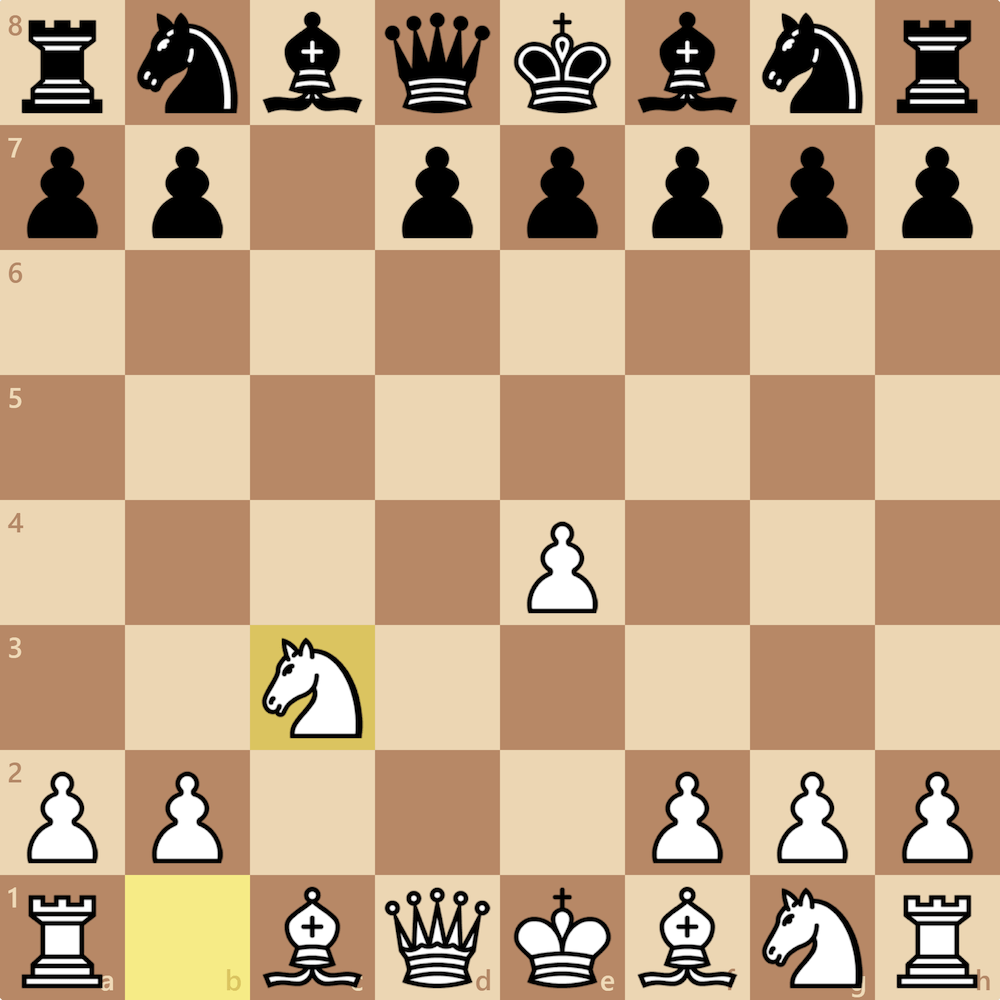
I had the White pieces, Black played the Sicilian Defense, and of course, I counter with the Smith-Morra Gambit, which was Accepted (1. e4 c5 2. d4 cxd4 3. c3 dxc3). Let’s go!

Sham (temporary) vs Real Sacrifices

Spielmann differentiated between sham (temporary) sacrifices:

…which involve no risk. After a series of forced moves, the player either recovers the invested material with advantage, or else even mates his opponent. The consequences of the sacrifice were foreseen from the first. Properly speaking, there is no sacrifice, only an advantageous business deal.

And there are what Spielmann categorised as real sacrifices, which are characterised by risk. That is, there is a probabilistic element to the sacrifice, an uncertainty, a gamble! With real sacrifices, one weighs up not only the potential benefits and the costs, but must also consider one own risk appetite, which requires an appraisal and reflection of the game strategy, and the overarching purpose of the game itself! Said Spielmann:

Real sacrifices, in contradistinction to sham sacrifices, are not combinations in the ordinary sense, but rather combinations with a time factor.

The likelihood of success is not necessarily based on positional judgement alone; it may be dependent on various extraneous circumstances. It is possible, for example, to allow for an opponent’s individual failings: to play psychologically. Or one can speculate on his time-difficulties, taking a sporting chance. Considering in this light, many combinations can be termed correct in a broader sense even though they may not be able to stand the test of subsequent analysis. We must distinguish between practical and theoretical soundness.

Real Sacrifice | Sacrifice for Development

Many opening gambits, the Smith-Morra Gambit included, fall under the category of sacrifice for development, which Spielmann described as the “simplest of the real sacrifices”. We see Spielmann’s insight regarding sacrifices and the distinction between practical and theoretical soundness in action with this opening. Although it can be argued that the Smith-Morra Gambit is theoretically unsound (from the Sicilian Defense to Gambit Accepted position) [+0.3 → -0.1], it is practically excellent with the win likelihood changing from balanced (White 48% vs Black 48%) to favouring White (White 52% vs Black 44%) in the Lichess community database.

Sacrifice for development, Smith-Morra Gambit Accepted. At turn 4, White has lost a pawn but has received compensation in the form of better development.

Real Sacrifice | Obstructive Sacrifice

On turn 12, I sacrifice a second pawn in the game with (12. e5!?). Stockfish labels this move an inaccuracy, but I had a clear strategic agenda. You see, after (12… dxe5), Black have doubled e-pawns which blocks Black’s light square bishop and queen from having vision into the kingside of the board. In essence, the kingside is relatively closed to Black’s pieces, which restricts not only their ability to attack my king which had castled short, but for those pieces to contribute to the defence of their own king.

Spielmann called this type of real sacrifice an obstructive sacrifice and noted that it was similar to the sacrifice for development.

After (14. Bd3), the purpose of the previous e-pawn sacrifice (12. e5!? dxe5) is made clear! Black’s pieces, especially their light square bishop and queen are blocked by their own pawns, while White has planned a Greek Gift Sacrifice attack!

Real Sacrifice | Deflecting or Decoy Sacrifice

On turn 18, I play my final “real” sacrifice which was (18. h4!?), which Spielmann would categorise as a deflecting or decoy sacrifice. By hanging my h-pawn, it drew Black’s dark square bishop back onto the h-file to capture (18… Bxh4??), a blunder [-4.0 → 0.00]! The purpose was to give me a step of tempo to play (19. Qh3). My goal was to line up both my light square bishop and queen to have vision on Black’s h7-pawn! In the position, Black must give up their bishop.

(18. h4!?) was a deflecting/decoy sacrifice to bait Black to play the very natural looking (18… Bxh4??). After (19. Qh3), Black cannot save or defend their h4-bishop without risk of checkmate, or massive material loss.

However, Black had probably assumed that their dark square bishop could operate as an in-and-out assassin. When threatened, it zipped back to its previous square (19… Be7??) not recognising that they had hung checkmate-in-two moves!

Sham (Temporary) Sacrifice | Mating Sacrifice

The final sacrifice in the game (20. Nf6+!!) is rated a brilliancy by the Chess.com analytic engine. In Spielmann’s taxonomy, this is a mating sacrifice which is a “sham” type, as it the move is part of a forced checkmate line.  The knight move opens the light square diagonal for my d3-bishop and as it comes with check, Black must respond to the check rather than defend the h7 square.

Brilliant move (20. Nf6+!!), a “mating sacrifice”. Black must respond to the check and none of the legal moves available allow Black to prevent (21. Qxh7#).

* * *

Good game, GG!

The big takeaway from this game is to include sacrifices in your calculations about positions and tactics. Learn to manage and consider risk and develop an appreciation between theoretical and practical soundness when analysing your games!
Game: https://www.chess.com/analysis/library/4YCSY1na1k

[Event "Live Chess"]
[Site "Chess.com"]
[Date "2024.10.31"]
[Round "?"]
[White "vitualis"]
[Black "Random Noob"]
[Result "1-0"]
[TimeControl "600"]
[WhiteElo ""]
[BlackElo ""]
[Termination "vitualis won by checkmate"]
[Link "https://www.chess.com/analysis/game/pgn/2xdFCXc5S6?tab=analysis&move=26"]
[BlackUrl ""]
[BlackCountry "225"]
[BlackTitle ""]
[WhiteUrl "https://images.chesscomfiles.com/uploads/v1/user/3711094.f52a0759.50x50o.ab18600a8723@2x.png"]
[WhiteCountry "17"]
[WhiteTitle ""]

1. e4 {[%clk 0:09:59.4][%timestamp 6]} 1... c5 {[%clk 0:09:59.6][%timestamp 4]}
2. d4 {[%clk 0:09:57.8][%timestamp 16]} 2... cxd4 {[%clk 0:09:58][%timestamp
16]} 3. c3 {[%clk 0:09:57.4][%timestamp 4]} 3... dxc3 {[%clk
0:09:56.1][%timestamp 19] Sicilian Defense: Smith-Morra Gambit Accepted. Let's
go $1} 4. Nxc3 {[%clk 0:09:57.1][%timestamp 3]} 4... Nc6 {[%clk
0:09:54.3][%timestamp 18]} 5. Bc4 {[%clk 0:09:56.7][%timestamp 4]} 5... a6
{[%clk 0:09:53.4][%timestamp 9]} 6. Nf3 {[%clk 0:09:52.8][%timestamp 39]} 6...
e6 {[%clk 0:09:52.6][%timestamp 8]} 7. O-O {[%clk 0:09:48.9][%timestamp 39]}
7... Nf6 {[%clk 0:09:51.7][%timestamp 9]} 8. Bg5 $6 {[%clk 0:09:46.7][%timestamp
22][%c_effect
g5;square;g5;type;Inaccuracy;path;null;size;100%25;animated;false;persistent;true][%c_arrow
e4e5;keyPressed;none;from;e4;opacity;0.8;to;e5;persistent;false,d1e2;keyPressed;none;from;d1;opacity;0.8;to;e2;persistent;false][%c_highlight
e5;keyPressed;none;opacity;0.8;square;e5;persistent;false,e2;keyPressed;none;opacity;0.8;square;e2;persistent;false]}
8... Be7 {[%clk 0:09:50.1][%timestamp 16]} 9. Qe2 {[%clk 0:09:33.6][%timestamp
131]} 9... d6 {[%clk 0:09:47.5][%timestamp 26]} 10. Rad1 {[%clk
0:09:32][%timestamp 16]} 10... Qc7 {[%clk 0:09:46.1][%timestamp 14]} 11. Rfe1
{[%clk 0:08:49][%timestamp 430]} 11... O-O {[%clk 0:09:41.8][%timestamp 43]} 12.
e5 $5 {[%clk 0:08:47.8][%timestamp 12][%c_effect
e5;square;e5;type;Interesting;path;null;size;100%2525;animated;false;persistent;true]
Pawn sacrifice to open the light square diagonal for my light bishop (after
Bd3), and closing the dark square diagonal  to Black's queen (after dxe5).}
12... dxe5 {[%clk 0:09:40.4][%timestamp 14]} 13. Bxf6 {[%clk
0:08:31.7][%timestamp 161]} 13... Bxf6 {[%clk 0:09:37.4][%timestamp 30]} 14. Bd3
{[%clk 0:08:29.9][%timestamp 18][%c_arrow
c8e6;keyPressed;ctrl;from;c8;opacity;0.8;to;e6;persistent;false,c7e5;keyPressed;ctrl;from;c7;opacity;0.8;to;e5;persistent;false,d3h7;keyPressed;shift;from;d3;opacity;0.8;to;h7;persistent;false,e2h5;keyPressed;shift;from;e2;opacity;0.8;to;h5;persistent;false,h5h7;keyPressed;shift;from;h5;opacity;0.8;to;h7;persistent;false,f3g5;keyPressed;shift;from;f3;opacity;0.8;to;g5;persistent;false,g5h7;keyPressed;shift;from;g5;opacity;0.8;to;h7;persistent;false][%c_highlight
g5;keyPressed;alt;opacity;0.8;square;g5;persistent;false,h5;keyPressed;alt;opacity;0.8;square;h5;persistent;false,h7;keyPressed;alt;opacity;0.8;square;h7;persistent;false]
Potential Greek Gift Sacrifice attack $1} 14... Nd4 {[%clk 0:09:15.5][%timestamp
219]} 15. Qe3 {[%clk 0:08:07.8][%timestamp 221]} 15... Nxf3+ {[%clk
0:09:13.6][%timestamp 19]} 16. Qxf3 {[%clk 0:08:05.7][%timestamp 21]} 16...
Bd7 $6 {[%clk 0:09:04.9][%timestamp 87][%c_effect
d7;square;d7;type;Inaccuracy;path;null;size;100%25;animated;false;persistent;true][%c_highlight
h7;keyPressed;none;opacity;0.8;square;h7;persistent;false,g7;keyPressed;none;opacity;0.8;square;g7;persistent;false,f7;keyPressed;none;opacity;0.8;square;f7;persistent;false,e6;keyPressed;none;opacity;0.8;square;e6;persistent;false,e5;keyPressed;none;opacity;0.8;square;e5;persistent;false,h6;keyPressed;none;opacity;0.8;square;h6;persistent;false][%c_arrow
h7h6;keyPressed;none;from;h7;opacity;0.8;to;h6;persistent;false] Note: this
structure $1 Black has potentially locked out their own pieces from the defence
of their king on the kingside $1} 17. Ne4 $6 {[%clk 0:07:52.2][%timestamp
135][%c_effect
e4;square;e4;type;Inaccuracy;path;null;size;100%25;animated;false;persistent;true][%c_arrow
d3h7;keyPressed;none;from;d3;opacity;0.8;to;h7;persistent;false,e4f6;keyPressed;none;from;e4;opacity;0.8;to;f6;persistent;false][%c_highlight
h7;keyPressed;none;opacity;0.8;square;h7;persistent;false,f6;keyPressed;none;opacity;0.8;square;f6;persistent;false]
Stockfish thinks that Bxh7+ immediately is the best move to punch a hole in
Black's defences. I saw this as a tempo winning move as if Black doesn't move
their f6-bishop, the Nxf6 gxf6 and Black exposes their king.} 17... Be7 {[%clk
0:08:59.2][%timestamp 57]} 18. h4 $5 {[%clk 0:07:17.2][%timestamp 350][%c_effect
h4;square;h4;type;Interesting;path;null;size;100%2525;animated;false;persistent;true][%c_highlight
h4;keyPressed;alt;opacity;0.8;square;h4;persistent;false] It's a trap $1 The
h-pawn is hanging but it's poisoned $1 Black has moved their dark square bishop
out of the way, and this draws it back $1} 18... Bxh4 $4 {[%clk
0:08:48.2][%timestamp 110][%c_effect
h4;square;h4;type;Blunder;path;null;size;100%2525;animated;false;persistent;true][%c_highlight
h4;keyPressed;none;opacity;0.8;square;h4;persistent;false,f5;keyPressed;none;opacity;0.8;square;f5;persistent;false,h6;keyPressed;none;opacity;0.8;square;h6;persistent;false,c6;keyPressed;none;opacity;0.8;square;c6;persistent;false][%c_arrow
f7f5;keyPressed;none;from;f7;opacity;0.8;to;f5;persistent;false,h7h6;keyPressed;none;from;h7;opacity;0.8;to;h6;persistent;false,d7c6;keyPressed;none;from;d7;opacity;0.8;to;c6;persistent;false]
Taking advantage of Black's material greed $1} 19. Qh3 {[%clk
0:07:05.2][%timestamp 120][%c_arrow
h3h7;keyPressed;none;from;h3;opacity;0.8;to;h7;persistent;false,d3h7;keyPressed;none;from;d3;opacity;0.8;to;h7;persistent;false][%c_highlight
h7;keyPressed;none;opacity;0.8;square;h7;persistent;false]} 19... Be7 $4 {[%clk
0:08:39.8][%timestamp 84][%c_effect
e7;square;e7;type;Blunder;path;null;size;100%25;animated;false;persistent;true][%c_highlight
e7;keyPressed;none;opacity;0.8;square;e7;persistent;false,f5;keyPressed;none;opacity;0.8;square;f5;persistent;false][%c_arrow
f7f5;keyPressed;none;from;f7;opacity;0.8;to;f5;persistent;false] Black doesn't
see the trap and hangs [+M2]} 20. Nf6+ $3 {[%clk 0:06:34.1][%timestamp
311][%c_effect
f6;square;f6;type;Brilliant;path;null;size;100%25;animated;false;persistent;true][%c_highlight
f6;keyPressed;alt;opacity;0.8;square;f6;persistent;false,g8;keyPressed;none;opacity;0.8;square;g8;persistent;false,h7;keyPressed;none;opacity;0.8;square;h7;persistent;false][%c_arrow
f6g8;keyPressed;none;from;f6;opacity;0.8;to;g8;persistent;false,h3h7;keyPressed;none;from;h3;opacity;0.8;to;h7;persistent;false,d3h7;keyPressed;none;from;d3;opacity;0.8;to;h7;persistent;false]
Knight sacrifice with check $1} 20... Bxf6 {[%clk 0:08:20.6][%timestamp
192][%c_highlight
e5;keyPressed;none;opacity;0.8;square;e5;persistent;false,e6;keyPressed;none;opacity;0.8;square;e6;persistent;false,f6;keyPressed;none;opacity;0.8;square;f6;persistent;false,f7;keyPressed;none;opacity;0.8;square;f7;persistent;false,g7;keyPressed;none;opacity;0.8;square;g7;persistent;false,h7;keyPressed;none;opacity;0.8;square;h7;persistent;false,f8;keyPressed;none;opacity;0.8;square;f8;persistent;false]
Black's defensive \"wall\" traps their king $1} 21. Qxh7# {[%clk
0:06:32.4][%timestamp 17][%c_effect
g1;square;g1;type;Winner,g8;square;g8;type;CheckmateBlack][%c_arrow
h7g8;keyPressed;none;from;h7;opacity;0.8;to;g8;persistent;false,h7h8;keyPressed;none;from;h7;opacity;0.8;to;h8;persistent;false,d3h7;keyPressed;none;from;d3;opacity;0.8;to;h7;persistent;false][%c_highlight
g8;keyPressed;none;opacity;0.8;square;g8;persistent;false,h8;keyPressed;none;opacity;0.8;square;h8;persistent;false,h7;keyPressed;none;opacity;0.8;square;h7;persistent;false]
Good game, GG $1} 1-0

Leave a comment