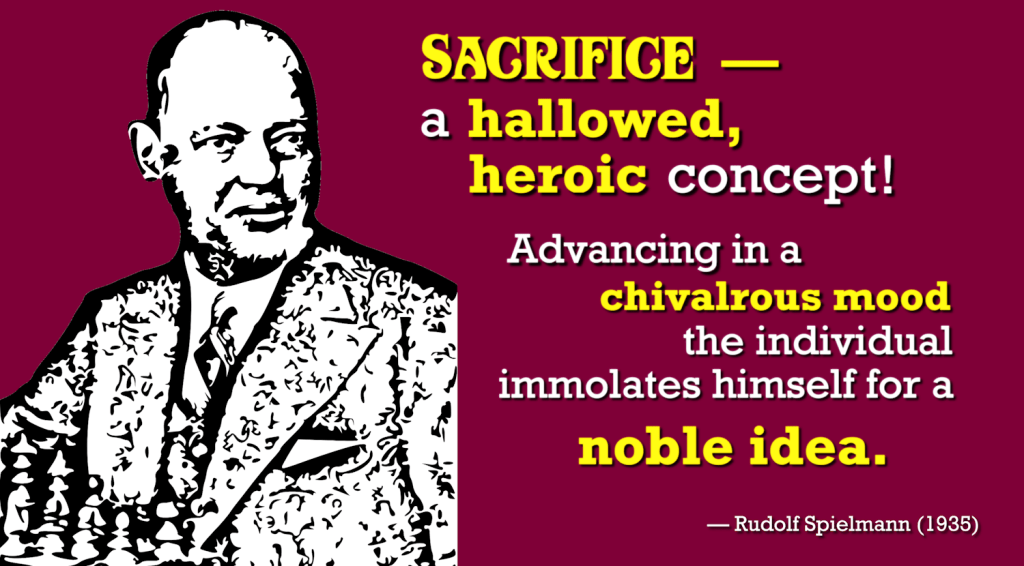
I love the Romantic style of chess, and one of the signature tactics of the style are piece sacrifices. And there is no sacrifice more daring, more audacious, than what Spielmann categorised as “real sacrifices” of a full queen!
A real sacrifice involves a genuine loss of material and involves true risk. One gains “dynamic advantages”, but stated Spielmann, the last of the great Romantic masters:
“Their secrets reveal themselves only to the gifted and courageous player, who has strong if controlled self-confidence. The timid player will take to real sacrifices only with difficulty, principally because the risk involved makes him uneasy.” (p.5)
Moreover:
“The likelihood of success is not necessarily based on positional judgement alone; it may be dependent on various extraneous circumstances. It is possible, for example, to allow for an opponent’s individual failings: to play psychologically… Considered in this light, many combinations can be termed correct in a broader sense even though they may not be able to stand the test of subsequent analysis. We must distinguish between practical and theoretical soundness.” (p.40-41)
So, what insights can we glean from Spielmann’s words in the modern day, ninety years after they were published? A few concrete ideas:
- Engine analysis gives us almost instant access to theoretical soundness, but not practical soundness. Engines can sometimes recommend objectively accurate lines that are nonetheless ineffective due to their difficulty to play. Engines also never recommend risky but very effective traps and tactics that are effective against other human players. In essence, the uncritical acceptance of engine recommendations blinds us to the full range of possibilities in chess.
- In practice, especially in casual recreational chess and in shorter time controls, playing psychologically, considering the psychological flow in a game against another human can substantially increase the likelihood of success. In some contexts, the empathy to predict how our opponent will respond, and the imagination and creativity to manipulate this on the board, may be more important than what is objectively the most accurate move.
Those of you who follow my channel will know that I love playing the Englund Gambit with the black pieces against White’s Queen’s Pawn Opening (1. d4 e5). I’ve seen many comments from players of all strengths who derisively label the Englund Gambit as “hope chess” given that there is a clear refutation line, that isn’t difficult to learn. However, from the perspective of Romanticism, it is interesting to reframe that “hope” is one of the principal human values. It represents optimism against adversity, meaningfulness as opposed to nihilism, joy rather than despair. Hope was the gift that remained in Pandora’s box after the evils were released!
In this recent game, I played the Englund Gambit and White clearly knew the refutation line after we entered the Englund Complex (1. d4 e5 2. dxe5 Nc6 3. Nf3 Qe7 4. Bf4 Qb4+). I cover the refutation to the Englund Complex line in my new book, “Become a Chess Assassin!” but to summarise, White needs to find the following three consecutive moves, each of which are rated as “excellent” by the Chess.com analytic engine:
- 5. Bd2! Qxb2
- 6. Nc3! Bb4
- 7. Rb1!
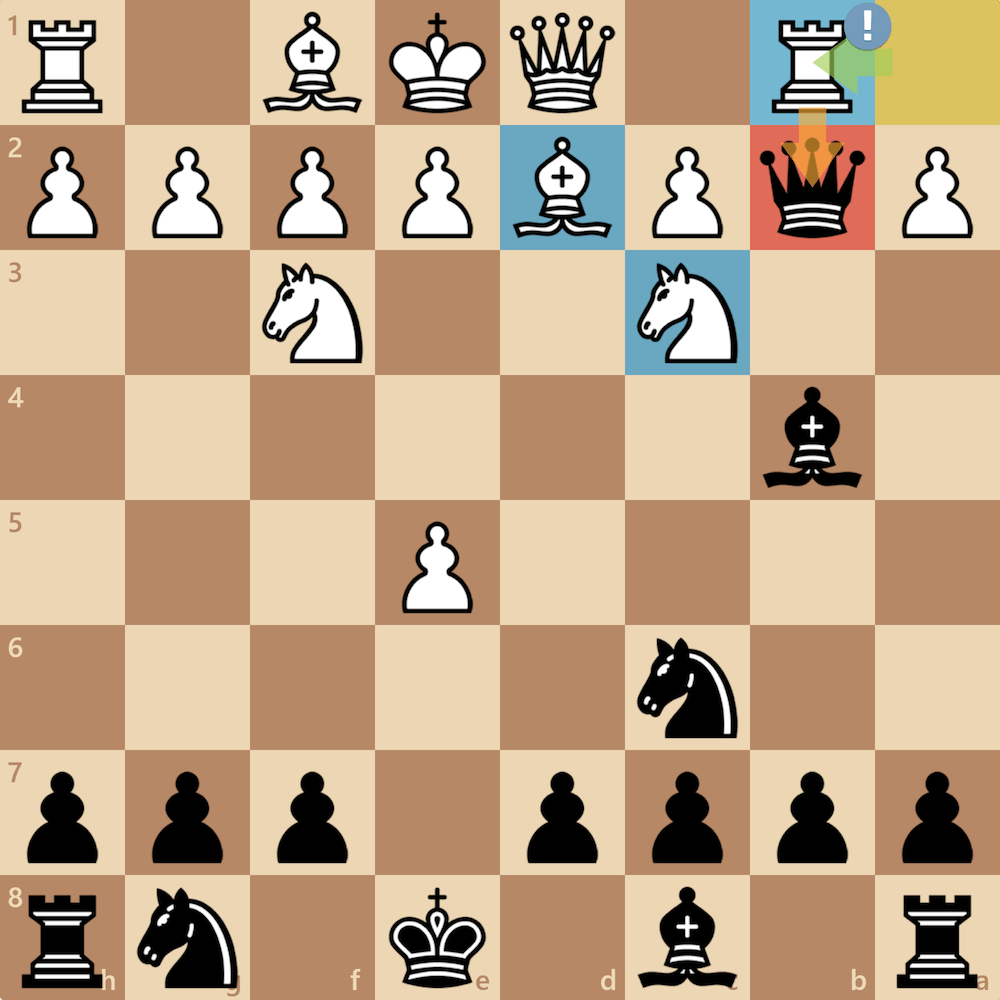
Here, Black has only a single move available to keep their queen (7… Qa3), but White has captured the initiative with a powerful counterattack. White has (8. Nd5), threatening Black’s b4-bishop, and the c7-pawn which would come with an absolute fork of Black’s king and a8-rook. Seemingly, Black has no choice but being forced into a miserable retreat in a losing position, with limited opportunities unless White blunders.
Did I just prove that the Englund Gambit is losing? 🤔
Let us re-evaluate the Englund Gambit and Englund Complex up to turn 7 from a more psychological perspective. Firstly (1… e5) is clearly an inaccuracy, it isn’t “theoretically sound”, but it has a forcing nature. White only captures the theoretical advantage by Accepting the gambit, and in doing so, is likely disallowed access to their planned (1. d4) opening structure (e.g., the Queen’s Gambit, or the London System). Black uses the sacrificed pawn to gain the initiative and launch a rapid attack with their queen with (4… Qb4+) being an absolute triple check! For inexperienced players with White against the Englund Complex, a mistake in the next few moves can be catastrophic: either massive loss of material or even checkmate!
However, if White plays down the Refutation Line, (7. Rb1!) becomes a turning point. As noted previously, the objectively accurate move (7… Qa3) is a path to slow, withering defeat. I recommend, and highlight as a variant in my book, the Romantic path where we hold onto the initiative, and we do so, by sacrificing our queen (7… Qxc3!?). 😚🤌😻
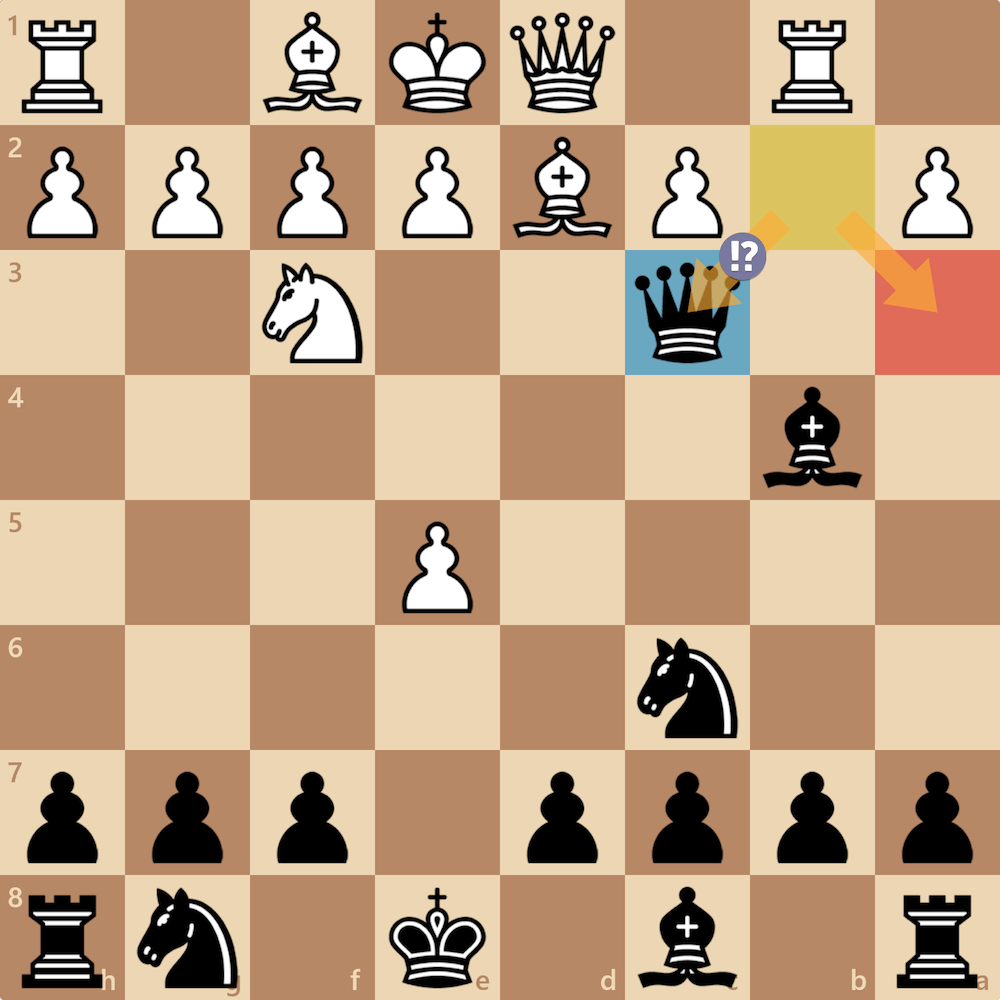
Although the engine disapproves of the “Queen Sacrifice Line” or the “Hambleton Variation” of the Englund Complex, it is surprisingly playable, effective even, and has been used by GM Hambleton, IM Rosen, and a few others in blitz tournaments! The Killer Black Queen of the Englund Complex plays one final definitive strike! If White knows and plays the Refutation Line, then they most likely have experienced and are anticipating an easy mop up with (7… Qa3). The queen sacrifice is like a psychological bomb that shockingly takes away this plan.
The follow up moves are obvious: White captures our queen, and we capture back with check (8. Bxc3 Bxc3+). White must block check with a backwards knight move (9. Nd2) and Black has one of two options. White’s e5-pawn can be captured with either our c3-bishop or the c6-knight. The engine thinks that Bxd5 is slightly better. However, I recommend Nxd5, which is slightly more winning on the Lichess community database. It is also more consistent, from the perspective of psychology: our c3-bishop maintains a pin of White’s d2-knight on their king, which binds up White’s position.
The potential advantages that Black has in the position is that White, who were expecting to have captured the initiative, has no development. White has a damaged queenside, having lost their queen’s bishop and knight, and their d- and b-pawns, leaving isolated a- and c-pawns. Black has more development, an undamaged pawn structure, and numerical superiority of pieces (6 vs 5). Black still has attacking chances and targets: for instance, the pinned d2-knight that is defended only by White’s queen and king, not to mention that White’s king is presently still “smothered”.
White’s awkward position means that their most accurate move, not difficult to find, is to develop their rook with an attack (10. Rb3). Though accurate, it is easy to make a mistake. A common cognitive bias is loss-aversion when ahead; not willing to give up the won material. White’s correct approach was to be willing to trade their rook for one of my minor pieces to simplify, but their avoiding this (13. Re4?) and (14. Ra4??) allowed me to chase their rook, winning tempo and more development! In fact, after (14. Ra4??) the engine gave the advantage to Black at around [-1.5]!
I played (14… Neg4) ostensibly moving my knight out of an attack by White’s f4-pawn, but I’d actually planned to attack White’s f2 square with a mating attack. In the rather unusual position, White missed the checkmate threat, attempted to kick my knight with the feckless (15. h3??) and blundered a delicious checkmate from White’s king being relatively smothered with (15… Bf2#).
Good game, GG!
* * *
The big takeaway from this game is to try the Romantic style in chess! Engine analysis is a fantastic and useful tool, but there is a lot more to chess than accuracy and trying to emulate the computer. And to the Englund Gambit critics, knowing the Refutation Line is very important, but that doesn’t make you invulnerable, especially against the Black Queen Sacrifice! 🤩
Learn more about the Englund Gambit/Complex, its refutation, and variants, including the anti-refutation Hambleton Variation in “Become a Chess Assassin! Learn to play the best chess opening attacks.”
Note: earlier today, electronic chess board reviewer Rolan, of the “All Things Awesome” YouTube channel published a review of the book! Check it out and subscribe to his channel! 🤩👍

[Event "Live Chess"]
[Site "Chess.com"]
[Date "2025.01.27"]
[Round "?"]
[White "Random Noob"]
[Black "vitualis"]
[Result "0-1"]
[TimeControl "600"]
[Termination "vitualis won by checkmate"]
[BlackUrl "https://images.chesscomfiles.com/uploads/v1/user/3711094.f52a0759.50x50o.ab18600a8723.png"]
[BlackCountry "17"]
[BlackTitle ""]
[WhiteUrl ""]
[WhiteCountry "225"]
[WhiteTitle ""]
[Link "https://www.chess.com/analysis/library/ynJaYuwz6?tab=analysis"]

1. d4 {[%clk 0:09:59.3][%timestamp 7]} 1... e5 {[%clk 0:09:58.9][%timestamp 11]
Englund Gambit  $1} 2. dxe5 {[%clk 0:09:51.9][%timestamp 74] Accepted  $1 Let's go
 $1} 2... Nc6 {[%clk 0:09:56.6][%timestamp 23]} 3. Nf3 {[%clk
0:09:49.3][%timestamp 26]} 3... Qe7 {[%clk 0:09:54.7][%timestamp 19]} 4. Bf4
{[%clk 0:09:45.7][%timestamp 36]} 4... Qb4+ {[%clk 0:09:53][%timestamp 17]
Entering the Englund Complex lines  $1} 5. Bd2 $1 {[%clk 0:09:41][%timestamp
47][%c_effect d2;square;d2;type;GreatFind;persistent;true][%c_highlight
d2;keyPressed;alt;opacity;0.8;square;d2;persistent;false] And White knows the
three critical moves of the Refutation line - well done  $1} 5... Qxb2 {[%clk
0:09:50.6][%timestamp 24]} 6. Nc3 $1 {[%clk 0:09:36.9][%timestamp 41][%c_effect
c3;square;c3;type;GreatFind;persistent;true][%c_highlight
c3;keyPressed;alt;opacity;0.8;square;c3;persistent;false]} 6... Bb4 {[%clk
0:09:48.6][%timestamp 20]} 7. Rb1 $1 {[%clk 0:09:31.8][%timestamp 51][%c_effect
b1;square;b1;type;GreatFind;persistent;true][%c_highlight
b1;keyPressed;alt;opacity;0.8;square;b1;persistent;false] White is nominally
\"refuted\" the Englund Complex and avoided the trap lines. Black's best move is
Qa3 and then a withering series of retreating moves as White gains captures the
initiative. Or do they  $2} 7... Qxc3 $5 {[%clk 0:09:47.8][%timestamp 8][%c_arrow
b2a3;keyPressed;none;from;b2;opacity;0.8;to;a3;persistent;false,b2c3;keyPressed;ctrl;from;b2;opacity;0.8;to;c3;persistent;false][%c_highlight
a3;keyPressed;shift;opacity;0.8;square;a3;persistent;false,c3;keyPressed;alt;opacity;0.8;square;c3;persistent;false][%c_effect
c3;square;c3;type;Interesting;persistent;true] I advocate for the Queen
Sacrifice line against the Refutation, also known as the Hambleton Variation  $1}
8. Bxc3 {[%clk 0:09:30.4][%timestamp 14]} 8... Bxc3+ {[%clk
0:09:47.3][%timestamp 5][%c_arrow
c3e1;keyPressed;none;from;c3;opacity;0.8;to;e1;persistent;false][%c_highlight
e1;keyPressed;none;opacity;0.8;square;e1;persistent;false]} 9. Nd2 {[%clk
0:09:26.7][%timestamp 37]} 9... Nxe5 {[%clk 0:09:46.5][%timestamp 8][%c_arrow
c3e5;keyPressed;none;from;c3;opacity;0.8;to;e5;persistent;false][%c_highlight
e5;keyPressed;shift;opacity;0.8;square;e5;persistent;false] Bxe5 and Nxe5 are
options. The engine slightly prefers Bxe5 but Nxe5 has a better win advantage
for Black as it keeps White bound up. Black's goal is to try to press the
advantage with their better development, numerical piece advantage (6 vs 5), and
undamaged pawn structure. There is a potential attack on the d2-knight as it is
only defended by the queen and king.} 10. Rb3 {[%clk 0:09:21.9][%timestamp 48]}
10... Ba5 {[%clk 0:09:37.4][%timestamp 91]} 11. Re3 {[%clk 0:08:57.1][%timestamp
248]} 11... d6 {[%clk 0:09:28.9][%timestamp 85]} 12. f4 {[%clk
0:08:32.5][%timestamp 246]} 12... Bb6 {[%clk 0:09:10.3][%timestamp 186]} 13.
Re4 $2 {[%clk 0:08:24.4][%timestamp 81][%c_effect
e4;square;e4;type;Mistake;size;100%25;animated;false;persistent;true]} 13...
Nf6 $5 {[%clk 0:09:00.7][%timestamp 96][%c_effect
f6;square;f6;type;Interesting;size;100%2525;animated;false;persistent;true][%c_arrow
f7f5;keyPressed;none;from;f7;opacity;0.8;to;f5;persistent;false][%c_highlight
f5;keyPressed;none;opacity;0.8;square;f5;persistent;false] This is a mistake and
f5 is the better execution of the idea to counterattack White's rook. This
variation is not good as fxe5 Nxe4 Nxe4 and Black basically loses a piece.
However, I'm actually angling for Ng4 and an attack on the f2 square  $1} 14.
Ra4 $4 {[%clk 0:08:12.6][%timestamp 118][%c_effect
a4;square;a4;type;Blunder;persistent;true][%c_highlight
a4;keyPressed;none;opacity;0.8;square;a4;persistent;false,e5;keyPressed;none;opacity;0.8;square;e5;persistent;false][%c_arrow
f4e5;keyPressed;none;from;f4;opacity;0.8;to;e5;persistent;false] A blunder  $1
White's loss aversion blinded them to the correct calculation.} 14... Neg4
{[%clk 0:08:50.5][%timestamp 102]} 15. h3 $4 {[%clk 0:08:03.6][%timestamp
90][%c_effect h3;square;h3;type;Blunder;persistent;true][%c_highlight
h3;keyPressed;none;opacity;0.8;square;h3;persistent;false] White didn't see the
threat and blunders mate  $1} 15... Bf2# {[%clk 0:08:49][%timestamp 15][%c_effect
e8;square;e8;type;Winner;animated;true,e1;square;e1;type;CheckmateWhite;animated;true][%c_arrow
g4f2;keyPressed;none;from;g4;opacity;0.8;to;f2;persistent;false,f2e1;keyPressed;none;from;f2;opacity;0.8;to;e1;persistent;false][%c_highlight
f2;keyPressed;none;opacity;0.8;square;f2;persistent;false,e1;keyPressed;none;opacity;0.8;square;e1;persistent;false]
Good game, GG  $1} 0-1
 Adventures of a Chess Noob