
One of my goals starting last year and continuing into 2025 is to better learn the many and varied lines in the Traxler Counterattack. It was first promoted and described by Karel Traxler (1866-1936), a Catholic priest and chess puzzle composer from the Kingdom of Bohemia, now Czechia. The Traxler Counterattack is, in my opinion, the most beautiful response by Black to White’s Knight Attack and attempt at the Fried Liver Attack. It is a Romantic line that deserves to be played for the sake of aesthetics and fun, even though it isn’t the most accurate. If you think that “winning with style” is a higher goal than just winning, then the Traxler is for you! 🤩👍
The Traxler Counterattack (1. e4 e5 2. Nf3 Nc6 3. Bc4 Nf6 4. Ng5 Bc5) can be a bit complicated as there are quite a range of moves that White can respond with. As such, it can take some time to gain confidence and familiarity. Recently, I played two games of the Traxler Counterattack where White responded in the same way. Within this line, there is a rather neat checkmate tactic that is worth knowing. I managed to spring it on my opponent in both games. Let’s go take a look!
* * *
The Traxler Line Variant of Interest
In these games, the variant in the Traxler begins where White captures the sacrificial bishop (5. Nxf7 Bxf2+ 6. Kxf2), and correctly parks their king on the g1 square against check (6… Nxe4+ 7. Kg1).
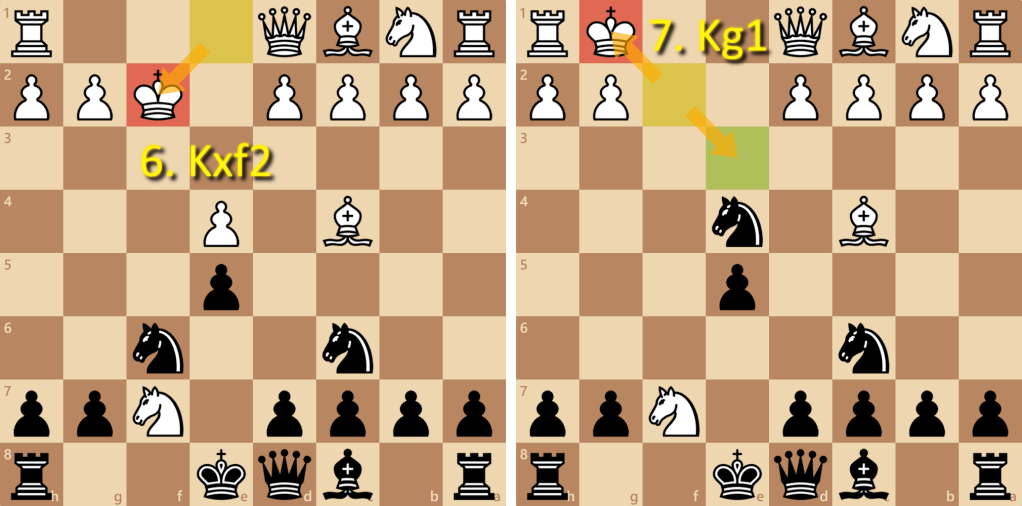
Black’s next move is obvious (7… Qh4!), a wayward queen that is immediately threatening checkmate with Qf2! In this position, White has two options that keep the equality, (8. g3) and (8. h3), and only (8. g3) intuitively looks viable. In the Lichess community database, (8. h3) was almost never played – in only about 1 in 500 games from the position.
In the position, White’s most common response is to defend the f2 square with their queen, and to counterattack down the f-file with their queen. That is, with (8. Qf3) or (8. Qf1). Together, these two moves make up 52% of responses from the position, are mistakes, but do give White some tactical chances, so it is well worth the Traxler player to explore!
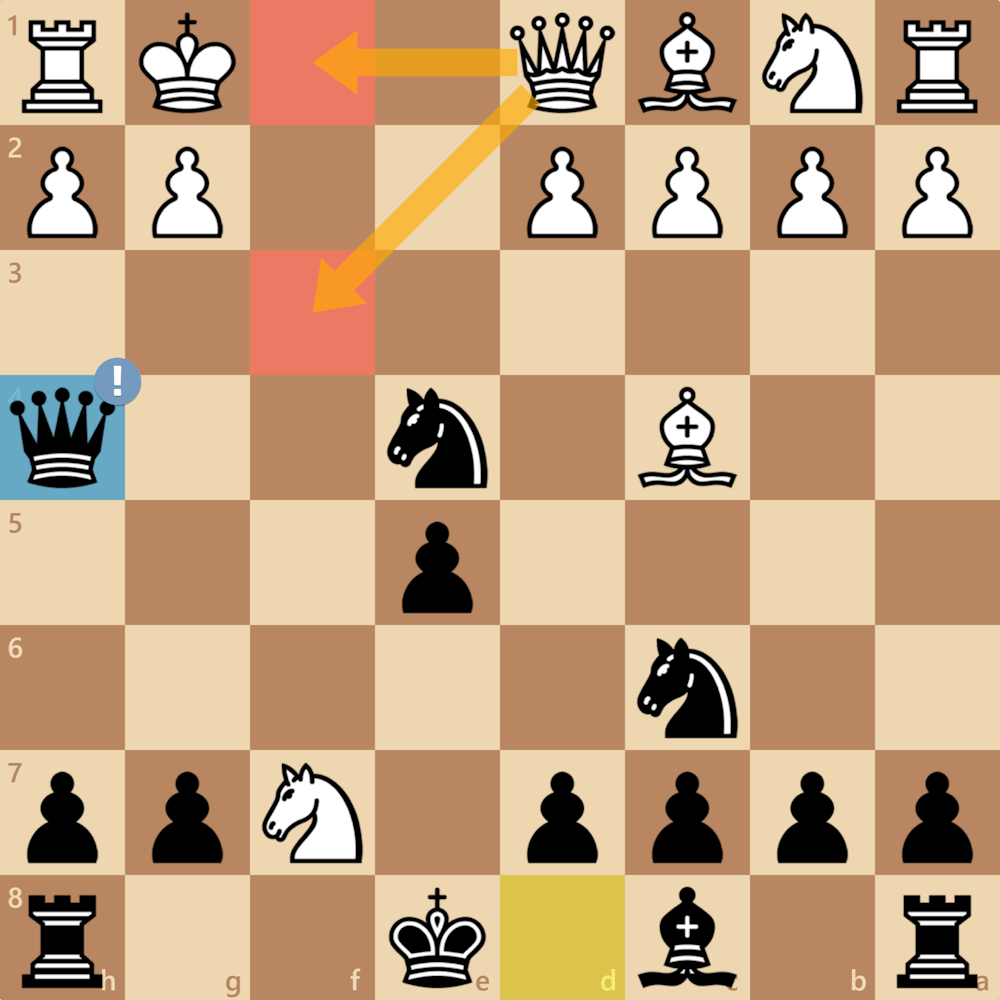
Game 1: 8. Qf1?
https://www.chess.com/analysis/game/pgn/2cFHTJAj2W?tab=analysis
Chronologically, I played this game first where White responded with (8. Qf1?). During this game, I couldn’t quite remember the best way to play the position, despite knowing that Qf1 was a mistake. It’s worth noting then that the most forcing immediate tactic is (8… Rf8!). On reflection, it makes a lot of sense as (i) the rook is no longer hanging and a target on h8, (ii) it pins White’s f7-knight to the queen on the f-file, and (iii) effectively counterattacks and controls the f-file.
In the game, I played (8… d5?), which is a mistake/blunder in the position, even though the move is a strong tactic in many Traxler positions. My logic in the game was that I often don’t mind losing the corner rook as it deactivates White’s knight, and in fact, White can often blunder a checkmate line by the loss of tempo with Nxh8!
The idea behind d5 is that it disconnects White’s bishop and knight, and it forces White to respond, winning tempo. It also opens the light square diagonal for my bishop, unleashing yet another attacker onto White’s kingside. Indeed, we see this playing down the line I predicted: (9. Bxd5) is White’s best move but notice that the bishop no longer defends the f1-queen. Committed in my (inaccurate) tactical approach I developed my bishop (9… Bg4?) which Stockfish again doesn’t like, preferring Rf8 again. However, with the g8-rook looking like a tempting morsel, White finally captures (10. Rxh8?), and as expected, it’s a serious mistake!
That loss of a single move allowed now for my (10… Nd4) and suddenly, I have four pieces attacking White’s king! Although White is up 8 points of material and objectively ahead, Black is pragmatically winning with a win likelihood of White 27% vs Black 69%. In the position, White must find their single good move, (11. Nc3!) which is hard to see! In effect, White needed to hold the tension by defending the critical e2 square: if White allowed Ne2+, it looked like White would be forced to trade away their queen for minor pieces!
Instead, White played the natural looking (11. Qf7+??) which was a blunder. Although it’s technically [0.00], this is only from the perspective that White’s best option is to force a draw by three-fold repetition. Against the scary looking check, I saw in the game that after (11… Kd8), White was out of attacks!
My Nigerian opponent spent almost two-and-a-half minutes considering their next move. Everything visibly looks bad or looks to obviously lead to repetition. Finally, they played (12. Bxe4??) capturing a “hanging” knight, but this blunders [-M2], and is a checkmate pattern on the back rank worth remembering down this line! First, we have (12… Qe1+!) and White’s queen is forced to block the check with their body (13. Qf1). But now, with their queen pinned, the knight gives the coup de grâce with the semi-smothered mate, (13… Ne2#)! Beautiful! 😚🤌

Game 2: 8. Qf3?!
https://www.chess.com/analysis/game/pgn/3caFKemRve?tab=analysis
In this second game, an unrated match of rapid very soon after game 1, my opponent played (8. Qf3?!). I’d already analysed the first game by this point and knew that Rf8 was probably the correct move. However, with White’s queen on the juicy f3 square, I decided to play (8… Nd4) first. Even though it wasn’t the most accurate move, it’s rarely a mistake to chase the opponent’s queen with development in the opening!
And in a sense, this tactical heuristic bore out! White decided to play an undercalculated tactic starting with (9. Nd6+??), a blunder. I think that they probably thought that they had a mating attack, but all this achieved was to lose their knight. After (9… cxd6 10. Qf7+), I sidestepped my king, just like in game 1 with (10… Kd8), and White is out of attacks!
Moreover, notice that the attack structure on White’s back rank has been put into place with the knights and the queen! What I needed to do was to try to remove White’s c4-bishop as the defender of that critical e2 square. So, I attacked the bishop with (11… b5) and tragically for White, they attempted to counterattack with (12. d3??), which closed White’s bishop’s defence of the e2 square.
And so, we have the same checkmate pattern in the back rank: (12… Qe1+!) check; White must block the check with their queen, pinning it to the king (13. Qf1); and the knight delivers the killing blow with a semi-smothered checkmate (13… Ne2#!). Good game, GG!
* * *
The big takeaway is that the Traxler Counterattack is an enormously fun and tactical opening to learn, with many beautiful attacking lines to explore! If you want to win with style against White’s Knight Attack in the Italian Game and to turn the tables on a Fried Liver Attack player, it’s one of the best choices you can make!
Learn more about the Traxler Counterattack, its refutation, and variants in “Become a Chess Assassin! Learn to play the best chess opening attacks.”
Note: earlier in the week, my mate @benhunt72 of the “Chess Boot Camp” club and YouTube channel published a review of the book! Check it out and subscribe to his channel! 🤩👍

[Event "Live Chess"]
[Site "Chess.com"]
[Date "2025.02.10"]
[Round "?"]
[White "Thrivewithtimi"]
[Black "vitualis"]
[Result "0-1"]
[TimeControl "900+10"]
[WhiteElo "1244"]
[BlackElo "1302"]
[Termination "vitualis won by checkmate"]
[ECO "C57"]
[EndTime "0:55:25 GMT+0000"]
[Link "https://www.chess.com/analysis/game/pgn/2cFHTJAj2W?tab=analysis"]
[WhiteUrl "https://images.chesscomfiles.com/uploads/v1/user/354586991.59a2d3f6.100x100o.b3720169bebd@3x.jpg"]
[WhiteCountry "204"]
[WhiteTitle ""]
[BlackUrl "https://images.chesscomfiles.com/uploads/v1/user/3711094.f52a0759.100x100o.671ef4f371ed@3x.png"]
[BlackCountry "17"]
[BlackTitle ""]

1. e4 {[%clk 0:15:08.8][%timestamp 12]} 1... e5 {[%clk 0:15:08.8][%timestamp
12]} 2. Nf3 {[%clk 0:15:15.7][%timestamp 31]} 2... Nc6 {[%clk
0:15:17.9][%timestamp 9]} 3. Bc4 {[%clk 0:15:20.2][%timestamp 55] Italian Game}
3... Nf6 {[%clk 0:15:26.5][%timestamp 14] Two Knights Defense} 4. Ng5 {[%clk
0:15:21.6][%timestamp 86][%c_arrow
g5f7;keyPressed;none;from;g5;opacity;0.8;to;f7;persistent;false,c4f7;keyPressed;none;from;c4;opacity;0.8;to;f7;persistent;false][%c_highlight
f7;keyPressed;none;opacity;0.8;square;f7;persistent;false] Knight Attack - White
is signalling their intention to attempt the Fried Liver Attack with the knight
and bishop pressuring the weak f7-pawn} 4... Bc5 {[%clk 0:15:33.5][%timestamp
30] The Traxler Counterattack $1 It practically looks like an error as Black
ignores the f7-pawn $1} 5. Nxf7 {[%clk 0:14:57.9][%timestamp 337][%c_arrow
c4f7;keyPressed;none;from;c4;opacity;0.8;to;f7;persistent;false,f7h8;keyPressed;none;from;f7;opacity;0.8;to;h8;persistent;false,f7d8;keyPressed;none;from;f7;opacity;0.8;to;d8;persistent;false][%c_highlight
f7;keyPressed;none;opacity;0.8;square;f7;persistent;false,h8;keyPressed;none;opacity;0.8;square;h8;persistent;false,d8;keyPressed;none;opacity;0.8;square;d8;persistent;false]
White makes good on their threat} 5... Bxf2+ {[%clk 0:15:38.9][%timestamp
46][%c_highlight
e1;keyPressed;none;opacity;0.8;square;e1;persistent;false][%c_arrow
f2e1;keyPressed;none;from;f2;opacity;0.8;to;e1;persistent;false,c5f2;keyPressed;alt;from;c5;opacity;0.8;to;f2;persistent;false]
And we now hit with the bishop sacrifice $1 Objectively, the evaluation is equal
according to the engine, but Black is much more likely to win $1} 6. Kxf2 {[%clk
0:13:09.4][%timestamp 1185]} 6... Nxe4+ {[%clk 0:15:46.9][%timestamp
20][%c_arrow
e4f2;keyPressed;none;from;e4;opacity;0.8;to;f2;persistent;false][%c_highlight
f2;keyPressed;none;opacity;0.8;square;f2;persistent;false] This is part of the
tactical logic - Black wins tempo, advances their knight forward to attack
White's king, and opens the diagonal for the queen $1} 7. Kg1 {[%clk
0:12:53.3][%timestamp 261][%c_arrow
f2e3;keyPressed;none;from;f2;opacity;0.8;to;e3;persistent;false,f2g1;keyPressed;none;from;f2;opacity;0.8;to;g1;persistent;false][%c_highlight
e3;keyPressed;shift;opacity;0.8;square;e3;persistent;false,g1;keyPressed;shift;opacity;0.8;square;g1;persistent;false]
In the position, White's king has only two moves which maintain equality. There
is the aggressive looking Ke3, and the conservative Kg1.} 7... Qh4 $1 {[%clk
0:15:09.3][%timestamp 476][%c_highlight
h4;keyPressed;alt;opacity;0.8;square;h4;persistent;false,f2;keyPressed;none;opacity;0.8;square;f2;persistent;false][%c_arrow
h4f2;keyPressed;none;from;h4;opacity;0.8;to;f2;persistent;false][%c_effect
h4;square;h4;type;GreatFind;persistent;true] The queen enters the fray, and
threatens checkmate $1} 8. Qf1 $2 {[%clk 0:12:29.5][%timestamp 338][%c_arrow
g2g3;keyPressed;none;from;g2;opacity;0.8;to;g3;persistent;false][%c_highlight
g3;keyPressed;none;opacity;0.8;square;g3;persistent;false][%c_effect
f1;square;f1;type;Mistake;persistent;true] The best move is g3, but} 8... d5 $2
{[%clk 0:15:04.7][%timestamp 146][%c_effect
d5;square;d5;type;Mistake;persistent;true][%c_arrow
h8f8;keyPressed;none;from;h8;opacity;0.8;to;f8;persistent;false][%c_highlight
f8;keyPressed;none;opacity;0.8;square;f8;persistent;false] This pawn sacrifice
is a mistake. My idea was to open the light square diagonal for my c8-bishop.
However, if White plays accurately, I'm not quite fast enough. Nonetheless, it
worked it this game and the idea is very Romantic $1 The correct move is Rf8
semi-pinning White's f7-knight to White's queen and challenging the control of
the open f-file.} 9. Bxd5 {[%clk 0:11:48.7][%timestamp 508]} 9... Bg4 $2 {[%clk
0:14:34.4][%timestamp 403][%c_effect
g4;square;g4;type;Mistake;persistent;true][%c_arrow
h8f8;keyPressed;none;from;h8;opacity;0.8;to;f8;persistent;false][%c_highlight
f8;keyPressed;none;opacity;0.8;square;f8;persistent;false] I'd already committed
to the plan $1} 10. Nxh8 $2 {[%clk 0:11:15.1][%timestamp 436][%c_effect
h8;square;h8;type;Mistake;persistent;true][%c_arrow
d5c6;keyPressed;none;from;d5;opacity;0.8;to;c6;persistent;false][%c_highlight
c6;keyPressed;none;opacity;0.8;square;c6;persistent;false] White is technically
comfortably ahead, but White's best move was to exchange their bishop with
Bxc6+ $1 This is not obvious. As is often the case, White's capture of the h8-rook
is often a mistake $1} 10... Nd4 {[%clk 0:14:43][%timestamp 14] And now we see
why $1 By chasing material, suddenly, White has four pieces attacking their king.
Although White is up 8 points of material with an evaluation of around +4, they
have only a single good move in the position $1} 11. Qf7+ $4 {[%clk
0:10:56.5][%timestamp 286][%c_effect
f7;square;f7;type;Blunder;persistent;true][%c_highlight
f7;keyPressed;none;opacity;0.8;square;f7;persistent;false,c3;keyPressed;none;opacity;0.8;square;c3;persistent;false][%c_arrow
b1c3;keyPressed;none;from;b1;opacity;0.8;to;c3;persistent;false] And this wasn't
it $1 This very natural move returns the winning position to equality. In fact,
the best sequence of moves now for White is to force a draw by threefold
repetition $1 The correct move was to hold the tension and to defend the critical
e2 square with Nc3.} 11... Kd8 {[%clk 0:14:42.8][%timestamp 102]} 12. Bxe4 $4
{[%clk 0:08:43.1][%timestamp 1434][%c_effect
e4;square;e4;type;Blunder;persistent;true][%c_highlight
e4;keyPressed;none;opacity;0.8;square;e4;persistent;false] However, White
doesn't see the mating attack on their back rank and blunders checkmate-in-two $1}
12... Qe1+ $1 {[%clk 0:14:47.9][%timestamp 49][%c_effect
e1;square;e1;type;GreatFind;persistent;true][%c_highlight
e1;keyPressed;alt;opacity;0.8;square;e1;persistent;false,g1;keyPressed;none;opacity;0.8;square;g1;persistent;false,f1;keyPressed;none;opacity;0.8;square;f1;persistent;false,f2;keyPressed;none;opacity;0.8;square;f2;persistent;false][%c_arrow
e1g1;keyPressed;none;from;e1;opacity;0.8;to;g1;persistent;false,e1f2;keyPressed;none;from;e1;opacity;0.8;to;f2;persistent;false]}
13. Qf1 {[%clk 0:08:10.3][%timestamp 428][%c_arrow
e1f1;keyPressed;none;from;e1;opacity;0.8;to;f1;persistent;false,f1g1;keyPressed;none;from;f1;opacity;0.8;to;g1;persistent;false,e1f2;keyPressed;none;from;e1;opacity;0.8;to;f2;persistent;false][%c_highlight
f1;keyPressed;none;opacity;0.8;square;f1;persistent;false,f2;keyPressed;none;opacity;0.8;square;f2;persistent;false]
This is a forced move. But with the queen now pinned to the king...} 13... Ne2#
{[%clk 0:14:55.8][%timestamp 21][%c_effect
d8;square;d8;type;Winner;animated;true,g1;square;g1;type;CheckmateWhite;animated;true][%c_arrow
e1f1;keyPressed;none;from;e1;opacity;0.8;to;f1;persistent;false,f1g1;keyPressed;none;from;f1;opacity;0.8;to;g1;persistent;false,e2g1;keyPressed;none;from;e2;opacity;0.8;to;g1;persistent;false,e1f2;keyPressed;none;from;e1;opacity;0.8;to;f2;persistent;false][%c_highlight
f1;keyPressed;none;opacity;0.8;square;f1;persistent;false,g1;keyPressed;none;opacity;0.8;square;g1;persistent;false,f2;keyPressed;none;opacity;0.8;square;f2;persistent;false]
White's king is semi-smothered and it's checkmate $1} 0-1


[Event "Live Chess"]
[Site "Chess.com"]
[Date "2025.02.11"]
[Round "?"]
[White "Random Noob"]
[Black "vitualis"]
[Result "0-1"]
[TimeControl "600"]
[WhiteElo ""]
[BlackElo ""]
[Termination "vitualis Won by checkmate"]
[Link "https://www.chess.com/analysis/game/pgn/3caFKemRve?tab=analysis"]
[BlackUrl "https://images.chesscomfiles.com/uploads/v1/user/3711094.f52a0759.100x100o.671ef4f371ed@3x.png"]
[BlackCountry "17"]
[BlackTitle ""]
[WhiteUrl ""]
[WhiteCountry "225"]
[WhiteTitle ""]

1. e4 {[%clk 0:09:58.8][%timestamp 12]} 1... e5 {[%clk 0:09:58.1][%timestamp
19]} 2. Nf3 {[%clk 0:09:56.1][%timestamp 27]} 2... Nc6 {[%clk
0:09:56.5][%timestamp 16]} 3. Bc4 {[%clk 0:09:53.1][%timestamp 30]} 3... Nf6
{[%clk 0:09:54.9][%timestamp 16]} 4. Ng5 {[%clk 0:09:49.8][%timestamp
33][%c_arrow
g5f7;keyPressed;none;from;g5;opacity;0.8;to;f7;persistent;false,c4f7;keyPressed;none;from;c4;opacity;0.8;to;f7;persistent;false][%c_highlight
f7;keyPressed;none;opacity;0.8;square;f7;persistent;false]} 4... Bc5 {[%clk
0:09:53.8][%timestamp 11] Italian Game --> Two Knights Defense --> Knight Attack
--> Traxler Counterattack $1} 5. Nxf7 {[%clk 0:09:46.3][%timestamp 35][%c_arrow
c4f7;keyPressed;none;from;c4;opacity;0.8;to;f7;persistent;false,f7d8;keyPressed;none;from;f7;opacity;0.8;to;d8;persistent;false,f7h8;keyPressed;none;from;f7;opacity;0.8;to;h8;persistent;false][%c_highlight
f7;keyPressed;none;opacity;0.8;square;f7;persistent;false,d8;keyPressed;none;opacity;0.8;square;d8;persistent;false,h8;keyPressed;none;opacity;0.8;square;h8;persistent;false]}
5... Bxf2+ {[%clk 0:09:52.3][%timestamp 15][%c_arrow
f2e1;keyPressed;none;from;f2;opacity;0.8;to;e1;persistent;false,c5f2;keyPressed;alt;from;c5;opacity;0.8;to;f2;persistent;false][%c_highlight
e1;keyPressed;none;opacity;0.8;square;e1;persistent;false]} 6. Kxf2 {[%clk
0:09:38.6][%timestamp 77]} 6... Nxe4+ {[%clk 0:09:51.3][%timestamp 10][%c_arrow
e4f2;keyPressed;none;from;e4;opacity;0.8;to;f2;persistent;false][%c_highlight
f2;keyPressed;none;opacity;0.8;square;f2;persistent;false]} 7. Kg1 {[%clk
0:09:14.8][%timestamp 238][%c_arrow
f2g1;keyPressed;shift;from;f2;opacity;0.8;to;g1;persistent;false,f2e3;keyPressed;shift;from;f2;opacity;0.8;to;e3;persistent;false]}
7... Qh4 $1 {[%clk 0:09:48.9][%timestamp 24][%c_effect
h4;square;h4;type;GreatFind;size;100%25;animated;false;persistent;true][%c_highlight
h4;keyPressed;alt;opacity;0.8;square;h4;persistent;false]} 8. Qf3 $6 {[%clk
0:08:56][%timestamp 188][%c_arrow
g2g3;keyPressed;none;from;g2;opacity;0.8;to;g3;persistent;false,h2h3;keyPressed;none;from;h2;opacity;0.8;to;h3;persistent;false,d1e2;keyPressed;none;from;d1;opacity;0.8;to;e2;persistent;false][%c_highlight
g3;keyPressed;none;opacity;0.8;square;g3;persistent;false,h3;keyPressed;none;opacity;0.8;square;h3;persistent;false,e2;keyPressed;none;opacity;0.8;square;e2;persistent;false][%c_effect
f3;square;f3;type;Inaccuracy;persistent;true] Similar to the previous game, the
best move is g3, but White played the relatively intuitive Qf3 to defend the f2
square with their queen, and to take control of the open f-file. This is a
mistake.} 8... Nd4 {[%clk 0:09:12][%timestamp 369][%c_arrow
h8f8;keyPressed;none;from;h8;opacity;0.8;to;f8;persistent;false][%c_highlight
f8;keyPressed;none;opacity;0.8;square;f8;persistent;false] I opted to
immediately chase White's queen with Nd4. This okay, but Rf8 first is best.} 9.
Nd6+ $4 {[%clk 0:07:36.6][%timestamp 794][%c_effect
d6;square;d6;type;Blunder;size;100%25;animated;false;persistent;true][%c_highlight
d6;keyPressed;none;opacity;0.8;square;d6;persistent;false,e3;keyPressed;none;opacity;0.8;square;e3;persistent;false][%c_arrow
f3e3;keyPressed;none;from;f3;opacity;0.8;to;e3;persistent;false] This is a
blunder. White probably thinks that their queen and bishop on f7 is winning. But
this is an illusion so the knight sacrifice is in vain.} 9... cxd6 $6  {[%clk
0:08:38.6][%timestamp 334][%c_effect
d6;square;d6;type;Inaccuracy;size;100%2525;animated;false;persistent;true][%c_arrow
e4d6;keyPressed;none;from;e4;opacity;0.8;to;d6;persistent;false][%c_highlight
d6;keyPressed;none;opacity;0.8;square;d6;persistent;false] The engine thinks
that Nxd6 is more accurate. The idea is to consolidate the small advantage in
material. However, I wanted to keep the e4-knight in the attack.} 10. Qf7+
{[%clk 0:07:23.5][%timestamp 131]} 10... Kd8 {[%clk 0:08:37.4][%timestamp 12]
And just like in the last game, after Kd8, White doesn't have a credible attack
on the king. White must maintain vision on both the f2 and e2 squares to avoid
checkmate $1} 11. Na3 $2 {[%clk 0:06:43.4][%timestamp 401][%c_arrow
f7f1;keyPressed;none;from;f7;opacity;0.8;to;f1;persistent;false][%c_highlight
f1;keyPressed;none;opacity;0.8;square;f1;persistent;false][%c_effect
a3;square;a3;type;Mistake;size;100%2525;animated;false;persistent;true] This is
a mistake. White is underestimating the checkmate threat $1} 11... b5 {[%clk
0:07:17][%timestamp 804][%c_arrow
b5c4;keyPressed;none;from;b5;opacity;0.8;to;c4;persistent;false][%c_highlight
c4;keyPressed;none;opacity;0.8;square;c4;persistent;false] Aiming to dislodge
White's light square bishop $1} 12. d3 $4 {[%clk 0:06:33.4][%timestamp
100][%c_effect
d3;square;d3;type;Blunder;size;100%2525;animated;false;persistent;true][%c_highlight
d3;keyPressed;none;opacity;0.8;square;d3;persistent;false,b5;keyPressed;none;opacity;0.8;square;b5;persistent;false][%c_arrow
a3b5;keyPressed;none;from;a3;opacity;0.8;to;b5;persistent;false] This blunders
checkmate-in-two has White's bishop has lost sight of the critical e2 square $1}
12... Qe1+ $1 {[%clk 0:06:59.6][%timestamp 174][%c_effect
e1;square;e1;type;GreatFind;size;100%25;animated;false;persistent;true][%c_highlight
e1;keyPressed;alt;opacity;0.8;square;e1;persistent;false,g1;keyPressed;none;opacity;0.8;square;g1;persistent;false,f1;keyPressed;none;opacity;0.8;square;f1;persistent;false,f2;keyPressed;none;opacity;0.8;square;f2;persistent;false][%c_arrow
e1g1;keyPressed;none;from;e1;opacity;0.8;to;g1;persistent;false,e1f2;keyPressed;none;from;e1;opacity;0.8;to;f2;persistent;false]}
13. Qf1 {[%clk 0:06:20.2][%timestamp 132][%c_arrow
e1f1;keyPressed;none;from;e1;opacity;0.8;to;f1;persistent;false,f1g1;keyPressed;none;from;f1;opacity;0.8;to;g1;persistent;false,e1f2;keyPressed;none;from;e1;opacity;0.8;to;f2;persistent;false][%c_highlight
f1;keyPressed;none;opacity;0.8;square;f1;persistent;false,g1;keyPressed;none;opacity;0.8;square;g1;persistent;false,f2;keyPressed;none;opacity;0.8;square;f2;persistent;false]}
13... Ne2# $1 {[%clk 0:06:58.7][%timestamp 9][%c_effect
e2;square;e2;type;GreatFind;size;100%25252525;animated;false;persistent;true,d8;square;d8;type;Winner;animated;true,g1;square;g1;type;CheckmateWhite;animated;true][%c_highlight
e2;keyPressed;alt;opacity;0.8;square;e2;persistent;false,g1;keyPressed;none;opacity;0.8;square;g1;persistent;false,f1;keyPressed;none;opacity;0.8;square;f1;persistent;false,f2;keyPressed;none;opacity;0.8;square;f2;persistent;false][%c_arrow
e2g1;keyPressed;none;from;e2;opacity;0.8;to;g1;persistent;false,e1g1;keyPressed;none;from;e1;opacity;0.8;to;g1;persistent;false,e1f2;keyPressed;none;from;e1;opacity;0.8;to;f2;persistent;false]
Good game, GG $1} 0-1
 Adventures of a Chess Noob