
Every now and then, I find an unexpected piece sacrifice on the board, a beautiful move that excites and delights. During the research for my book, “Become a Chess Assassin”, I found the following lovely quotation that I included in my introduction, from former World Champion, GM Vladimir Kramnik, in an interview with artist Ugo Dossi published in December 2005 by ChessBase:
Sometimes a game takes an unexpected turn, in which beauty begins to emerge… I am convinced, the way one plays chess always reflects the player’s personality… For me art and chess are closely related, both are forms in which the self finds beauty and expression.
— GM Vladimir Kramnik (2005), in Art, Chess, Beauty and Depth
Now, I think Kramnik was referring to chess at the rarified heights of elite titled players rather than the swampy lowlands that I muddle through! 😅 However, I like to think that beauty can be found in even the swampiest and lowest of games and can emerge even from the fallout of the most egregious of blunders! 🌹 Let’s begin!
* * *
In today’s Quick Win, I had the black pieces and White led with the King’s Gambit (1. e4 e5 2. f4!?). As I reviewed this game, I came to the realisation that I don’t really have a specific response to the King’s Gambit, a fantastic aggressive and Romantic opening for White. As such, I don’t perform well; OpeningTree.com identified that I only won 43% of the time with Black. In a coming article, I’ll talk about “my method” of finding and choosing Romantic responses and lines to play in the opening, and in this case, I think I need to apply it to the King’s Gambit!
In any case, the habit that I’ve fallen into is to Accept the King’s Gambit and then play the Modern Defense (2… exf4 3. Nf3 d5). Although the engine thinks that the approach is “fine”, the Lichess community database of online community games gives it a bit of a thumbs down. The KGA: Modern Defense has a win likelihood ratio of White wins 54% vs Black wins 43% when White plays the most common and sensible-looking continuation of (4. exd5). In comparison, the much more typical KGA line (3. Nf3 g5) with Black seeking to hold onto the won f4-pawn has a more balanced win likelihood ratio of White wins 51% vs Black 47%!
After the exchange (4. exd5 Qxd5), White developed their queen’s knight and kicked my queen (5. Nc3). Against this, I chose to respond with the aggressive (5… Qh5), which kept the queen in play and pinned White’s king’s knight to their queen. It isn’t quite accurate at [+0.7], but it’s very direct and creates some tactical opportunities, especially if White castles kingside!
White developed their bishop to a natural square (6. Bc4!?) which is a tactical mistake that gives up their advantage completely [0.00]. Presumably, White’s idea is to castle kingside, but if they do so, Black has Qc5+, an absolute fork of White’s king and their undefended bishop on c4! Needless to say, I didn’t see this in game either! 😅
I played the follow-up move to Qh5, which is (6… Bg4), now a queen-bishop battery on White’s hapless f3-knight. Not only is it pinned, but I’m also threatening White to recapture with the g2-pawn, which would expose and weaken the defence of White’s king. White, however, pushed on with kingside castling, a blunder, but it would only be so with the aforementioned Qc5+ absolute fork. Instead, I played the otherwise logical move (7… Nc6?), preparing for queenside (opposite-side) castling and a battle in the middlegame.
White, who seemed also to be someone who enjoyed aggressive games, immediately launched an attack with their queen’s knight (8. Nd5?), a powerful move (even if Stockfish disapproves) as it represents a fork of my f4-pawn, and the c7-pawn which would chain an absolute fork of my king and a8-rook.
I thought about long-castling (which was the correct move), but decided to play Bd6 instead, developing my dark square bishop and defending both pawns. Or at least, that was my intention. In the game, I mouse-slipped and blundered (8… Be7??). Argh!! Naturally, White took the rook (9. Nxc7+ 9. Kf8 10. Nxa8). 🥲
So, what to do? One of the approaches that I’ve described previously is to treat a blunder like a gambit! White’s formerly active knight has indeed captured material, but it’s temporarily unavailable in the corner on a8. On the other hand, my rook had yet to develop so wasn’t really exerting much influence; that hasn’t changed. So, from a certain point of view, White has less control of the centre of the board because of the capture, at least, for the short term.
And then, I saw a rather beautiful attack that started with (10… Bc5+!?). White had weakness around the defences of their king. Stockfish thinks that this is “fine”, but White had to play very accurately. They played (11. d4), which was sensible and correct, but I then had another devious move with (11… Nxd4!?).
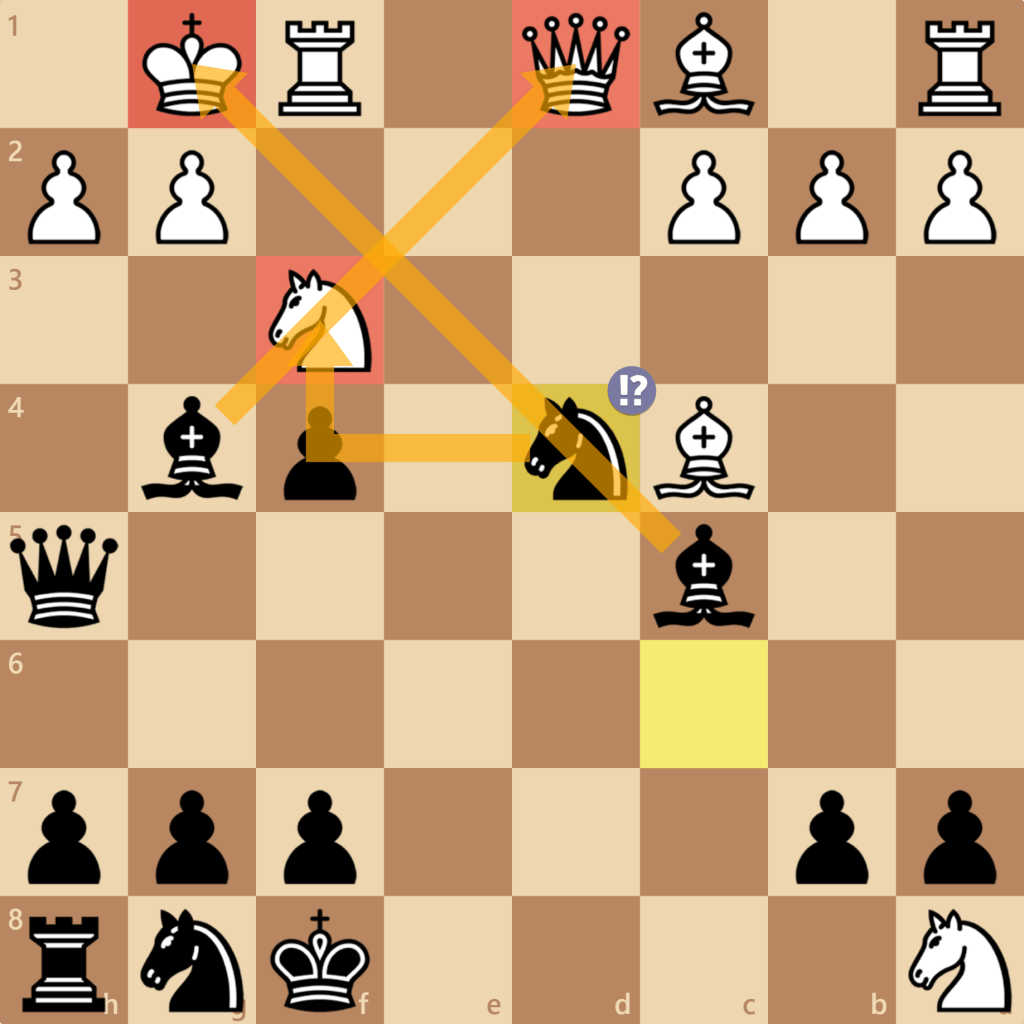
White’s pinned knight is attacked three times. There is also a discovered check with the c5-bishop on the dark square diagonal. Importantly, there is also an impending DOUBLE CHECK!
The correct moves for White to refute the attack is either Kh1 to move out of the discovered check, or the more subtle Bxf2, which critically defends the h2-pawn. However, while White possibly identified the discovered check by the bishop and probably even saw the knight, I suspect that they didn’t fully recognise the implication of a double check. Double checks make the impossible possible!
Even the laziest king flees wildly in the face of a double check.
— Aron Nimzowitsch
White spent about 21 seconds considering their response, their longest of the game thus far. Ultimately, they played (12. b4??) to counterattack my c5-bishop, ostensibly “removing” the checking piece of the discovered check. This blundered checkmate-in-two! I played (12… Nxf3+!) double check! Although both squares of my checking pieces, f3 and c5, are defended, meaning that both the knight and bishop are hanging, both are immortal from the double check and White’s king must move. And it had but one square available, h1.
White thought for a full minute, and I wonder what was going through their mind as they processed the emotional damage… 😂 Rather than resigning, they were a good sport and played (13. Kh1) so that checkmate could be played on the board (13… Qxh2#). Good game, GG!
Combinations have always been the most intriguing aspect of chess. The masters look for them, the public applauds them, the critics praise them. It is because combinations are possible that chess is more than a lifeless mathematical exercise. They are the poetry of the game; they are to chess what melody is to music. They represent the triumph of mind over matter.
— GM Reuben Fine
* * *
Learn how to play the best chess opening attacks in the Romantic style with my new book, “Become a Chess Assassin!”.

* * *
[Event "Live Chess"]
[Site "Chess.com"]
[Date "2025.06.20"]
[Round "-"]
[White "NikolaiN1123"]
[Black "vitualis"]
[Result "0-1"]
[CurrentPosition "N4knr/pp3ppp/8/2b5/1PB2pb1/5n2/P1P3Pq/R1BQ1R1K w - - 0 14"]
[Timezone "UTC"]
[ECO "C36"]
[ECOUrl "https://www.chess.com/openings/Kings-Gambit-Accepted-Modern-Defense-4.exd5"]
[UTCDate "2025.06.20"]
[UTCTime "02:14:46"]
[WhiteElo "1052"]
[BlackElo "1031"]
[TimeControl "300+5"]
[Termination "vitualis won by checkmate"]
[StartTime "02:14:46"]
[EndDate "2025.06.20"]
[EndTime "02:19:27"]
[Link "https://www.chess.com/analysis/game/pgn/32mpmZJhRQ?tab=analysis"]
[WhiteUrl "https://www.chess.com/bundles/web/images/noavatar_l.84a92436.gif"]
[WhiteCountry "116"]
[WhiteTitle ""]
[BlackUrl "https://images.chesscomfiles.com/uploads/v1/user/3711094.db4cf652.50x50o.4dec0e446096.png"]
[BlackCountry "17"]
[BlackTitle ""]

1. e4 {[%clk 0:05:01.8][%timestamp 32]} 1... e5 {[%clk 0:05:00.6][%timestamp
44]} 2. f4 $5 {[%clk 0:05:04.5][%timestamp 23][%c_effect
f4;square;f4;type;Interesting;persistent;true] King's Gambit} 2... exf4 {[%clk
0:05:01.1][%timestamp 45] Accepted  $1} 3. Nf3 {[%clk 0:05:07.3][%timestamp 22]}
3... d5 {[%clk 0:05:01.4][%timestamp 47] Modern Defense} 4. exd5 {[%clk
0:05:10.2][%timestamp 21]} 4... Qxd5 {[%clk 0:05:05][%timestamp 14] Not really
accurate, but let's see where this goes  $1} 5. Nc3 {[%clk 0:05:12.9][%timestamp
23]} 5... Qh5 {[%clk 0:04:51.3][%timestamp 187] Playing in a highly provocative
style  $1} 6. Bc4 $6 {[%clk 0:04:57.6][%timestamp 203][%c_effect
c4;square;c4;type;Inaccuracy;persistent;true][%c_arrow
d2d4;keyPressed;none;from;d2;opacity;0.8;to;d4;persistent;false,f1e2;keyPressed;none;from;f1;opacity;0.8;to;e2;persistent;false][%c_highlight
d4;keyPressed;none;opacity;0.8;square;d4;persistent;false,e2;keyPressed;none;opacity;0.8;square;e2;persistent;false]
A natural developing move, which the engine calls inaccurate and returns the
evaluation to equality.} 6... Bg4 {[%clk 0:04:50.6][%timestamp 57] A simple
tactical idea  $1} 7. O-O $4 {[%clk 0:04:59.2][%timestamp 34][%c_effect
g1;square;g1;type;Blunder;persistent;true][%c_highlight
g1;keyPressed;none;opacity;0.8;square;g1;persistent;false,b5;keyPressed;none;opacity;0.8;square;b5;persistent;false][%c_arrow
c3b5;keyPressed;none;from;c3;opacity;0.8;to;b5;persistent;false] This is a
blunder at -3 due to Qc5+ absolute fork of White's king and c4-bishop...} 7...
Nc6 $2 {[%clk 0:04:47.1][%timestamp 85][%c_effect
c6;square;c6;type;Mistake;persistent;true][%c_arrow
h5c5;keyPressed;none;from;h5;opacity;0.8;to;c5;persistent;false,c5g1;keyPressed;none;from;c5;opacity;0.8;to;g1;persistent;false,c5c4;keyPressed;none;from;c5;opacity;0.8;to;c4;persistent;false][%c_highlight
c5;keyPressed;none;opacity;0.8;square;c5;persistent;false] ... but I missed it
as I hadn't intuitively understood the ramification of White's missing f-pawn
from the King's Gambit  $1} 8. Nd5 $2 {[%clk 0:04:45][%timestamp 192][%c_effect
d5;square;d5;type;Mistake;persistent;true][%c_arrow
d1e1;keyPressed;none;from;d1;opacity;0.8;to;e1;persistent;false][%c_highlight
e1;keyPressed;none;opacity;0.8;square;e1;persistent;false] White moves forward
with an attack, which I see. This is mistake.} 8... Be7 $4 {[%clk
0:04:20.6][%timestamp 315][%c_effect
e7;square;e7;type;Blunder;persistent;true][%c_highlight
e7;keyPressed;none;opacity;0.8;square;e7;persistent;false,c8;keyPressed;none;opacity;0.8;square;c8;persistent;false][%c_arrow
e8c8;keyPressed;none;from;e8;opacity;0.8;to;c8;persistent;false] This was a
mouse-slip  $1 Argh  $3 I had intended Bd6, which is inaccurate but tricky
(pressuring White's h2-pawn).} 9. Nxc7+ $1 {[%clk 0:04:43][%timestamp
70][%c_effect c7;square;c7;type;GreatFind;persistent;true][%c_highlight
c7;keyPressed;alt;opacity;0.8;square;c7;persistent;false,a8;keyPressed;none;opacity;0.8;square;a8;persistent;false,e8;keyPressed;none;opacity;0.8;square;e8;persistent;false][%c_arrow
c7e8;keyPressed;none;from;c7;opacity;0.8;to;e8;persistent;false,c7a8;keyPressed;none;from;c7;opacity;0.8;to;a8;persistent;false]
Of course} 9... Kf8 {[%clk 0:04:20.5][%timestamp 51]} 10. Nxa8 {[%clk
0:04:43.9][%timestamp 41]} 10... Bc5+ $5 {[%clk 0:04:12.4][%timestamp
131][%c_effect c5;square;c5;type;Interesting;persistent;true][%c_arrow
c6d4;keyPressed;none;from;c6;opacity;0.8;to;d4;persistent;false][%c_highlight
d4;keyPressed;shift;opacity;0.8;square;d4;persistent;false] But let's treat the
blunder like a gambit  $1 I saw the weak dark square diagonal and so decided to
launch an attack  $1 My intuition was that White would have to give back material
with this attack  $1 How will White respond  $2} 11. d4 {[%clk 0:04:33.6][%timestamp
153]} 11... Nxd4 $5 {[%clk 0:04:14.6][%timestamp 28][%c_effect
d4;square;d4;type;Interesting;persistent;true][%c_arrow
d4f3;keyPressed;none;from;d4;opacity;0.8;to;f3;persistent;false,g4d1;keyPressed;none;from;g4;opacity;0.8;to;d1;persistent;false,c5g1;keyPressed;none;from;c5;opacity;0.8;to;g1;persistent;false][%c_highlight
f3;keyPressed;none;opacity;0.8;square;f3;persistent;false,d1;keyPressed;none;opacity;0.8;square;d1;persistent;false,g1;keyPressed;none;opacity;0.8;square;g1;persistent;false]
A very tricky position with an impending double-check  $1 White's best moves need
a high level of awareness...} 12. b4 $4 {[%clk 0:04:17.2][%timestamp
214][%c_effect b4;square;b4;type;Blunder;persistent;true][%c_highlight
b4;keyPressed;none;opacity;0.8;square;b4;persistent;false,f4;keyPressed;none;opacity;0.8;square;f4;persistent;false,h1;keyPressed;none;opacity;0.8;square;h1;persistent;false][%c_arrow
c1f4;keyPressed;none;from;c1;opacity;0.8;to;f4;persistent;false,g1h1;keyPressed;none;from;g1;opacity;0.8;to;h1;persistent;false]
White attempted to counterattack, but chose poorly  $1 This hangs checkmate-in-two
moves  $1} 12... Nxf3+ $1 {[%clk 0:04:11.7][%timestamp 79][%c_effect
f3;square;f3;type;GreatFind;persistent;true][%c_highlight
f3;keyPressed;alt;opacity;0.8;square;f3;persistent;false,g1;keyPressed;none;opacity;0.8;square;g1;persistent;false][%c_arrow
f3g1;keyPressed;none;from;f3;opacity;0.8;to;g1;persistent;false,c5g1;keyPressed;none;from;c5;opacity;0.8;to;g1;persistent;false]
DOUBLE-CHECK makes the impossible possible  $1 Although both the knight and bishop
are hanging, both are immortal and White's king must move...} 13. Kh1 {[%clk
0:03:20.2][%timestamp 620]} 13... Qxh2# {[%clk 0:04:15.3][%timestamp
14][%c_effect
f8;square;f8;type;Winner;animated;true,h1;square;h1;type;CheckmateWhite;animated;true][%c_arrow
f3h2;keyPressed;none;from;f3;opacity;0.8;to;h2;persistent;false,h2h1;keyPressed;none;from;h2;opacity;0.8;to;h1;persistent;false,h2g1;keyPressed;none;from;h2;opacity;0.8;to;g1;persistent;false][%c_highlight
h2;keyPressed;none;opacity;0.8;square;h2;persistent;false,h1;keyPressed;none;opacity;0.8;square;h1;persistent;false,g1;keyPressed;none;opacity;0.8;square;g1;persistent;false]
Good game, GG  $1} 0-1
 Adventures of a Chess Noob