
It’s been quite a hectic November, and I’d realised this morning, that I hadn’t played a rated game on Chess.com for over a month!
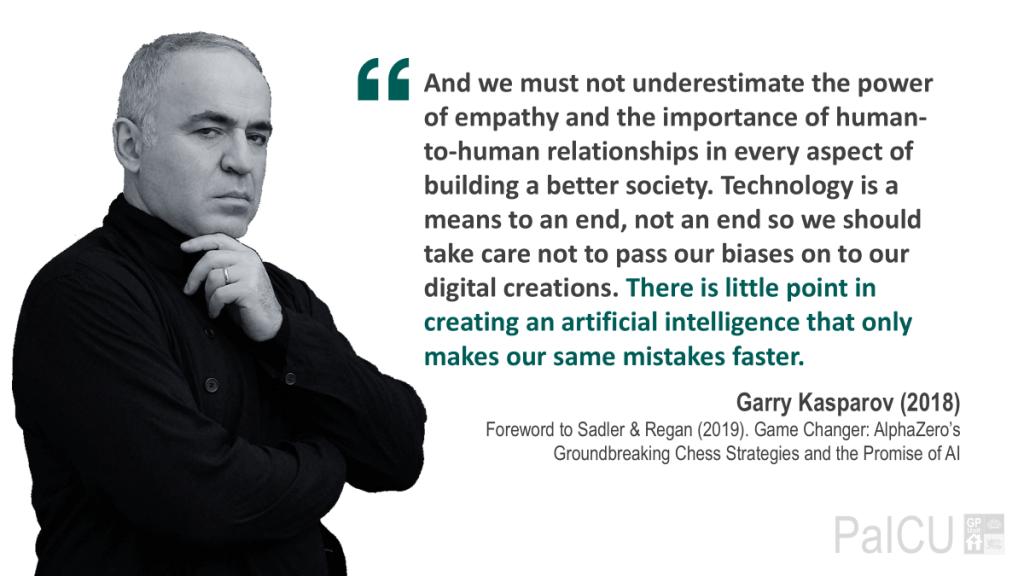
I’d had a couple of conferences to attend, one in Brisbane and another in Adelaide, and then a lot of professional and academic committee work. You might have noticed that apart from the Chessiverse review, most of my videos and articles in the past month involved Chess Out and About, and on travel! A few highlights in the last week? I was interviewed by a journalist for AusDoc (an Australian medical news periodical and platform), who wrote a “human interest” piece [PDF] about my chess endeavours! And on Saturday, I gave the keynote presentation at the University of New South Wales Clinical Supervisors Workshop titled, “AI & General Practice: Ideas and Implementation”. The chess field provides some great conceptual insights and analogies regarding the possibilities and challenges with regards to AI! I included this fantastic quote from GM Garry Kasparov which is especially important as AI tools encroach increasingly into all aspects of social life:
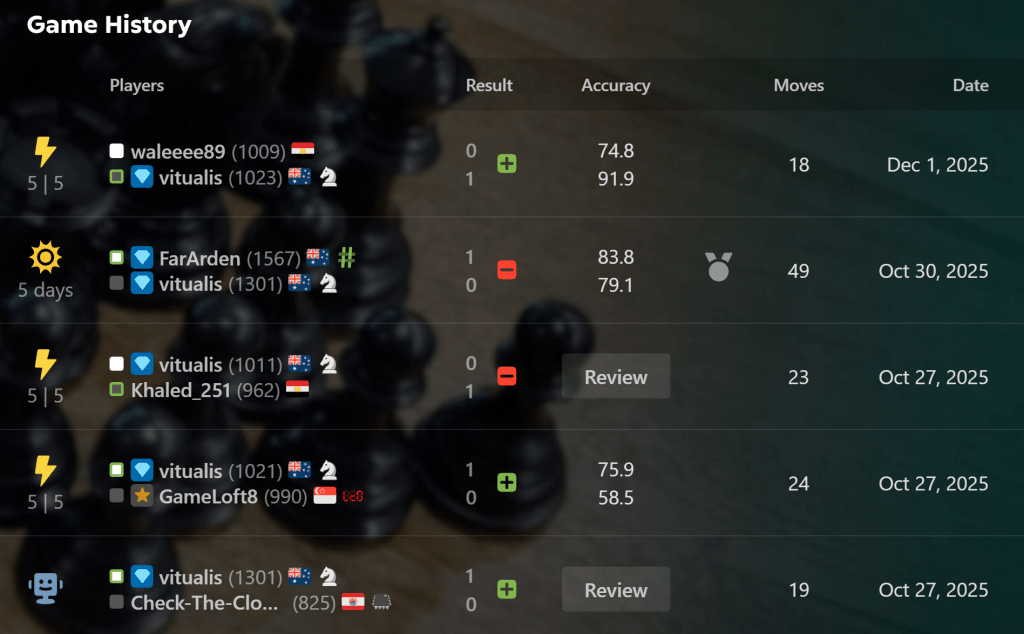
However, I’ve just started some long service leave and will in fact be commencing a new job in January 2026. So, I’ve some time in December to potentially do some “chess stuff”! 🤩👍 As mentioned, I hadn’t played a rated game on Chess.com for over a month and so this morning, feeling quite rusty, decided to play a game of 5 | 5 blitz. Happily, it went my way, with a Chess.com accuracy rating of 91.9 (💪😏) and it ended deliciously with a mostly planned trap that sprung a royal fork! 😙🤌 Let’s check it out!
This morning, I had the black pieces and my Egyptian opponent started with the Italian Game (1. e4 e5 2. Nf3 Nc6 3. Bc4), I responded with the Two Knights Defense (3… Nf6), and White then played a slow and rock-solid variant with (4. d3). Meh. Those of you who follow my channel and blogs will know that I highly prefer bombastic opening tactics, but with Black, White can often drag me into the Giuoco Piano/Pianissimo lines as I usually respond to e4 with e5!
By the next turn, White had castled, and it was indeed transposed into a very staid Giuoco Pianissimo, the “very quiet game”.
Sometimes, I’m in the mood to launch an immediate unbalanced attack, for instance a knight attack with (Nf4!?) and then if (h3), double-down with a fishing pole tactic of (h5!?). This is dodgy pirate chess, very unsound, commonly criticised as “hope chess”, but potentially super-fun at the intermediate beginner level! 🦜🤪🏴☠️
In today’s game, my brain wasn’t yet fully caffeinated, so I decided to play the more principled approach in the Giuoco Piano lines; the “retaliator” tactic. That is, it is often better to keep things quiet and closed, develop and make improving moves, wait for the opponent to make the first aggressive move and then launch a counterattack!
And my opportunity arose soon, with White playing a knight attack on turn 7 (7. Ng5). If you look at the game diagram and the video, the challenge for White is that their knight is offside and although they have an attack, it just doesn’t have enough “juice”. With Black, I not only foiled their attack quickly, but by turn 11, White was forced to make a couple of major concessions: doubled d-pawns, and being substantially behind on development.
At this point, I no longer needed to play slowly and tentatively but instead went straight for the attack with (12… f4!); I started the attack on White’s king! We had a few trades and with (15… Nh4!), I won tempo with an attack on White’s queen. For a second time in the game, Stockfish evaluated that White’s most accurate move was un-developing the queen (Qd1). Where my opponent found this the first time, it was more difficult to contemplate in this position as it would result in every single one of White’s pieces on the back rank! Instead, they played a very understandable mistake with (16. Qe4?!), ostensibly threatening my e5-pawn, and threatening a discovered attack on my a8-rook with a forward step of the d-pawn.
However, thinking for about 40 seconds, I found a lovely trap with (16… Bf5!?). 🤩👍
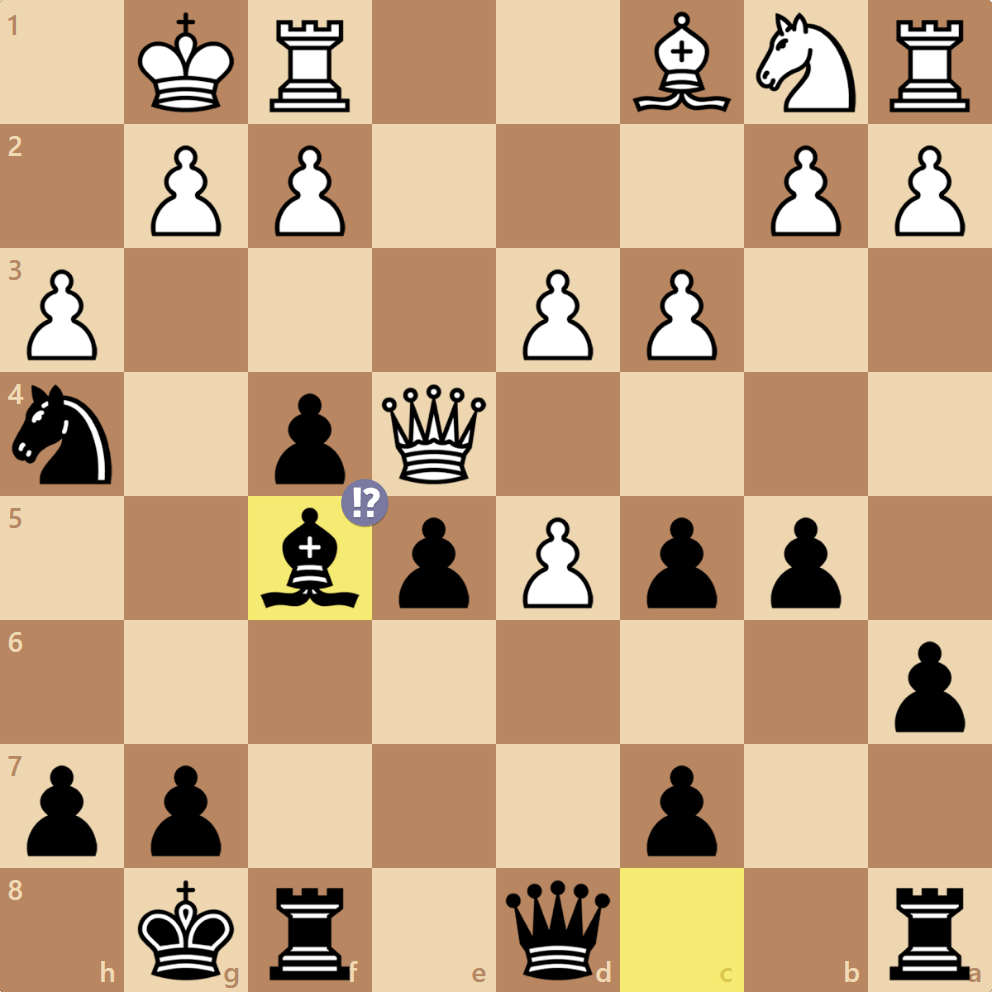
There are two ideas. Firstly, we want to force White’s queen off the long light square diagonal, and hence the defence of the g2-pawn. Secondly, we are baiting White’s queen to capture the seemingly hanging and juicy e5-pawn!
White falls for the trap with (17. Qxe5??). In the game, I calculated the next move repeatedly and carefully to convince myself that it was real, and after a minute, I committed with (17… Qg5)!. White is in a bind as my h4-knight and queen now immediately threatened checkmate! The only logical seeming move for White was to push their g-pawn forward, and my opponent played (18. g3). Remember that I wanted to bait White’s queen onto the e5 square? 😏 The final move of the game, (18… Nf3+) royal fork, emotional damage, my opponent resigned! Good game, GG!
* * *
Learn how to play the best chess opening attacks in the Romantic style with my new book, “Become a Chess Assassin!” available now on your local Amazon store!

 Adventures of a Chess Noob