

🔥 Coupon code: CHESSNOOB64
- Get up to 10-17% discount at the Chessnut store (can be used in conjunction with other coupons, though the total saving is capped)
It’s been a while since I’ve recorded and written a new entry in my chess noob Quick Wins series. I played this very fun game of the Max Lange Vienna Gambit earlier in the week and reflected that it was some time since I’ve played the tactic that was in this game!
While on long service leave, I’ve been motivated to make some content that I’d planned a long time ago but had never quite gotten around to. Over a year ago when Chessconnect was young, I’d asked Jörn (@joernupbde), the author who created this free software that connects many electronic chess boards to Chess.com, to support the analysis board function. You see, I use the Chess.com analysis board to both analyse my games, and as the canvas for the videos on my channel. My intention was to record videos describing and analysing games on a real 3D board, with an automagically synchronised 2D representation. Well, I’ve finally enacted the intention! 🤩👍
Speaking of electronic chess boards, I’ve used and reviewed around a half-dozen models, as well as a couple of robots by this point. The electronic chess board reviews and demonstrations are some of the most popular videos on my channel. A common question that I’m asked is which board is my favourite. At home, I always tend to go back to my Chessnut Pro. It isn’t the most feature rich device, and nor is it the newest. However, it doesn’t look like an electronic gadget, but simply a handsome wooden set of tournament sized pieces and board. It works flawlessly with a range of online chess platforms through Chessconnect. As Chessnut sells the sensors as a set, you can create custom pieces to use with the board. Wonderful!
As this was a game of the Vienna Gambit, it seemed only appropriate that I used my Austrian Coffee House reproduction pieces fitted with the Chessnut sensors. 😊

* * *
After I played the Max Lange Vienna Gambit (1. e4 e5 2. Nc3 Nc6 3. f4), my opponent with the Black pieces took a little bit of time to think. I suspect that they weren’t familiar with the position, and indeed, it can catch people off guard. Now, many people might know that it is a mistake to accept the pawn with (3… exf4) in the “regular” (the Falkbeer) Vienna Gambit (where Black played 2… Nf6). A curious thing with the Max Lange version is that accepting the gambit is the only move where Black holds onto the advantage! My opponent might have felt a bit skittish and opted to add some more juice to the capture with (3… Bd6?!), which was a mistake.
For White, it’s easy. I played the typical approach with (4. Nf3), developing the knight behind the f-pawn, which critically covers the h4 square against Qh4+. Only now did Black accept the gambit (4… exf4) and White once again has a simple and principled next move (5. d4). Notice: I’ve successfully taken the centre with my pawns and have developed both of my knights to natural squares. On the other hand, Black’s developed pieces are at risk of being attacked by a forward push of my centre pawns, and their position is relatively cramped. Although Black is nominally up a point of material, Stockfish evaluates the position as favouring White at around [+1.5]!
Here, Black played (5… g5) to support their hard won f4-pawn, and this is a structure that we often see in the Max Lange Vienna Gambit. Some of you might also recognise this as a pattern that can arise from the King’s Gambit, and indeed, the Vienna Gambit was considered by some in the 1800s as a kind of delayed King’s Gambit. On the surface, it looks like White’s knight could be in trouble, especially if Black pushes the g-pawn further to g4. However, a tactical pattern to know is the Hamppe-Allgaier Gambit (-ish) attack! The fundamental idea is that we’re going to double-down on the romanticism and sacrifice that knight! 😲
💡 Check out my previous blog article on one of my Hamppe-Allgaier Gambit games from the 2024 Chess.com Daily Chess Championship, which includes commentary and some history about the opening! 🤩
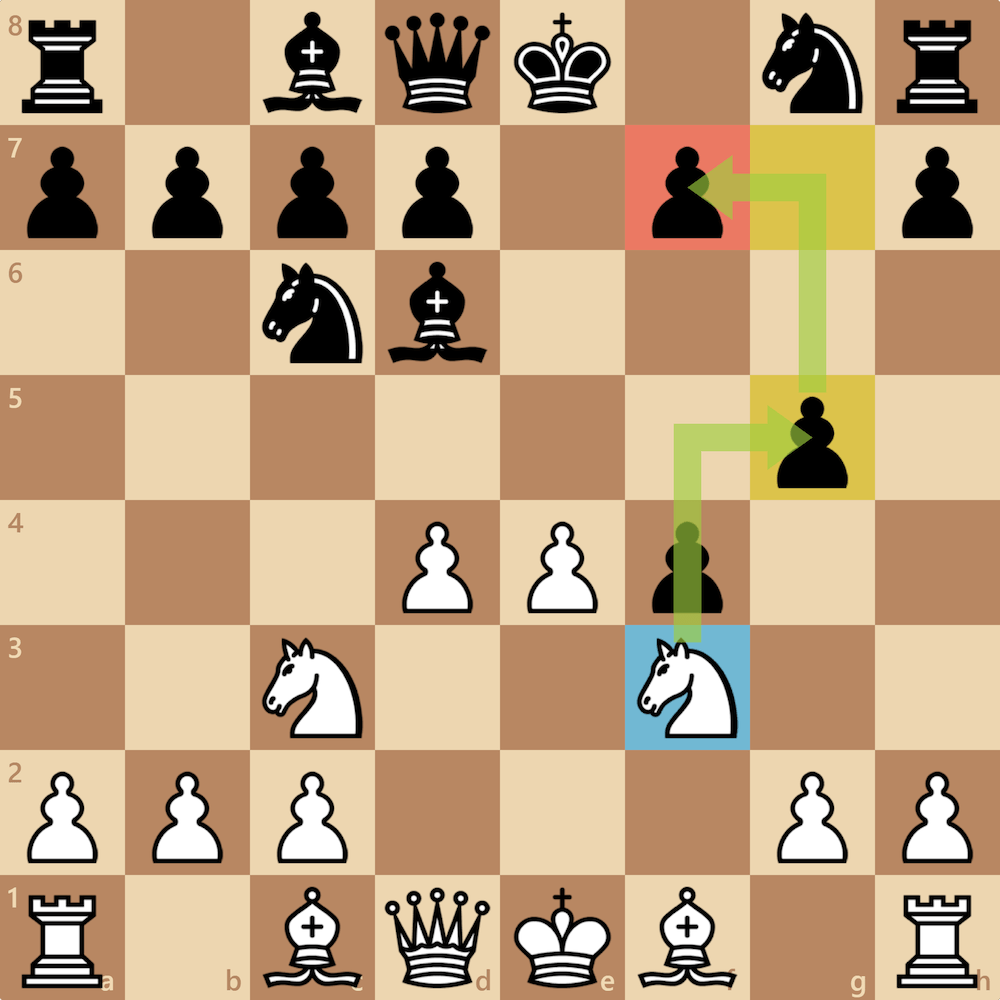
To set up this attack, we first need to play (6. h4) so that our knight can first safely land on the g5 square. Black’s plan seemed to have been to provide a second defender of their f4-pawn so to release their dark square bishop and played (6… Bb4?!). Another tactical pattern to know in the Vienna Game/Gambit, is that trading our queen’s knight for Black’s dark square bishop is usually completely fine. Indeed, it’s good for us, so it’s not a threat, and so there is no need to waste tempo to avoid it.
My knight leapt forward (7. Nxg5!?); Stockfish thinks it’s inaccurate but we’re still comfortably ahead in evaluation. Black traded their bishop for my knight (7… Bxc3+ 8. bxc3). Yes, I’m left with doubled c-pawns, but I have a solid pawn formation that limits the forward mobility of Black’s only developed piece, their queen’s knight. Black attempted to kick away my forward knight (8… h6) but it is his time to shine. For glory’s sake!… (9. Nxf7!!), a brilliant sacrifice, and after (Kxf7), Black’s king is suddenly stuck in the shattered remains of their kingside defences!
Following the path wrought by the heroic knight came the rest of my army for the attack: first my queen (10. Qh5+), and then dark square bishop (11. Bxf4). Black attempted to counterattack with their queen (11… Qf6?!), but this was a tactical error. Notice that Black’s queen and king were on the same file, specifically, the fully opened f-file.
I didn’t notice for a turn, but neither did Black. I did see the potential on turn 13 and deliberately played the very conservative (13. Be2) from a psychological perspective. I saw that Bc4 was probably best, but that would turn Black’s eye towards the f7 square, and it would increase the likelihood that they’ll notice the problem of their king and queen on the same file. With Be2, my aim was to keep Black’s vision on my side of the board, and so hopefully, continue to be blind to the tactic.
And it seemed to work! 😏 Almost immediately, Black responded with just a developing move (13… Bd7??) which allowed me to play the finisher, a beautiful pin along the full length of the board (14. Rf1). Emotional damage, Black resigned, good game, GG! 🤩👍
* * *
Learn how to play the best chess opening attacks in the Romantic style with my new book, “Become a Chess Assassin!” available now on your local Amazon store!

[Event "Live Chess"]
[Site "Chess.com"]
[Date "2025.12.04"]
[Round "?"]
[White "vitualis"]
[Black "Random Noob"]
[Result "1-0"]
[TimeControl "600"]
[WhiteElo ""]
[BlackElo ""]
[Termination "Guest1369163472 won by resignation"]
[Link "https://www.chess.com/analysis/game/pgn/2pckwMaQG6/analysis"]
[WhiteUrl "https://images.chesscomfiles.com/uploads/v1/user/3711094.b9866645.32x32o.b1cf5b001ab7@2x.webp"]
[WhiteCountry "17"]
[WhiteTitle ""]
[BlackUrl ""]
[BlackCountry "225"]
[BlackTitle ""]

1. e4 {[%clk 0:09:59.2][%timestamp 8]} 1... e5 {[%clk 0:09:59.9][%timestamp 1]}
2. Nc3 {[%clk 0:09:58.1][%timestamp 11]} 2... Nc6 {[%clk 0:09:58.2][%timestamp
17]} 3. f4 {[%clk 0:09:57][%timestamp 11][%c_highlight
f4;keyPressed;alt;opacity;0.8;square;f4;persistent;false] Vienna Game: Max
Lange, Vienna Gambit $1 Let's go $1} 3... Bd6 $6  {[%clk 0:09:45.4][%timestamp
128][%cal de5f4][%c_arrow
e5f4;keyPressed;none;opacity;0.8;from;e5;to;f4;persistent;false][%c_highlight
f4;keyPressed;none;opacity;0.8;square;f4;persistent;false][%c_effect
d6;square;d6;type;Inaccuracy;size;100%2525;animated;false;persistent;true] Black
was a bit hesitant, and this is inaccurate.} 4. Nf3 {[%clk 0:09:40.6][%timestamp
164]} 4... exf4 {[%clk 0:09:43.5][%timestamp 19]} 5. d4 {[%clk
0:09:38.3][%timestamp 23]} 5... g5 {[%clk 0:09:39.1][%timestamp 44]} 6. h4
{[%clk 0:09:29.1][%timestamp 92][%cal sf1c4,se4e5][%c_arrow
f1c4;keyPressed;shift;opacity;0.8;from;f1;to;c4;persistent;false,e4e5;keyPressed;shift;opacity;0.8;from;e4;to;e5;persistent;false]
h4 can lead to a Hamppe-Allgaier Gambit type structure. In the position, e5 is
good, and so is Bc4. In many of these lines, the goal is to target the f7 square
and control the f-file.} 6... Bb4 $6 {[%clk 0:09:31][%timestamp 81][%c_effect
b4;square;b4;type;Inaccuracy;size;100%25;animated;false;persistent;true][%cal
dg5g4][%c_arrow
g5g4;keyPressed;none;opacity;0.8;from;g5;to;g4;persistent;false][%c_highlight
g4;keyPressed;none;opacity;0.8;square;g4;persistent;false]} 7. Nxg5 $5 {[%clk
0:09:02.9][%timestamp 262][%cal sh4g5,sf1c4,sd4d5][%c_arrow
h4g5;keyPressed;shift;opacity;0.8;from;h4;to;g5;persistent;false,f1c4;keyPressed;shift;opacity;0.8;from;f1;to;c4;persistent;false,d4d5;keyPressed;shift;opacity;0.8;from;d4;to;d5;persistent;false][%c_effect
g5;square;g5;type;Interesting;persistent;true] I LIKE the Hamppe-Allgaier
approach, and the idea is to potentially sacrifice the knight $1 The engine
prefers hxg5, but also d5 and Bc4.} 7... Bxc3+ $6 {[%clk 0:09:28.1][%timestamp
29][%c_effect
c3;square;c3;type;Inaccuracy;size;100%25;animated;false;persistent;true][%cal
dh7h6,dd7d5][%c_arrow
h7h6;keyPressed;none;opacity;0.8;from;h7;to;h6;persistent;false,d7d5;keyPressed;none;opacity;0.8;from;d7;to;d5;persistent;false][%c_highlight
h6;keyPressed;none;opacity;0.8;square;h6;persistent;false,d5;keyPressed;none;opacity;0.8;square;d5;persistent;false]
Trading away this bishop is inaccurate} 8. bxc3 {[%clk 0:09:01.7][%timestamp
12]} 8... h6 {[%clk 0:09:22.8][%timestamp 53]} 9. Nxf7 $3 {[%clk
0:08:52.7][%timestamp 90][%c_effect
f7;square;f7;type;Brilliant;size;100%25;animated;false;persistent;true][%c_highlight
f7;keyPressed;alt;opacity;0.8;square;f7;persistent;false] Oh yeah $1 Knight
sacrifice $1} 9... Kxf7 {[%clk 0:09:21.2][%timestamp 16]} 10. Qh5+ {[%clk
0:08:52.2][%timestamp 5][%cal sf1d3][%c_arrow
f1d3;keyPressed;shift;opacity;0.8;from;f1;to;d3;persistent;false] A very direct
attack. This isn't the most accurate but has a psychological impact. Stockfish
prefers Bd3 to prepare for short castle, with the rook controlling the f-file $1}
10... Kf8 $6 {[%clk 0:09:14.9][%timestamp 63][%c_effect
f8;square;f8;type;Inaccuracy;size;100%25;animated;false;persistent;true][%cal
df7e7][%c_arrow
f7e7;keyPressed;none;opacity;0.8;from;f7;to;e7;persistent;false][%c_highlight
e7;keyPressed;none;opacity;0.8;square;e7;persistent;false]} 11. Bxf4 {[%clk
0:08:29.2][%timestamp 230]} 11... Qf6 $6 {[%clk 0:09:11.2][%timestamp
37][%c_effect
f6;square;f6;type;Inaccuracy;size;100%25;animated;false;persistent;true][%cal
dd7d6][%c_arrow
d7d6;keyPressed;none;opacity;0.8;from;d7;to;d6;persistent;false][%c_highlight
d6;keyPressed;none;opacity;0.8;square;d6;persistent;false] Black develops their
queen. I knew it was probably a mistake, but at the same time, one needs to play
carefully $1} 12. Bxc7 {[%clk 0:07:40][%timestamp 492][%cal sf1c4][%c_arrow
f1c4;keyPressed;shift;opacity;0.8;from;f1;to;c4;persistent;false] I moved my
bishop out of the attack with a pawn capture, and realised on analysis that Bc4
was better as Black can't capture the bishop with their queen. I did find the
winning idea in the game nonetheless $1} 12... d6 {[%clk 0:09:02.7][%timestamp
85]} 13. Be2 {[%clk 0:06:46.3][%timestamp 537] A slower creeping move to lull
Black into a sense of complacency $1 Bc4 is the better move, but might turn
Black's eye towards the fact that their king and queen are on the same file...}
13... Bd7 $4 {[%clk 0:08:57.9][%timestamp 48][%c_effect
d7;square;d7;type;Blunder;persistent;true][%c_highlight
d7;keyPressed;none;opacity;0.8;square;d7;persistent;false] This blunders the
queen $1} 14. Rf1 {[%clk 0:06:42.8][%timestamp 35][%c_effect
e1;square;e1;type;Winner;animated;true,f8;square;f8;type;ResignBlack;animated;true][%cal
df1f6,df6f8][%c_arrow
f1f6;keyPressed;none;opacity;0.8;from;f1;to;f6;persistent;false,f6f8;keyPressed;none;opacity;0.8;from;f6;to;f8;persistent;false][%c_highlight
f6;keyPressed;none;opacity;0.8;square;f6;persistent;false,f8;keyPressed;none;opacity;0.8;square;f8;persistent;false,f1;keyPressed;alt;opacity;0.8;square;f1;persistent;false]
A beautiful pin and Black resigns immediate $1 Good game, GG $1} 1-0
 Adventures of a Chess Noob