

Another week, another chess noob Quick Wins article and video! And today, I’m going to show two games that follow the same theme: aggressive, unsound, Romantic attacks in the early stages of the game, factoring in a psychological approach, to coax our opponent into blundering into our trap! These are tactics that may lead you to lose as often as win, but they are fun to play! 🤩👍
So, let’s begin!
Game 1: Misdirection – leading your opponent down the garden path!
In the first game, my opponent had the black pieces and attempted a Sicilian Defense (1. e4 c5), to which I responded with the Smith-Morra Gambit (2. d4) – check out my channel playlist which currently has 33 videos! I love the Smith-Morra as it is forcing: the only accurate path is for Black to Accept, and this tends to pull the game down lines that are not very Sicilian-ish. However, in this game, Black hesitated and then played (2… b6?). How can we interpret this?
My intuition immediately is that this means that Black is probably a beginner player. They did not feel confident to capture but felt they had to defend their c-pawn. Ah ha! This is an opportunity to play in an aggressive Romantic style in the opening!
A way to do this is to not immediately “cash out” the advantage. For instance, on turn 3, White can hold their evaluation advantage with d5 or dxc5, which Stockfish recommends. Instead, we want to strike with a killer blow, not just to drag the advantage into the middlegame! So, we need to foment a plan for attack, and commit to it, and even an unsound one can work (though we should aim for solid ones first!).
The opponent’s f7 or f2 square is often a great opening target. It is uniquely weak in that it only has the king as a defender in the opening stages. Importantly, this can be threatened by our own king’s knight and king’s bishop with “normal” developing moves. Why is this important? Firstly, developing these pieces is rarely “wrong”, even if they are not the most accurate moves, and even if the position evolves such that an opening attack isn’t wise or possible. Secondly, with it no longer being very “normal” to play in the Romantic style, the opponent can be lulled into a complacent mood and not realise that an attack is coming!
My next two moves: (3. Nf3?!) and (4. Bc4!?). Stockfish considers that both are inaccurate, but I’m still ahead evaluation-wise, and much further ahead on development!
On turn 4, Black makes a blunder with (4… Bg4??). Can you see why?
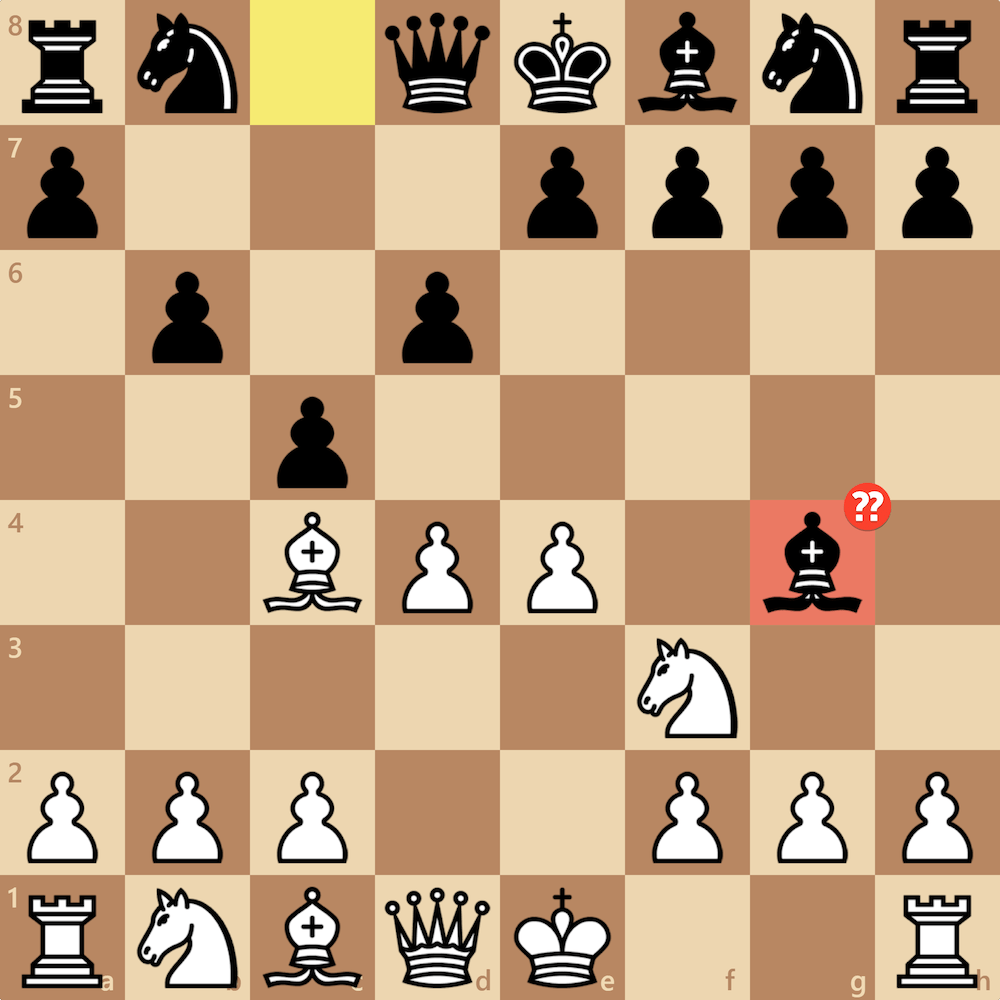
Here, White can “cash out” with an unpinning tactic that starts with an ostensible bishop sacrifice (5. Bxf7+!!), check! Once again, the weak f-square! After (5… Kxf7) we unpin our knight with check (6. Ng5+!), and regardless of Black’s response their bishop is cleanly lost the next turn (7. Qxg4)!
However, there is another opportunity here! The structure is somewhat analogous to the von Hennig Gambit against the Caro-Kann Defense, within which there is a brilliant 8-move checkmate line! In fact, I describe this line in depth in the second chapter of my book, Become a Chess Assassin! (check it out: USD $15.99 at Amazon).
Notice, if Black allows our knight onto the e5 square, then Bxf7 would not just be check, but checkmate! So, the question is, “how do we move our knight there, without our opponent smelling a rat?”. If we immediately played (5. Ne5??), Black will naturally ask themselves, why did White just play that move? The move doesn’t seem to make sense. The only way we will win is if Black’s material greed, seeing the “hanging” queen, overrides their natural curiosity that can be expected from an opponent’s irrational move.
Instead, we need to lead our opponent down the garden path. Psychologically, we need them to tell themselves an explanatory story that is of our convenience, to assuage suspicion. One of the best ways to do this is to seemingly blunder against a tactic that they had set!
In this game, I played (5. e5!?) to tempt (5… dxe5), a logical looking move! For Black, it seems like both ways that I could recapture, with Nxe5 or dxe5 is problematic as both pieces are pinned to my queen! However, it’s all a ruse! I of course played (5. Nxe5!!). Superficially, the knight has a reason to go to that square; it’s recapturing and so Black’s intuition is that I’ve made a mistake! I “forgot” that the knight was pinned. Black gleefully took my queen (6… Bxd1??). I could imagine their elation… and then confusion, and then dismay as immediately after their move, I struck with (7. Bxf7#)! 😏
💡 Psychological tactics require the empathy and creativity to predict and manipulate how our opponents will interpret and understand our moves!
* * *
Game 2: Structural traps exploit lapses in continuity
In the second game, I had the Black pieces, and White led with a Four Knights Game (boo!), and played in a solid and defensive manner. I recently remarked in my article, Get FORK-ed | First game in a month! Beating the Giuoco Pianissimo, that in these sorts of openings, “it is often better to keep things quiet and closed… [to] wait for the opponent to make the first aggressive move and then launch a counterattack”. This is the more accurate and principled approach. However, I also noted that, “sometimes, I’m in the mood to launch an immediate unbalanced attack”, and that this is “dodgy pirate chess, very unsound… but potentially super-fun”! I was in the mood for FUN! 🦜🤪🏴☠️
So, I decided to play a Fishing Pole Attack even though I knew that I didn’t have enough “juice” for the attack to work should White respond accurately. I played, (6… h5!?) to set the hook, and then (7… Ng4!?) offering the bait!
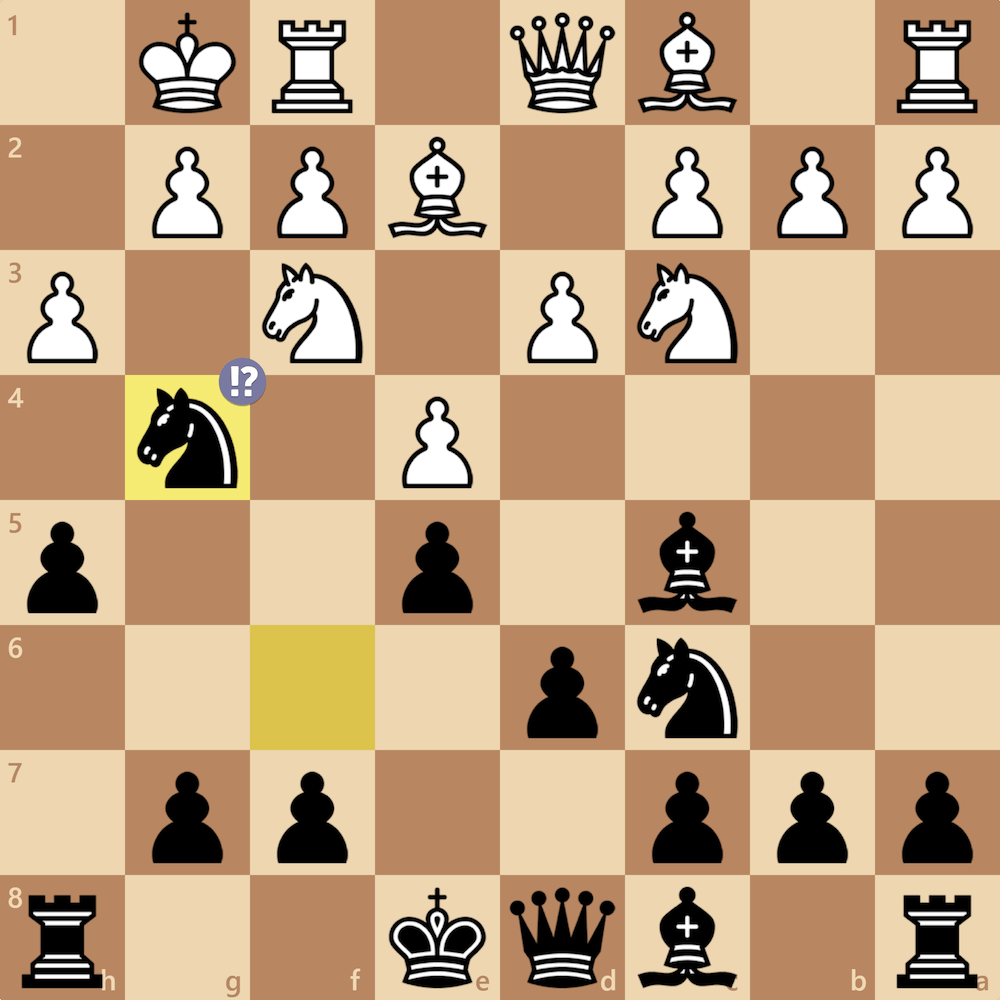
The Lichess community database gives us some quantitative insights regarding how people respond to this temptation. The top move from the position is that White captures the knight (8. hxg4?). The fascinating thing is that although White did make a mistake, Stockfish reckons that White is still a bit ahead [+0.5]. However, this is not at all reflected in the win-loss statistics. Out of almost 9,000 games from the position, Black won 84% to White 15%. This is a great example of one of the concepts that I raise in my book: although an engine might evaluate a position to be favouring one player in terms of accuracy, this does not imply that that position is necessarily better in real-life human-vs-human games!
In the game, I think White calculated that they were still okay after (8. hxg4) and they played accurately after (8… hxg4) with the forward movement (9. Ng5). We ended up trading pieces, and it seemed that White navigated to avoid my queen and rook to form a battery on the h-file. Stockfish rated the evaluation as equal at the end of turn 11 [0.00]. However, notice the position after (12… Nd4!).
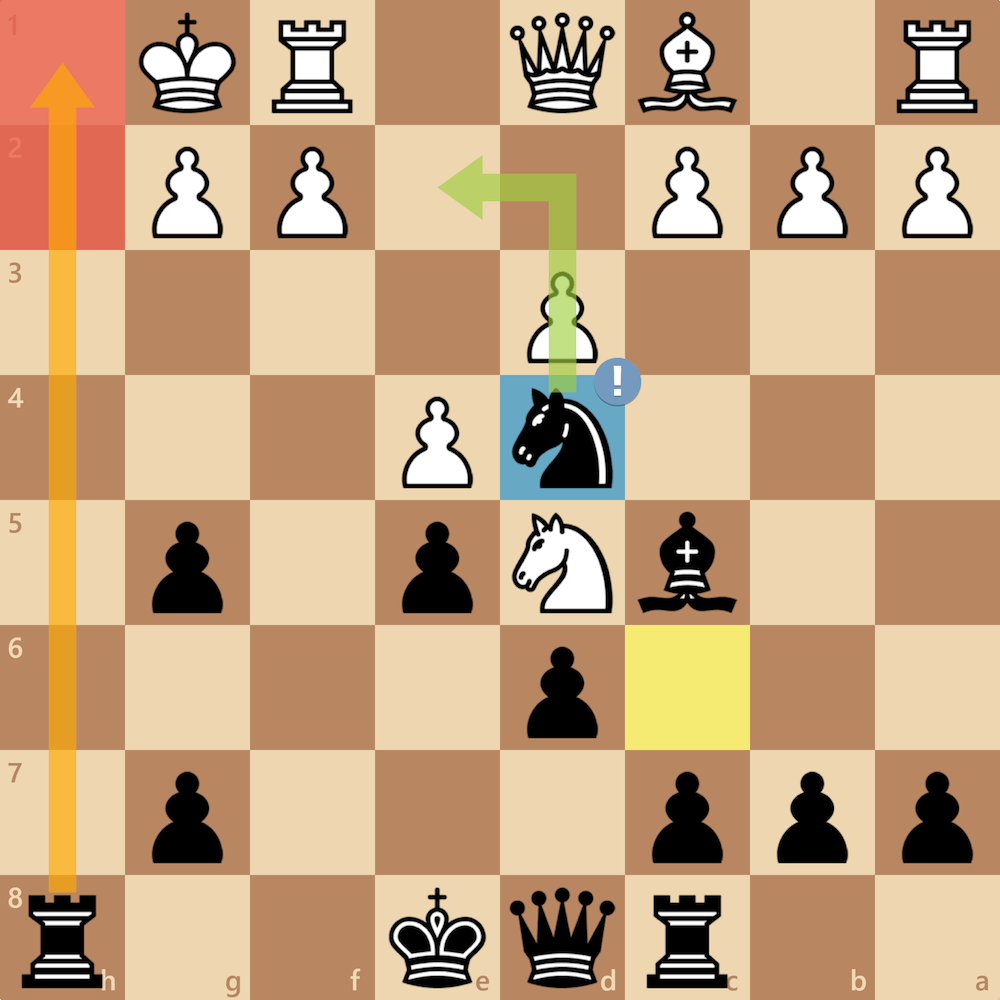
White has two structural weaknesses: the bare open h-file, and the e2-square defended only by their queen. With both, White must maintain continuity to prevent these weaknesses becoming fatal. Unfortunately, White might have under-appreciated the risk and went on the attack with (13. Qg4??), hitting my g5-pawn and presumably attempting to shred the defences of my king. But this was a blunder as (13… Rh4!) forces White’s queen to commit. In the position, White’s best move was to trade their queen for my rook (14. Qxh4 gxh4) or potentially retreating their queen entirely (14. Qd1). White went through with their attack and captured my g5-pawn (13. Qxg5??), but in doing so, lost sight of continuity; their queen was no longer guarding the e2-square, and their king could not step onto the h-file. Suddenly, (14… Ne2#), good game, GG!
💡 Attacks that weaken the defences of the king are often effectively traps, as they exploit lapses in continuity, something that can be difficult to maintain!
* * *
Learn how to play the best chess opening attacks in the Romantic style with my new book, “Become a Chess Assassin!” available now on your local Amazon store!

[Event "Live Chess"]
[Site "Chess.com"]
[Date "2025.12.10"]
[Round "?"]
[White "vitualis"]
[Black "Random Noob"]
[Result "1-0"]
[TimeControl "600"]
[Termination "vitualis won by checkmate"]
[WhiteUrl "https://images.chesscomfiles.com/uploads/v1/user/3711094.b9866645.32x32o.b1cf5b001ab7.webp"]
[WhiteCountry "17"]
[WhiteTitle ""]
[BlackUrl ""]
[BlackCountry "225"]
[BlackTitle ""]
[Link "https://www.chess.com/analysis/collection/shorts-xetkbLia/jGSA6ZLMk/analysis"]

1. e4 {[%clk 0:09:59.1][%timestamp 9]} 1... c5 {[%clk 0:09:57.9][%timestamp 21]}
2. d4 {[%clk 0:09:57.5][%timestamp 16] Smith-Morra Gambit vs Black's Sicilian  $1}
2... b6 $2 {[%clk 0:09:44.4][%timestamp 135][%c_effect
b6;square;b6;type;Mistake;size;100%25;animated;false;persistent;true][%c_arrow
c5d4;keyPressed;none;opacity;0.8;from;c5;to;d4;persistent;false][%c_highlight
d4;keyPressed;none;opacity;0.8;square;d4;persistent;false] Interesting... pretty
much all Declines of the Smith-Morra Gambit are bad  $1} 3. Nf3 $6 {[%clk
0:09:52.8][%timestamp 47][%c_arrow
d4d5;keyPressed;none;opacity;0.8;from;d4;to;d5;persistent;false][%c_highlight
d5;keyPressed;none;opacity;0.8;square;d5;persistent;false][%c_effect
f3;square;f3;type;Inaccuracy;size;100%2525;animated;false;persistent;true]
Stockfish recommends d5 to take space and control the centre. However, I'm
already thinking that Random Noob is probably a beginner, and that we should
immediately aim for an early attacking tactic on Black's f7 square. So, aim to
develop the king's knight and bishop for the attack  $1} 3... d6 $2 {[%clk
0:09:20.5][%timestamp 239][%c_arrow
c5d4;keyPressed;none;opacity;0.8;from;c5;to;d4;persistent;false][%c_highlight
d4;keyPressed;none;opacity;0.8;square;d4;persistent;false][%c_effect
d6;square;d6;type;Mistake;size;100%2525;animated;false;persistent;true] This is
a mistake. Notice the very weak light squares around Black's king  $1} 4. Bc4 $5
{[%clk 0:09:46.3][%timestamp 65][%c_effect
c4;square;c4;type;Interesting;size;100%2525;animated;false;persistent;true][%c_arrow
d4c5;keyPressed;none;opacity;0.8;from;d4;to;c5;persistent;false][%c_highlight
c5;keyPressed;shift;opacity;0.8;square;c5;persistent;false] Setting the trap  $1}
4... Bg4 $4 {[%clk 0:08:59][%timestamp 215][%c_effect
g4;square;g4;type;Blunder;size;100%2525;animated;false;persistent;true][%c_highlight
g4;keyPressed;none;opacity;0.8;square;g4;persistent;false] This blunders the
bishop...} 5. e5 $5  {[%clk 0:09:30.7][%timestamp 156][%c_effect
e5;square;e5;type;Interesting;size;100%2525;animated;false;persistent;true][%c_arrow
c4f7;keyPressed;none;opacity;0.8;from;c4;to;f7;persistent;false][%c_highlight
f7;keyPressed;shift;opacity;0.8;square;f7;persistent;false] A devious move $1
Black can shut things down by playing d5, but my intuition is that they'll play
dxe5, and this allows for an \"Oh no, my queen $1\" trap.} (5. Bxf7+ $3 {[%c_effect
f7;square;f7;type;Brilliant;persistent;true][%c_highlight
f7;keyPressed;alt;opacity;0.8;square;f7;persistent;false,e8;keyPressed;none;opacity;0.8;square;e8;persistent;false][%c_arrow
f7e8;keyPressed;none;opacity;0.8;from;f7;to;e8;persistent;false]} 5... Kxf7 6.
Ng5+ $1 {[%c_effect
g5;square;g5;type;GreatFind;size;100%25;animated;false;persistent;true][%c_highlight
g5;keyPressed;alt;opacity;0.8;square;g5;persistent;false,f7;keyPressed;none;opacity;0.8;square;f7;persistent;false,g4;keyPressed;alt;opacity;0.8;square;g4;persistent;false][%c_arrow
g5f7;keyPressed;none;opacity;0.8;from;g5;to;f7;persistent;false,d1g4;keyPressed;none;opacity;0.8;from;d1;to;g4;persistent;false]
Unpinning tactic} 6... Ke8 7. Qxg4 $1 {[%c_effect
g4;square;g4;type;GreatFind;size;100%25;animated;false;persistent;true][%c_highlight
g4;keyPressed;alt;opacity;0.8;square;g4;persistent;false]}) 5... dxe5 $4 {[%clk
0:08:44.1][%timestamp 149][%c_effect
e5;square;e5;type;Blunder;size;100%2525;animated;false;persistent;true][%c_highlight
e5;keyPressed;none;opacity;0.8;square;e5;persistent;false] Yes $1 They walk on the
land mine $1} 6. Nxe5 $3 {[%clk 0:09:29.8][%timestamp 9][%c_effect
e5;square;e5;type;Brilliant;size;100%2525;animated;false;persistent;true][%c_highlight
e5;keyPressed;alt;opacity;0.8;square;e5;persistent;false] Oh no, my queen $1} 6...
Bxd1 $4 {[%clk 0:08:31][%timestamp 131][%c_effect
d1;square;d1;type;Blunder;size;100%252525;animated;false;persistent;true][%c_highlight
d1;keyPressed;none;opacity;0.8;square;d1;persistent;false]} 7. Bxf7# {[%clk
0:09:28.6][%timestamp 12][%c_effect
e1;square;e1;type;Winner;animated;true,e8;square;e8;type;CheckmateBlack;animated;true][%c_arrow
e5f7;keyPressed;none;opacity;0.8;from;e5;to;f7;persistent;false,f7e8;keyPressed;none;opacity;0.8;from;f7;to;e8;persistent;false,e5d7;keyPressed;none;opacity;0.8;from;e5;to;d7;persistent;false][%c_highlight
f7;keyPressed;alt;opacity;0.8;square;f7;persistent;false,e8;keyPressed;none;opacity;0.8;square;e8;persistent;false,d7;keyPressed;none;opacity;0.8;square;d7;persistent;false]
Good game, GG $1} 1-0

[Event "Live Chess"]
[Site "Chess.com"]
[Date "2025.12.06"]
[Round "?"]
[White "Random Noob"]
[Black "vitualis"]
[Result "0-1"]
[TimeControl "600"]
[WhiteElo ""]
[BlackElo ""]
[Termination "Guest0724253197 won by checkmate"]
[Link "https://www.chess.com/analysis/game/pgn/5GxuhuSY1C/analysis"]
[WhiteUrl ""]
[WhiteCountry "225"]
[WhiteTitle ""]
[BlackUrl "https://images.chesscomfiles.com/uploads/v1/user/3711094.b9866645.32x32o.b1cf5b001ab7@2x.webp"]
[BlackCountry "17"]
[BlackTitle ""]

1. e4 {[%clk 0:09:59.9][%timestamp 1]} 1... e5 {[%clk 0:09:59.1][%timestamp 9]}
2. Nf3 {[%clk 0:09:58.4][%timestamp 15]} 2... Nc6 {[%clk 0:09:58.7][%timestamp
4]} 3. Nc3 {[%clk 0:09:57.2][%timestamp 12]} 3... Nf6 {[%clk
0:09:56.7][%timestamp 20] Four Knights Game... let's go... $2 Meh...} 4. Be2
{[%clk 0:09:53.9][%timestamp 33]} 4... Bc5 $6 {[%clk 0:09:53.1][%timestamp
36][%c_arrow
d7d5;keyPressed;none;opacity;0.8;from;d7;to;d5;persistent;false][%c_highlight
d5;keyPressed;none;opacity;0.8;square;d5;persistent;false][%c_effect
c5;square;c5;type;Inaccuracy;persistent;true] This is somewhat suboptimal, as
White has Nxe5 Nxe5 d4 $1} 5. h3 $6 {[%clk 0:09:52.3][%timestamp 16][%c_arrow
f3e5;keyPressed;none;opacity;0.8;from;f3;to;e5;persistent;false][%c_highlight
e5;keyPressed;none;opacity;0.8;square;e5;persistent;false][%c_effect
h3;square;h3;type;Inaccuracy;persistent;true] Perhaps a missed opportunity} 5...
d6 {[%clk 0:09:50.3][%timestamp 28]} 6. O-O {[%clk 0:09:50.8][%timestamp 15]}
6... h5 $5 {[%clk 0:09:48.2][%timestamp 21][%c_effect
h5;square;h5;type;Interesting;persistent;true][%c_arrow
a7a6;keyPressed;none;opacity;0.8;from;a7;to;a6;persistent;false,h7h6;keyPressed;none;opacity;0.8;from;h7;to;h6;persistent;false,e8g8;keyPressed;none;opacity;0.8;from;e8;to;g8;persistent;false][%c_highlight
a6;keyPressed;shift;opacity;0.8;square;a6;persistent;false,h6;keyPressed;shift;opacity;0.8;square;h6;persistent;false,g8;keyPressed;shift;opacity;0.8;square;g8;persistent;false]
The conventional and accurate moves are to castle, or a waiting move like a6 or
h6. However, I decided that I not only did not want to castle, but that I wanted
to rock the boat and go for a Fishing Pole Attack $1} 7. d3 {[%clk
0:09:48.2][%timestamp 26]} 7... Ng4 $5 {[%clk 0:09:46.2][%timestamp 20][%c_effect
g4;square;g4;type;Interesting;size;100%2525;animated;false;persistent;true] This
is, of course, a mistake as White has no obligation to capture the trappy
looking poisoned knight...} 8. hxg4 $2  {[%clk 0:09:43.3][%timestamp 49][%c_effect
g4;square;g4;type;Mistake;size;100%2525;animated;false;persistent;true] ... but
it's so tempting $1 And White is still ahead on evaluation here. Except, there is
now a permanent weakness along the h-file $1} 8... hxg4 {[%clk
0:09:45.4][%timestamp 8]} 9. Ng5 {[%clk 0:09:39][%timestamp 43] The is the
correct and best move, and White potentially should give back the material $1}
9... f6 {[%clk 0:09:20.9][%timestamp 245]} 10. Bxg4 {[%clk 0:09:32][%timestamp
70]} 10... fxg5 {[%clk 0:09:18.3][%timestamp 26]} 11. Bxc8 $6 {[%clk
0:09:30.5][%timestamp 15][%c_effect
c8;square;c8;type;Inaccuracy;persistent;true][%c_arrow
g4h5;keyPressed;none;opacity;0.8;from;g4;to;h5;persistent;false][%c_highlight
h5;keyPressed;none;opacity;0.8;square;h5;persistent;false] This was a suboptimal
move, and the game moves back to equality. Except, when the engine thinks the
game is \"equal\", the player with more material must have a \"worse\" position.
Commonly, this means that they are in trouble unless they navigate the position
very accurately $1} 11... Rxc8 {[%clk 0:09:15.6][%timestamp 27]} 12. Nd5 {[%clk
0:09:25.2][%timestamp 53]} 12... Nd4 $1 {[%clk 0:08:24.9][%timestamp
507][%c_effect d4;square;d4;type;GreatFind;persistent;true][%c_highlight
d4;keyPressed;alt;opacity;0.8;square;d4;persistent;false,h2;keyPressed;none;opacity;0.8;square;h2;persistent;false,h1;keyPressed;none;opacity;0.8;square;h1;persistent;false][%c_arrow
h8h1;keyPressed;none;opacity;0.8;from;h8;to;h1;persistent;false,d4e2;keyPressed;shift;opacity;0.8;from;d4;to;e2;persistent;false]
Note the tactic: the h8-rook controls the h-file, which means that Ne2+ is
checkmate, should White stop defending the e2 square $1 From the perspective of
beginner-intermediate psychology, it is not uncommon to forget the significance
of a lost flank pawn $1} 13. Qg4 $4 {[%clk 0:09:19.2][%timestamp 60][%c_effect
g4;square;g4;type;Blunder;size;100%25;animated;false;persistent;true][%c_highlight
g4;keyPressed;none;opacity;0.8;square;g4;persistent;false,e3;keyPressed;none;opacity;0.8;square;e3;persistent;false][%c_arrow
c1e3;keyPressed;none;opacity;0.8;from;c1;to;e3;persistent;false] White goes on
the offensive, threatening my g5-pawn with both their queen and dark square
bishop on c1. But this is a straight up blunder $1} 13... Rh4 $1 {[%clk
0:08:05.8][%timestamp 191][%c_effect
h4;square;h4;type;GreatFind;size;100%25;animated;false;persistent;true][%c_highlight
h4;keyPressed;alt;opacity;0.8;square;h4;persistent;false] Tempo on the queen $1 In
the position, Stockfish believes that White should sacrifice their queen, but
that's hard to imagine $1} 14. Qxg5 $4 {[%clk 0:09:04.3][%timestamp 149][%c_effect
g5;square;g5;type;Blunder;size;100%25;animated;false;persistent;true][%c_highlight
g5;keyPressed;none;opacity;0.8;square;g5;persistent;false,e2;keyPressed;none;opacity;0.8;square;e2;persistent;false]
White captures, probably thinking that they've forced a queen trade $1 However,
they've lost sight of continuity $1 The queen was the only defender of the e2
square, and now, it stepped off the light squares $1} 14... Ne2# $1 {[%clk
0:07:58][%timestamp 78][%c_effect
e2;square;e2;type;GreatFind;size;100%2525;animated;false;persistent;true,e8;square;e8;type;Winner;animated;true,g1;square;g1;type;CheckmateWhite;animated;true][%c_highlight
e2;keyPressed;alt;opacity;0.8;square;e2;persistent;false,g1;keyPressed;none;opacity;0.8;square;g1;persistent;false,h1;keyPressed;none;opacity;0.8;square;h1;persistent;false,h2;keyPressed;none;opacity;0.8;square;h2;persistent;false][%c_arrow
e2g1;keyPressed;none;opacity;0.8;from;e2;to;g1;persistent;false,h4h1;keyPressed;none;opacity;0.8;from;h4;to;h1;persistent;false]
Checkmate $1 Good game, GG $1} 0-1
 Adventures of a Chess Noob