I recently played a Team Australia tournament match where I made a bold bishop sacrifice that I thought during the game was possibly brilliant. I had calculated that there was a chance of checkmate if my opponent played inaccurately, and even if they didn’t, it seemed that they had to sacrifice their queen to avoid it. And it seemed that I was right – I won by checkmate three moves later.
So, I was very surprised when I analysed the game afterwards that Stockfish smacked me down and called the move a straight up blunder! How can this be possible?!
Now of course, the machine is pretty much always right, at least, from the perspective of cold, objective, and perfect play. In this game where I played with the black pieces, on move 11, my opponent has just played Na4, threatening my bishop on c5. It didn’t seem that the bishop had anywhere good to go. I didn’t want to drop it back to b6 and then trade it for their knight, undoubling the c-pawns. Simply, I didn’t think that the doubled c-pawn was a problem, I thought that their knight on the edge of the board was weak, and I wanted to make use of its threat on f2.
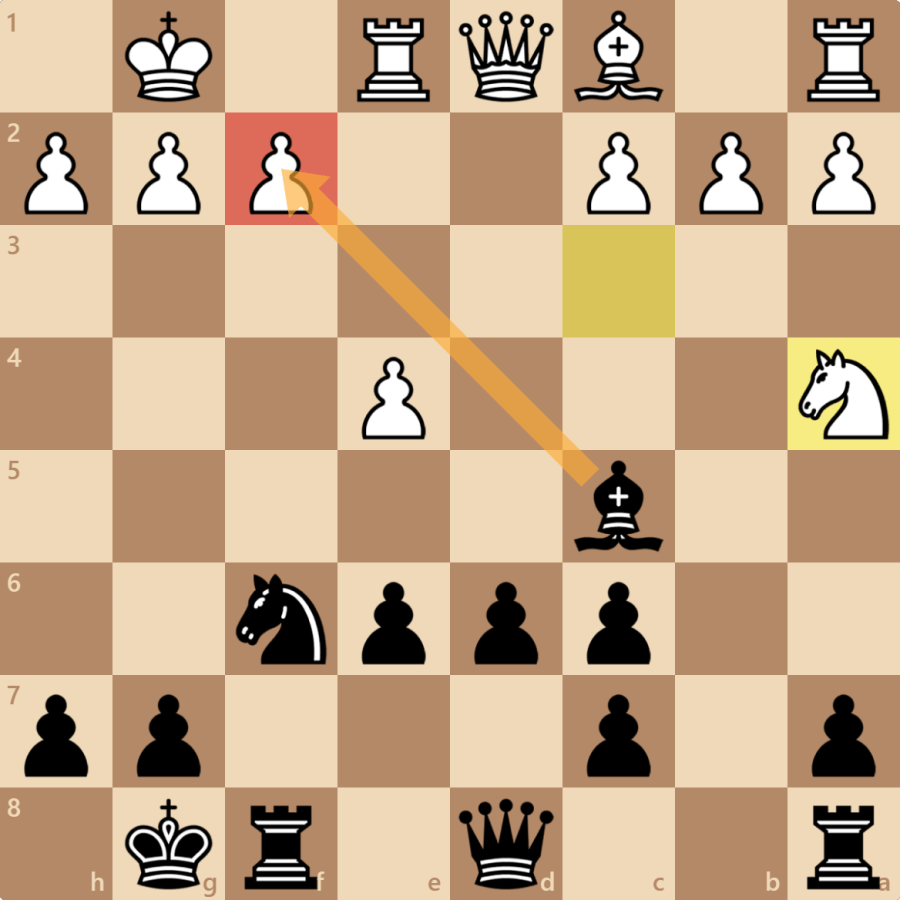
When I analysed the candidate move I eventually played (11… Bxf2+) I was increasingly excited by it. As it comes with check, the opponent must respond. And basically, there was only one logical move for my opponent which is the king must capture the bishop (12. Kxf2), or else, the bishop captures the rook on e1 the following turn. But with the king now on the f2 square, an impossible looking forward knight attack (12… Ng4+) becomes possible as it comes with double check (knight and rook on f8)! I had thought that the only possible move for my opponent was to retreat the king to g1, and then I could play Qh4 threatening mate. I couldn’t see how my opponent could get out of this bind without losing outright or losing their queen.
So why did Stockfish call my move (11… Bxf2+) a blunder? What I had missed was that the opponent didn’t have to retreat their king on the double check! There were two other possible moves. And one of them was the extraordinary and insane looking option of the king walking INTO the attack and danger (13. Kg3)! However, this was an illusion! The king is somehow completely safe in that absurd position, with an advantage of over [+3]!
However, they had to overcome the intuition that the move was ridiculous and find this move. The other option is also terrible looking (13. Ke2), and it really is bad with a disadvantage of at least [-3]. The “sensible” looking retreating move, which is what I calculated and what my opponent played (13. Kg1), is surprisingly the worst of the three possible moves with a disadvantage of [-12]. That is, the “obvious” human move was completely winning for Black!
Which comes to a rather interesting idea! Although this move was objectively a blunder, I would propose that it is psychologically brilliant against humans, at least at the beginning-intermediate level!
Game on chess.com: https://www.chess.com/game/daily/418123371
[Event "TA 2022 Improvers Mach 11 - Round 1"]
[Site "Chess.com"]
[Date "2022.07.26"]
[Round "-"]
[White "nancy02"]
[Black "vitualis"]
[Result "0-1"]
[ECO "C55"]
[WhiteElo "876"]
[BlackElo "1188"]
[TimeControl "1/259200"]
[Tournament "https://www.chess.com/tournament/ta-2022-improvers-mach-11"]
[Timezone "UTC"]
[ECOUrl "https://www.chess.com/openings/Italian-Game-Two-Knights-Open-4...exd4"]
[UTCDate "2022.07.26"]
[UTCTime "01:38:28"]
[Termination "vitualis won by checkmate"]
[StartTime "01:38:28"]
[EndDate "2022.07.30"]
[EndTime "01:20:35"]
[Link "https://www.chess.com/game/daily/418123371"]

1. e4 e5 2. Nf3 Nc6 3. Bc4 Nf6 4. d4 {Italian Game: Two Knights, Open} 4... exd4 5. Nxd4 Bc5 6. Nxc6 bxc6 7. Nc3 d6 8. O-O O-O 9. Re1 $4 {A blunder as the king is the only piece defending f2, which will soon be under attack} 9... Be6 $4 {A blunder as I forgo an opportunity to immediate attack f2 with Ng4. My plan, however, was to open up the f-file.} 10. Bxe6 fxe6 11. Na4 Bxf2+ $4 {A technical blunder, but perhaps psychologically brilliant against humans $6} 12. Kxf2 Ng4+
{[%c_arrow
g4f2;keyPressed;none;from;g4;opacity;0.8;to;f2;persistent;false,f8f2;keyPressed;none;from;f8;opacity;0.8;to;f2;persistent;false,f2g1;keyPressed;none;from;f2;opacity;0.8;to;g1;persistent;false,f2e2;keyPressed;none;from;f2;opacity;0.8;to;e2;persistent;false,f2g3;keyPressed;none;from;f2;opacity;0.8;to;g3;persistent;false][%c_highlight
g1;keyPressed;none;opacity;0.8;square;g1;persistent;false,g3;keyPressed;none;opacity;0.8;square;g3;persistent;false,e2;keyPressed;none;opacity;0.8;square;e2;persistent;false]
Double check $1} 13. Kg1 $4 {The only good move is the inhuman looking Kg3} 13... Qh4 $1 {Black is now completely winning [-10.6]} 14. Rf1 $4 Qxh2# {[%c_effect
g8;square;g8;type;Winner,g1;square;g1;type;CheckmateWhite]} 0-1


[…] h-pawn. This is objectively a mistake [-5.98], but like the scenario in a recent video (https://adventuresofachessnoob.com/2022/08/08/is-this-move-a-blunder-or-brilliant/), a move can be objectively bad but psychologically brilliant in the right […]
LikeLike